Odin hangs for nine nights on a tree to win the runes
In the poem Hávamál, the god Odin offers himself, wounded by a spear and hanging on a tree for nine nights, and returns with the knowledge of the runes.
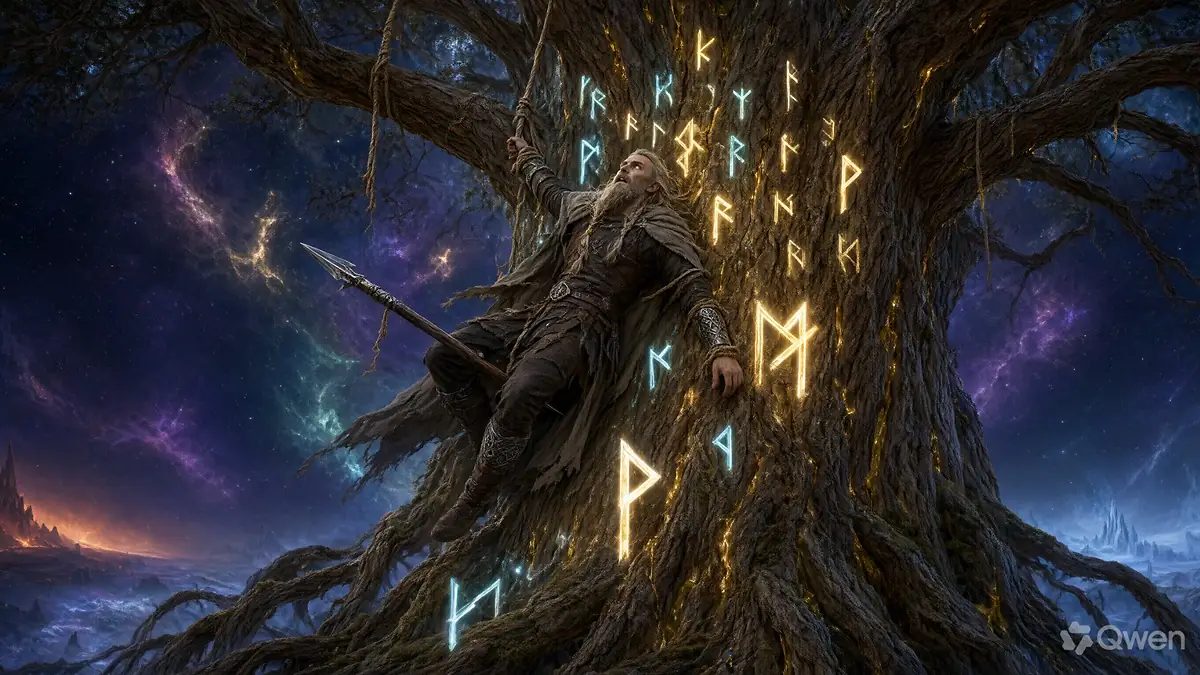
In the poem Hávamál, the god Odin says he hung on a wind-swept tree for nine nights, wounded by a spear, to win the knowledge of the runes. It was a sacrifice made to himself: he, given to Odin, offered by Odin.
The Hávamál, the “Sayings of the High One”, is part of the Poetic Edda, a collection of poems preserved in a 13th-century Icelandic manuscript. The verses are very probably older than the manuscript, and the one speaking in them, in the first person, is Odin himself.
The tree and the spear
According to the poem, Odin says he knows that he hung on the windy tree for nine whole nights, pierced by a spear, given to Odin. No one gave him bread, and no one handed him a drinking horn. He looked down.
The poem does not name the tree. But Yggdrasil, the great world tree in the Norse sources, is usually interpreted as “Yggr’s horse”, Yggr being one of Odin’s names. Some see in this image a gallows, the horse on which the hanged man “rides”, which would link the god to those who die hanging.
The poem also does not explain how Odin survived, or who wounded him. The scene is told as a trial he sets himself, without witnesses and without help.
The runes down below
It was from the top of the tree, Odin says, that he saw the runes. He took them up, screaming, and fell. From then on, the poem continues, he began to thrive and to be wise: one word led him to another word, one deed to another deed.
The Hávamál does not say, in this passage, what the runes are for. The poem goes on with a list of charms, each mentioned without detail, as if the listener knew what was left unsaid.
Real runes, divine runes
Runes existed as real writing. The oldest alphabet, the Elder Futhark, appears in inscriptions from the 2nd century onward, on objects of metal, stone and bone, across several regions of Germanic Europe. By the Viking Age, the alphabet had been reduced to 16 letters, the Younger Futhark.
The myth gives this alphabet a divine origin and a price. In the Norse sources, knowledge almost always comes from a sacrifice, and Odin is shown paying for wisdom more than once. Snorri Sturluson, in the Prose Edda, tells that he left an eye as a pledge at the well of the giant Mímir, which the Völuspá also suggests.
In practice, the Viking Age rune stones have far more everyday uses than the myth. Most are memorials: a family carves the name of a dead relative, sometimes with a note of where he had been or who ordered the stone raised.
To fly with Odin’s ravens, play The flight of Huginn.
Sources.
- *Poetic Edda*, poem Hávamál (13th-century manuscript)
- *Poetic Edda*, poem Völuspá (13th-century manuscript)
- Snorri Sturluson, *Prose Edda*, section Gylfaginning (c. 1220)