Askeladden and the troll: the Norwegian tale of the boy who squeezed the stone
Askeladden is the clever youngest son of Norwegian tales. In the contest with the troll, he wins by cunning, from a stone that turns into cheese to a hidden bag.
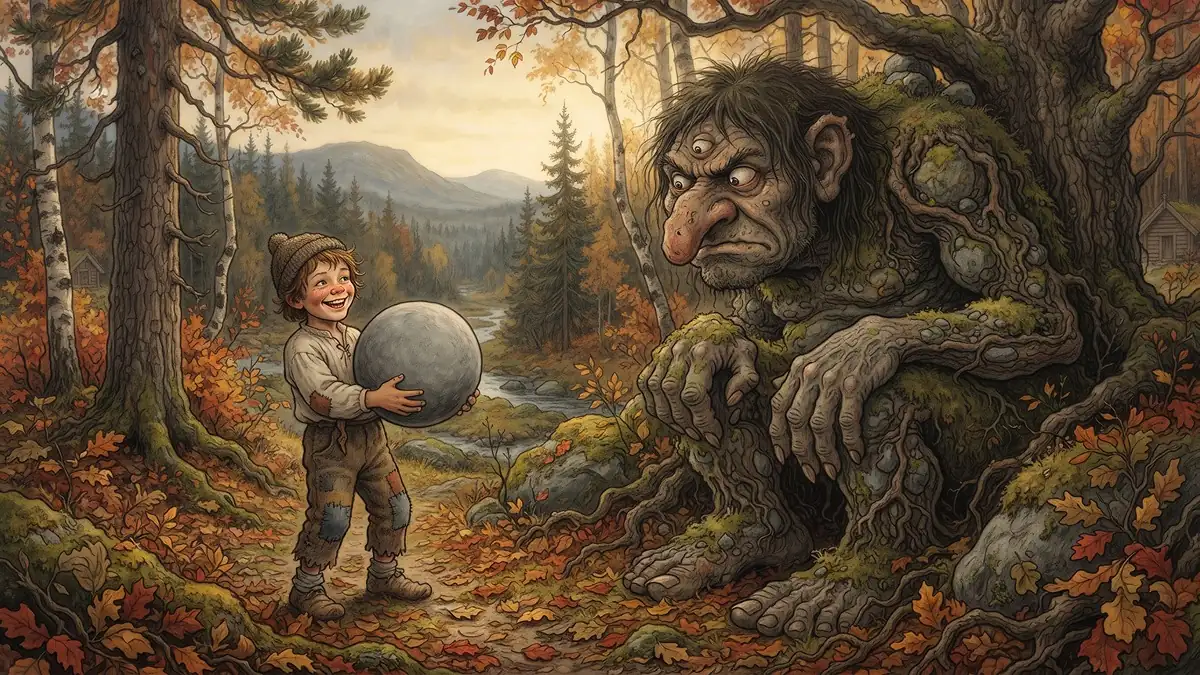
Askeladden is the clever youngest son who runs through dozens of Norwegian tales. He is usually the youngest of three brothers, the one who stays in the ashes by the stove (hence the name, “the one who stirs the ashes”) and whom everyone despises, until he defeats kings, giants and trolls. It was the folklorist Peter Christen Asbjørnsen, together with Jørgen Moe, who placed him at the center of the Norske Folkeeventyr collection, published from 1841.
Who Asbjørnsen and Moe were
The two friends traveled through Norwegian villages listening to and writing down orally told stories, a few decades after Norway separated from Denmark in 1814, when the country was seeking its own identity. They rewrote the tales in a simple style close to speech, which influenced written Norwegian. The tales have no single author: they are oral traditions that the two organized.
The contest with the troll
In one of the best-remembered stories, Askeladden meets a troll in the forest, and the two decide to test their strength. The troll boasts that he is so strong he can squeeze water out of a stone. Askeladden, who is carrying a cheese hidden away, squeezes the cheese and lets the whey run, and the troll, fooled, believes he really squeezed the stone.
Then comes an eating contest. Askeladden puts a leather bag under his clothes and pours the porridge into it, pretending he has eaten it. The troll, wanting to imitate him, cuts open his own belly and comes to a bad end. In several versions, the boy then takes the troll’s gold and silver.
Why the story works
The charm of the tale lies in the reversal: the small and poor defeat the big and powerful with intelligence, not strength. Trolls in Norwegian tales are usually strong and foolish, and the hero’s cunning appears as a virtue. Versions vary with whoever tells them, and the troll’s darker ending is softened in many modern adaptations.
The troll before and after the books
In Norwegian tales, trolls live in the mountains and forests and, in several stories, turn to stone when the sun reaches them. The image many people have of them, with huge noses and clumsy bodies, comes in large part from the illustrations by Theodor Kittelsen and Erik Werenskiold for the late 19th-century editions, which shaped how trolls look to this day.
The tales of Asbjørnsen and Moe are in the public domain and can be read today in many editions and translations, including versions digitized by the National Library of Norway.
To try the hidden bag trick, play Askeladden and the troll.
Sources.
- Peter Christen Asbjørnsen and Jørgen Moe, *Norske Folkeeventyr* (1841-1844)