Hnefatafl: the board game the Vikings played and no one knows exactly how it went
Hnefatafl boards have been found from Gokstad to Scotland. The game was asymmetrical, with a besieged king, but its original rules were lost.
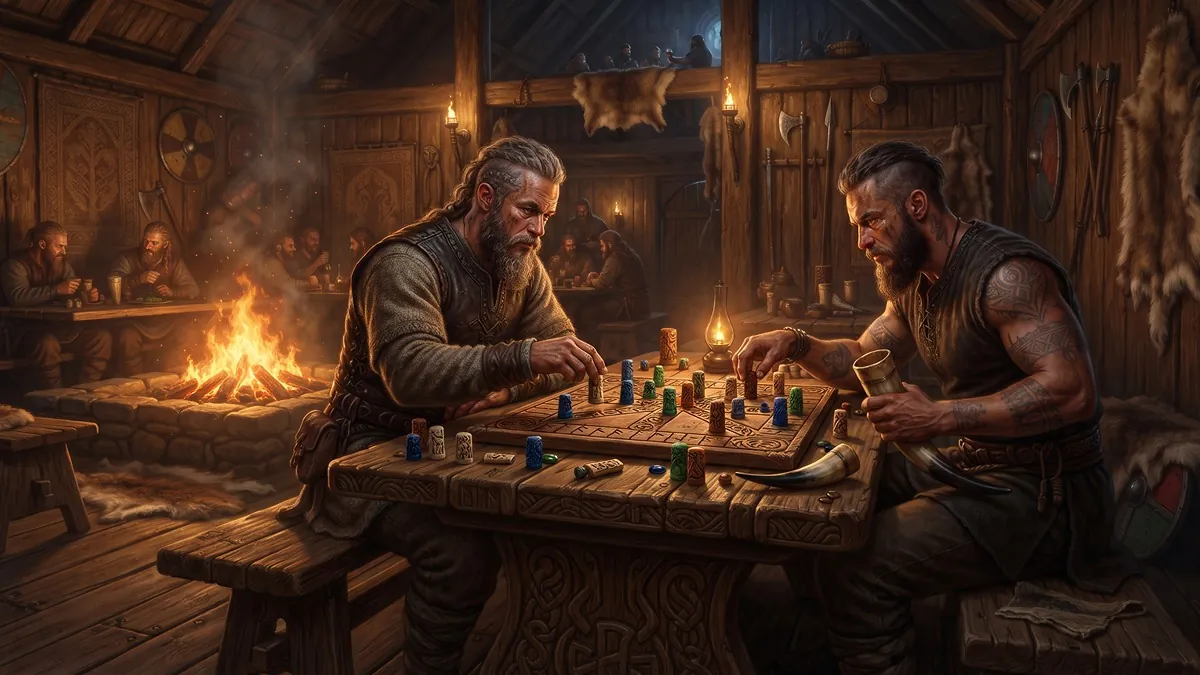
The Vikings played games, and one of their favorites was hnefatafl, a board game for two in which one side defends a king and the other tries to capture him. Boards and pieces of this kind of game have been found across Northern Europe, but the exact rules they used were never recorded.
A widespread game
Games of the tafl family were played in Norway, Sweden, Denmark, Iceland, the British Isles, Ireland and among the Sami, from the 4th century until about the 12th. Finds include a board and a horn piece in the Gokstad ship burial in Norway, twenty-two whalebone pieces in Orkney, a board from a monastery in Scotland, a glass piece at Lindisfarne and numerous glass pieces at Birka, in Sweden. Chess gradually took the place of tafl from the 12th century.
An unequal duel
Hnefatafl was asymmetrical, and that is what makes it different from many modern games. On one side is the king, in the center of the board, surrounded by a few defenders. On the other, a troop of attackers with twice as many pieces. The king’s goal is to escape, normally to a corner or the edge of the board, while the attackers want to capture him. Ordinary pieces are captured when trapped between two enemy pieces.
The rules that were lost
No medieval text explains how to play. What exists are scattered mentions in the sagas, such as the Saga of Hervör and Heidrek and the Orkneyinga Saga, and the poem Völuspá, which imagines the gods playing tafl on the lawn and, after the end of the world, finding the golden pieces in the grass.
The main clue came much later: in 1732, the Swedish naturalist Carl Linnaeus wrote down the rules of a similar game, tablut, during a trip to Lapland. He described a board of nine by nine squares, with the king in the center. It was from tablut, and other sources, that researchers reconstructed modern versions, such as brandubh, seven by seven squares, with a king, four defenders and eight attackers.
Why did tafl disappear? The usual explanation is that chess, which arrived from the south and the east, replaced it, but historians note that the tradition survived among the Sami for centuries, which is how Linnaeus was able to record it. Tafl games are also a rare case of a Viking-age pastime that can still be played today, though only by reconstruction.
The game on the site
Boreal Saga Play board game uses that small version, but it is a simplification: here the king is only captured when surrounded on four sides, and other rules have been adapted.
To play a match against the attackers, play Hnefatafl in miniature.
Sources.
- *Orkneyinga Saga* and *Saga of Hervör and Heidrek*, with mentions of the game (13th-14th centuries)
- Carl Linnaeus, *Iter Lapponicum* (diary of the trip to Lapland, 1732)
- *Poetic Edda*, poem Völuspá (13th-century manuscript)