The sunstone: the crystal that may have helped the Vikings find the sun in a cloudy sky
An Icelandic saga mentions a stone that shows where the hidden sun is. Modern experiments show a crystal could work, but do not prove the Vikings used one.
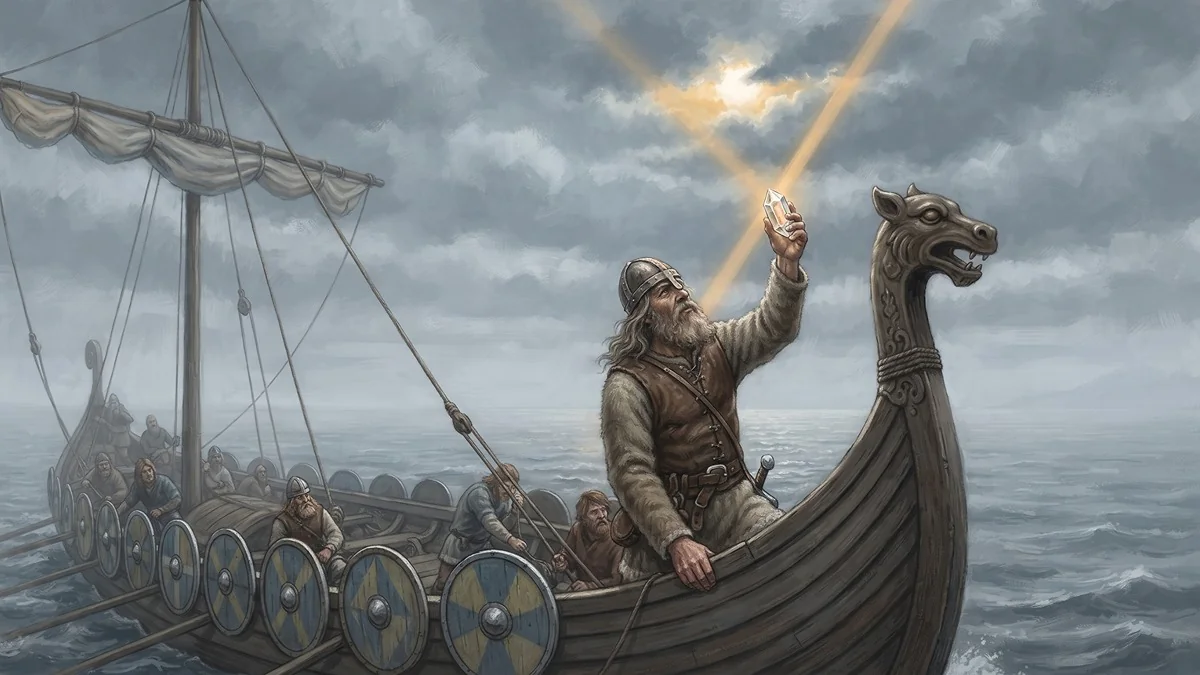
How did the Vikings cross the North Atlantic, where the sky is often overcast and the magnetic compass was not yet used in Europe? They steered by the sun, the stars, birds, waves and the shape of the coast. An Icelandic saga adds a curious object: the sólarsteinn, the sunstone.
The scene in the saga
The text appears in Rauðúlfs þáttr, a short tale preserved in the Flateyjarbók, an Icelandic manuscript of the late 14th century. On a morning of snow and cloud, King Olaf tests a man named Sigurd and asks where the sun is. Sigurd answers, and the king takes a sunstone, looks at the sky and sees where the light comes from. The king thus confirms that the sun is where Sigurd said.
The saga does not explain how the stone works. It only says that it showed the position of the sun when it could not be seen.
The crystal hypothesis
In 1967, the Danish archaeologist Thorkild Ramskou suggested that the stone was a transparent crystal, such as Iceland spar, a variety of calcite. This crystal splits light into two images. Skylight is partly polarized, and the brightness of the two images changes as the crystal is turned. When the two look equal, the crystal points in a direction tied to that of the sun.
Experiments with volunteers by the Hungarian Gábor Horváth and the Swede Susanne Åkesson showed that polarized light is still present in fog and cloud, though weaker, and that a turned crystal shows a pattern of light that changes with orientation and can indicate the direction of the sun.
What remains in doubt
The researchers say the tests show how a crystal could work, not that the Vikings used one. Critics point out that an experienced sailor can already estimate the sun’s position from the brighter edge of the clouds. Other specialists in Norse navigation say sailors combined several cues, and that archaeological proof is missing, such as a crystal found in a Norse ship or grave.
It is also unknown whether the saga’s sólarsteinn was really a crystal. The word may refer to something else.
What is known is that finding one’s way at sea in Viking times depended on a trained eye, memory and attention to what nature offered, and that the idea of a crystal able to see the sun through the clouds still fascinates those who study the subject.
To try to find the hidden sun, play The sunstone.
Sources.
- *Rauðúlfs þáttr*, in the *Flateyjarbók* (late 14th century)
- Thorkild Ramskou, *Solstenen*, 1967
- Gábor Horváth and others, 'On the trail of Vikings with polarized skylight', *Philosophical Transactions of the Royal Society B*, 2011