Lindisfarne, 793: the attack on the monastery that Europe remembers as the start of the Viking Age
On 8 June 793, men from the sea plundered the holy island of Lindisfarne. The chronicle speaks of omens, and a letter from Alcuin shows the shock the attack caused.
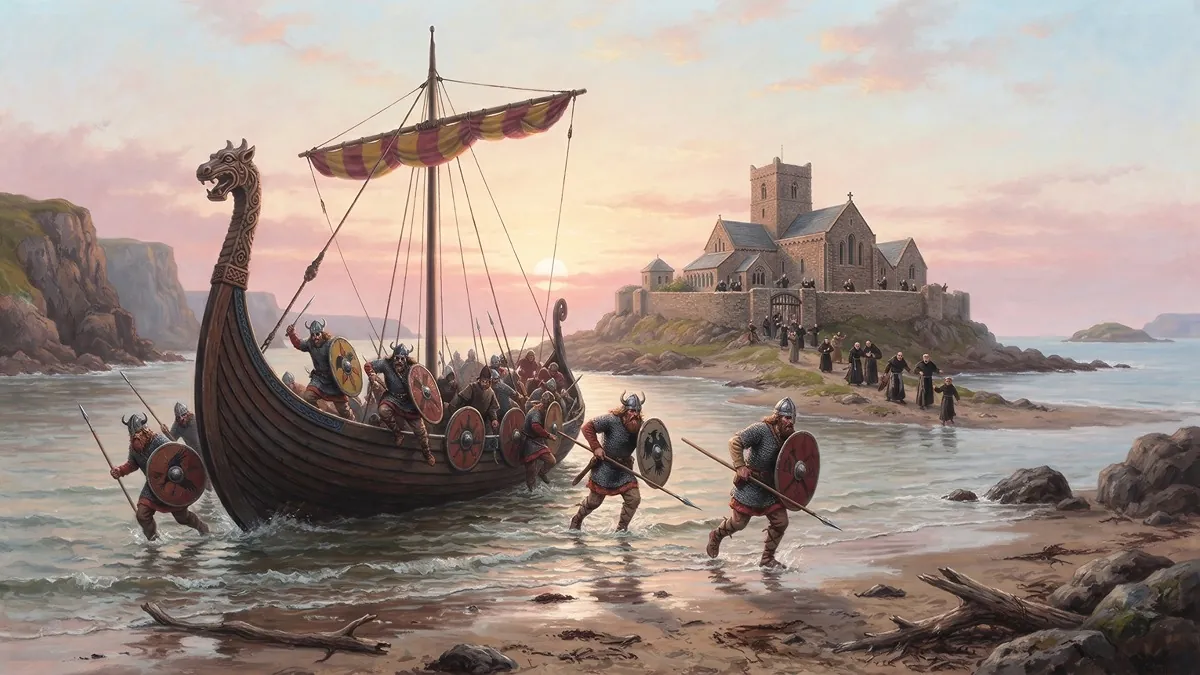
On 8 June 793, the island of Lindisfarne, off the coast of Northumbria, was attacked by men who came from the sea. The monastery was one of the holiest places in England, and the attack shocked Christendom. That is why the date became, in European memory, the marker of the start of the Viking Age.
What the sources say
The Anglo-Saxon Chronicle records omens in the year 793: “immense whirlwinds, flashes of lightning and fiery dragons flying in the air”, followed by a great famine. And it says that “heathen men came and miserably destroyed God’s church on Lindisfarne, with plunder and slaughter”. Those who wrote afterwards tied the warnings to the disaster.
It was not the Vikings’ first attack in England: in 789, a raid had hit Wessex. But Lindisfarne was the sacred centre of the kingdom of Northumbria, where the saint Cuthbert had been bishop, and violence against such a place weighed heavily.
Alcuin’s letter
Alcuin of York, a Northumbrian scholar working for Charlemagne, wrote to Bishop Higbald of Lindisfarne. He said the church was “spattered with the blood of the priests of God” and asked whether this was the result of the sins of those who lived there. He also wrote that the attack was “the sign of some great guilt”. For the historian Joanna Story, Alcuin was thinking of the kingdom’s recent crimes: in 788, King Ælfwald had been murdered by Sicga, and Sicga was buried on Lindisfarne in April 793, two months before the attack. Alcuin seems to have seen the attack as divine vengeance.
What happened afterwards
The Christian community did not disappear. The cult of Cuthbert moved, over time, to Norham, then to Chester-le-Street, in 883, and finally to Durham, in 995. The religious sculpture made at Lindisfarne in the 9th and 10th centuries shows that life at the place went on.
The attacks, however, multiplied. Around 850, foreign armies were already wintering in England, and from 870 the Danish conquest of several Anglo-Saxon kingdoms began.
A beginning or a marker?
The date of 793 is convenient, but scholars remind us that Scandinavians were already sailing and trading before it, and that the attack on Lindisfarne is the first one to be recorded by Christian writers, who saw the horror and told it. The Vikings themselves left no account of the day.
To reach the beach with your oars in time, play Row to Lindisfarne.
Sources.
- Anglo-Saxon Chronicle, entry for the year 793
- Alcuin of York, letters to Bishop Higbald and to King Æthelred of Northumbria (793)
- Joanna Story, text for English Heritage on the Lindisfarne raid