Loki in chains: the feast where he insulted the gods and the punishment that awaits him until Ragnarök
In the Lokasenna, Loki insults the gods at a feast. In Snorri, he is caught as a salmon and bound to three stones with a serpent dripping venom, and only his wife shields him.
Loki is the trickster god of Norse mythology, the one who helps the gods and harms them. The story of his punishment has two parts, told in different sources: a feast at which he insults everyone, in the poem Lokasenna, and the capture and punishment, in the Prose Edda of Snorri Sturluson. Both were written in the Christian Iceland of the 13th century.
Ægir’s feast
The Lokasenna, “Loki’s quarrel”, is set at a feast given by Ægir, lord of the sea, for the gods. The prose introduction that precedes the poem says that Loki, resentful of the praise given to one of the servants, killed him, and that the gods drove him out with clubs. He came back, and Odin, remembering that the two had sworn blood-brotherhood, offered him a place at the table. Many scholars think this introduction was added after the poem.
The poem itself is a sequence of insults. Loki turns on each god and goddess present and throws accusations of cowardice, infidelity and old shames. The gods answer. When Thor arrives and threatens to strike him with the hammer, Loki falls silent. Before leaving, he predicts that Ægir’s hall will be destroyed by fire.
The salmon and the net
The punishment comes in Snorri, after the death of Baldr, in which Loki had a central part. The gods want to seize him. Loki flees to the mountains and builds a house with four doors, from which he can see in every direction. By day he turns into a salmon and hides in a waterfall, the Fránangr.
One evening, Loki invents a fishing net, throwing it into the fire when he sees the gods approaching. Kvasir, the wisest of them, rebuilds the net from the ashes. The gods drag it through the river, and Loki leaps over it. Thor, waiting at the river mouth, grabs the salmon by the tail. Snorri says this is why the salmon’s tail is thin.
The stones, the serpent and Sigyn
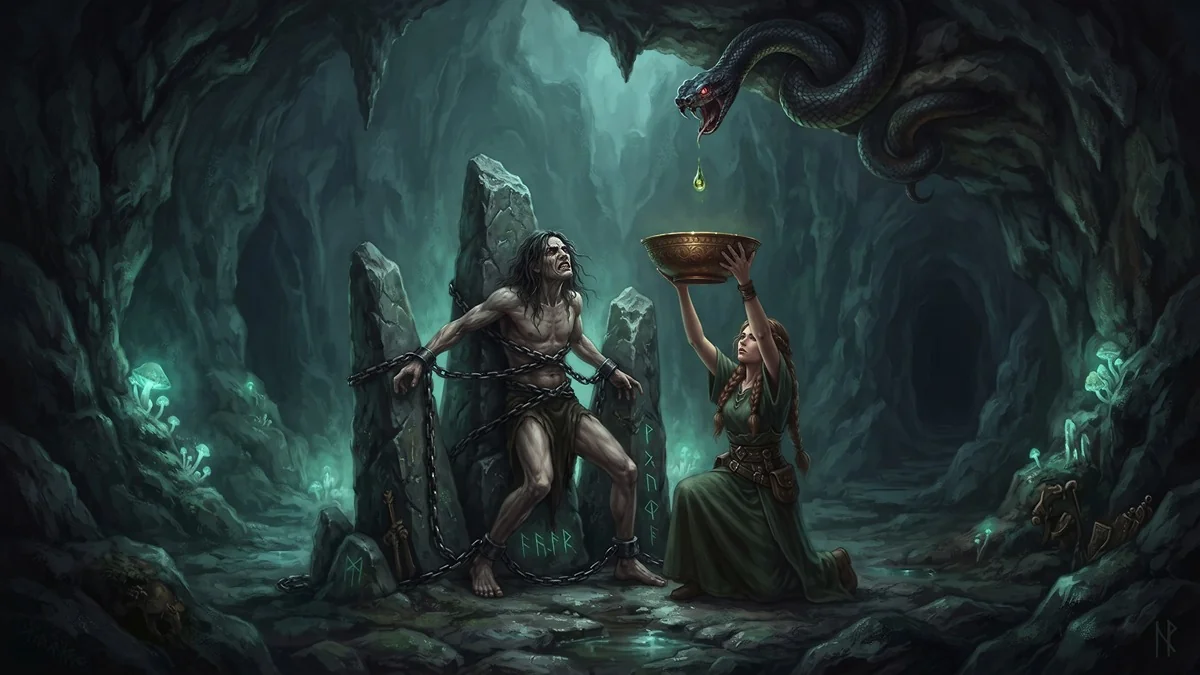
The gods take Loki to a cave. They bind him over three stones, and the chains are the entrails of his son Narfi, whom his other son, Váli, turned into a wolf, had torn apart. The entrails turn to iron.
Skadi, a goddess whose giant father was killed by the gods, hangs a serpent over his face so that the venom drips. Loki’s wife, Sigyn, stays by his side and holds a bowl to catch the drops. When the bowl fills, she steps away to empty it, and at that moment the venom falls on Loki’s face. He struggles so hard that the earth shakes. This, says Snorri, is how earthquakes are explained.
Loki stays there, bound, until Ragnarök. In the Völuspá, the seeress also sees him in chains and speaks of a woman who, at his side, does not rejoice at his situation.
The figure of Loki
Scholars debate Loki’s place in the old Norse religion. Almost everything we know of him comes from Christian texts, and nothing indicates that he was worshipped. Some see him as a literary figure, created to give the myths humor and conflict. Others think the sources hide something older.
To hold Sigyn’s bowl, play Sigyn’s bowl.
Sources.
- *Lokasenna*, poem of the *Poetic Edda* (Codex Regius manuscript, c. 1270)
- Snorri Sturluson, *Prose Edda*, section Gylfaginning (c. 1220)
- *Völuspá*, poem of the *Poetic Edda* (Codex Regius manuscript, c. 1270)