Yggdrasil, the world tree: what the sources say and what only modern interpreters added
The Eddas describe a giant ash with three roots, an eagle, a serpent and a gossiping squirrel. The nine worlds, however, are never listed.
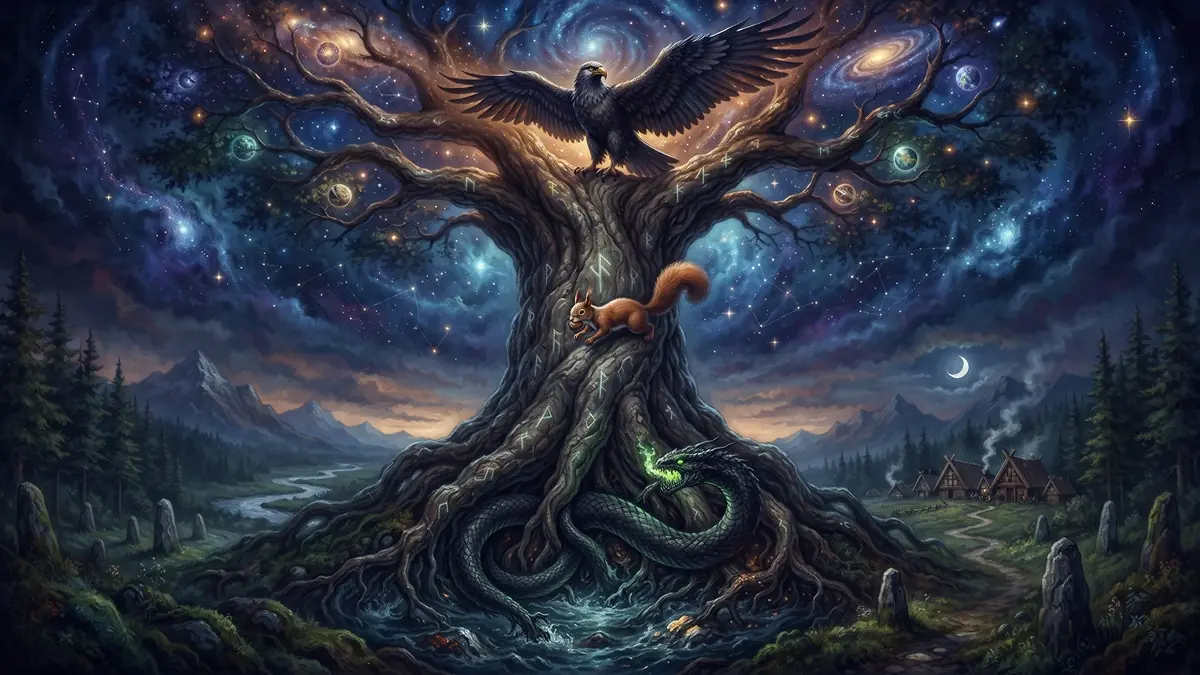
Yggdrasil is the great tree of Norse mythology, an ash so tall that its branches touch the sky and its roots spread to distant places. The gods gather beneath it to give judgment, every day. The image is famous, but much of what is said about it today is not in the sources. The account below separates the two.
Almost everything comes from three texts: the Völuspá and the Grímnismál, poems of the Poetic Edda, and the Gylfaginning by Snorri Sturluson. They were written in Iceland in the 13th century, and they do not always agree with one another.
The three roots
The Grímnismál says the tree has three roots: one over Hel, the realm of the dead, another over the frost giants and the third over humans. Snorri tells it differently: one root among the gods, another among the frost giants and the third over Niflheim, the world of cold. Each root has a spring. In Mímisbrunnr, beside the giants, wisdom is kept. In Urdarbrunnr, beside the gods, live the Norns, who take water and mud from the spring and pour them on the tree so that it does not rot.
Beneath the root of Niflheim lies the spring Hvergelmir, where the serpent or dragon Níðhöggr gnaws the roots along with many other serpents.
Who lives in the tree
The Grímnismál and Snorri list the inhabitants. At the top is an eagle, and between its eyes, the hawk Veðrfölnir. Four stags, Dáinn, Dvalinn, Duneyrr and Duraþrór, eat the leaves. And the squirrel Ratatoskr runs along the trunk, carrying up and down the insults that the eagle and Níðhöggr trade with each other.
When Ragnarök comes, the Völuspá says that Yggdrasil trembles and groans. The sources do not say, however, what happens to the tree afterwards.
The name and the gallows
The name is usually read as “Ygg’s horse”, Ygg being one of Odin’s names. For many scholars, “horse” is an image for the gallows, the “horse” on which the hanged man rides. This ties in with the poem Hávamál, in which Odin says he hung nine nights on a tree to gain the knowledge of the runes. The poem does not name that tree, but almost all specialists identify it as Yggdrasil. There are other proposals for the origin of the name, and none is certain.
The nine worlds nobody lists
The Völuspá speaks of “nine worlds”, but no early source says which they are. The maps of Asgard, Midgard, Helheim, Jotunheim and others around the tree that we see today are a modern reconstruction, built from names scattered through the texts. It is a good reconstruction, but it is a reconstruction.
The same goes for the idea that the humans Líf and Lífthrasir survived the end of the world hidden in Yggdrasil. The sources speak only of Hoddmímir’s wood. Modern interpreters have proposed that wood and tree are the same thing, but that is a hypothesis.
To climb the tree in search of messages, play Ratatoskr and the tree.
Sources.
- *Völuspá*, poem of the *Poetic Edda* (Codex Regius manuscript, c. 1270)
- *Grímnismál*, poem of the *Poetic Edda* (13th-century manuscripts)
- Snorri Sturluson, *Prose Edda*, section Gylfaginning (c. 1220)