Hedeby: the Viking port where the world's merchants met
At the base of the Jutland peninsula, Hedeby was for over two centuries one of the largest trading centres of the North. Today its ruins are part of a UNESCO World Heritage Site.
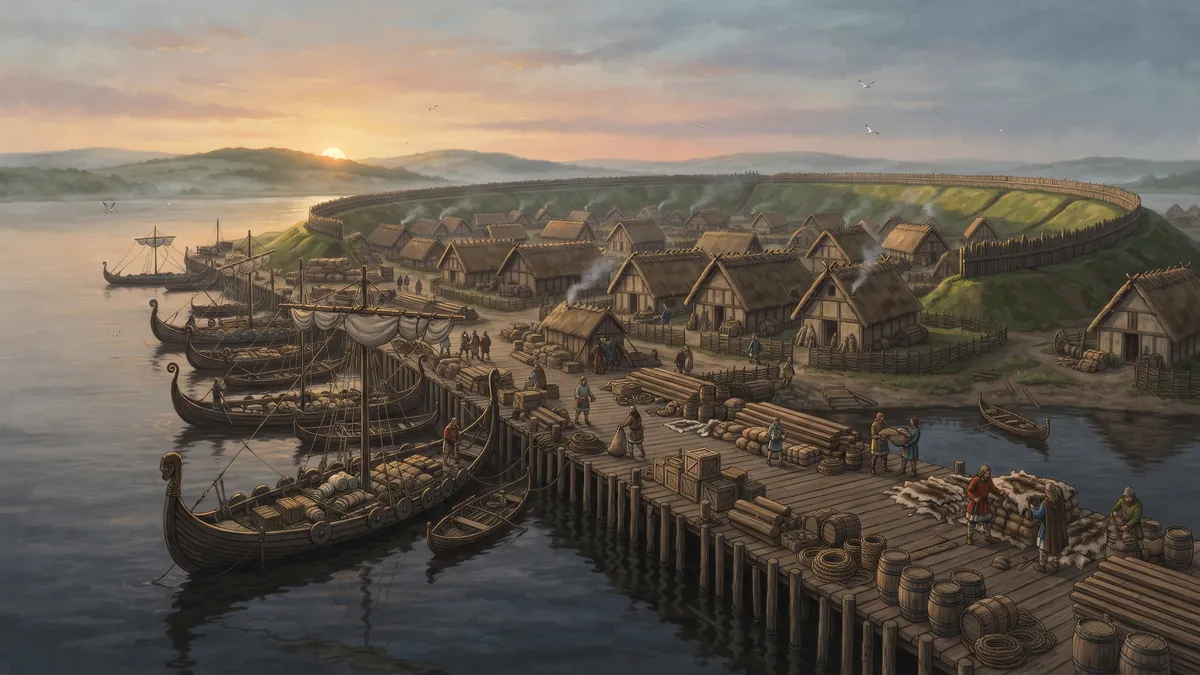
Before London, Paris or Copenhagen were great cities, the North had a trading town on the edge of an inlet. Hedeby, in Danish, or Haithabu, in German, stood in what is now northern Germany, near the town of Schleswig, and for over two centuries it drew merchants from all over Europe.
A choice of place
The location was decisive. Hedeby lies at the narrowest point of Jutland, between the North Sea and the Baltic. Anyone who wanted to go from one sea to the other without sailing around Denmark could unload cargo and carry it overland a few kilometres to load again. The town sat in the middle of that passage.
Archaeologists date the founding of the settlement to around the year 770. In the 9th and 10th centuries the town grew. It came to have thousands of inhabitants, with wooden houses, organised streets, workshops and a harbour with a narrow quay.
What was sold
Excavations show the reach of the exchange. Finds include glass from the Rhine, pottery from the Rhineland, bone combs, Arab silver coins, Baltic amber and furs from the North. There was also local production: workshops for iron, glass, leather, bone and precious metals.
Trade included people. Written sources show that enslaved people were sold in the markets of the Viking world, and Hedeby was one of those places, though the exact scale is debated.
Visitors and views
Few travellers left descriptions. The Norwegian Ohthere, in the 9th century, passed through on his travels and told an Anglo-Saxon king about it. The missionary Ansgar, who brought Christianity to Scandinavia, visited Hedeby in the 9th century.
The best-known account is that of Ibn Yaqub, a traveller from Muslim Spain in the 10th century. He found the town poor in food and said the inhabitants’ singing resembled the barking of dogs. This is the opinion of a foreigner, not an impartial portrait.
The wall and the end
Hedeby was protected by a semicircular wall, linked to the Danevirke, the long system of fortifications that guarded southern Denmark. The harbour had a barrier of stakes.
In 1979, divers found on the harbour floor a warship about thirty metres long, burned, which seems to have been used as a fire ship to block the entrance. Today it is displayed in the local museum.
In 1050, the Norwegian king Harald Hardrada attacked the town and set it on fire. In 1066 it was destroyed again, by Slavs. After that Hedeby was abandoned, and trade moved to Schleswig, further inland.
What remains
Because nobody rebuilt the town on top of it, the ground preserved many traces. In 2018, UNESCO added the Hedeby and Danevirke complex to the World Heritage list. The museum beside the site shows rebuilt houses, and it is one of the best places to see the Viking Age as a time of exchange, and not only of raids.
To organise the cargo on the quay, play The port of Hedeby.
Sources.
- Viking Museum Haithabu (Wikinger Museum Haithabu), Schleswig
- UNESCO listing: Archaeological Border complex of Hedeby and the Danevirke
- Account of Ibn Yaqub (al-Tartushi), cited in studies on Hedeby
- Vita Anskarii, by Rimbert, and Ohthere's narrative in the Anglo-Saxon Orosius