The Norns: the three women who tend the world tree and everyone's fate
By the well of Urðr, beneath a root of Yggdrasil, three women water the tree with water and mud and decide lives. The Norse texts speak of them in a few dense stanzas.
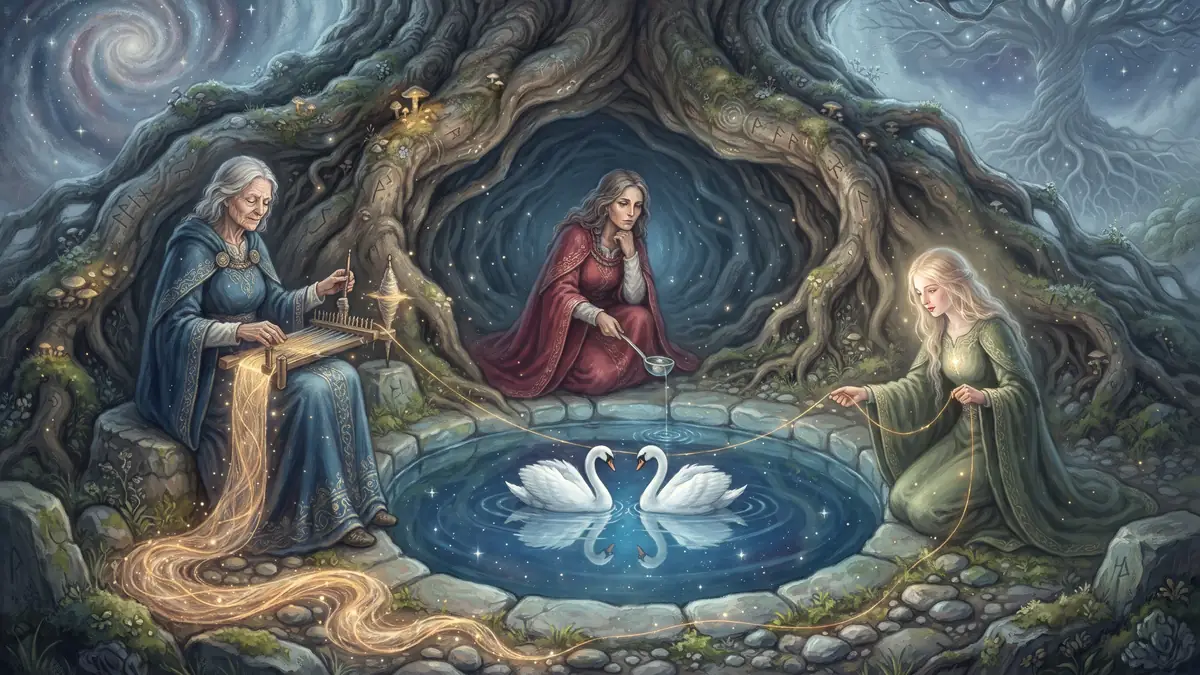
In Norse mythology, fate is not decided by the gods. Those who do it are the Norns, women who live beside a spring beneath the world tree. They appear in few texts, but they left one of the strongest images in the imagination of the North.
The well
Urðarbrunnr, the well of Urðr, lies beneath one of the three roots of Yggdrasil. The name may refer to the norn Urðr or to the very idea of fate. In the Prose Edda, it is one of the three springs that feed the tree.
The gods ride every day over the bridge Bifröst to reach it, to hold court. The water of the well is so holy, the sources say, that everything entering it turns white. Two swans feed there, and all other swans are said to descend from them.
The three
The names of the three chief Norns are Urðr, Verðandi and Skuld. They appear in the Völuspá, in stanzas 19 and 20, and in the Gylfaginning, chapters 15 to 17. Scholars often link the names to past, present and future, but this reading is an interpretation of the names and not a statement of the texts.
According to the sources, the Norns shape people’s lives. The Völuspá says they lay down laws and choose the lives of the sons of men. The Prose Edda adds that there are other norns, who visit each person at birth to decide their fortune.
Tending the tree
The Norns also do a gardener’s work. They take water and mud from the well and spread them over Yggdrasil, so that its branches do not rot. The tree is attacked by animals, among them the serpent Níðhöggr, and this daily care is what keeps it standing.
The picture is one of balance: the fate of the world and of people depends on constant work, done without haste, by those who stay by the root.
What we do not know
The meaning of a stanza of the Hávamál, number 112, is disputed. The Christian-influenced poet Eilífr Goðrúnarson described the well linking it to Rome and the south, and parallels have been proposed with Adam of Bremen’s account of a sacred tree at Uppsala. All of this remains speculative.
It is also worth remembering that almost everything known about the Norns comes from a few texts, written by Christians centuries after the time when people believed in them. So the image of three weavers is partly a modern construction, and the sources do not always speak of threads.
To keep the thread taut on the Norns’ loom, play The threads of the Norns.
Sources.
- Völuspá, stanzas 19 and 20 (Poetic Edda)
- Gylfaginning, chapters 15 to 17 (Prose Edda, by Snorri Sturluson)
- Encyclopedia entries on Urðarbrunnr and the Norns