Ingólfr Arnarson and the high-seat pillars: how tradition tells the founding of Reykjavík
According to the Book of Settlements, Ingólfr threw his high-seat pillars overboard and settled where the waves left them. Here is what archaeology adds to the tale.
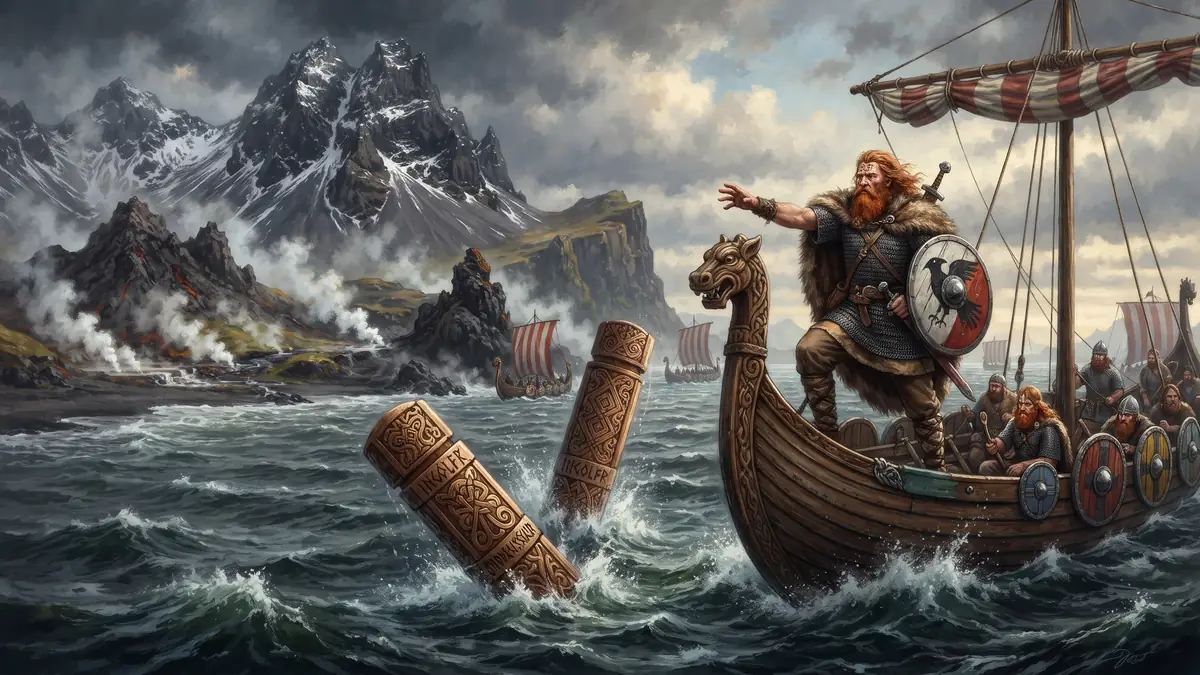
When Ingólfr Arnarson’s ship neared the coast of Iceland, he did what tradition says the chieftains of his day did: he threw the pillars of his high seat, the öndvegissúlur, into the sea and swore to settle wherever the waves left them.
What the source says
The Book of Settlements (Landnámabók) is a list of Iceland’s settlers, written centuries after the events and preserved in different versions. It presents Ingólfr as a Norwegian nobleman who left Norway after a quarrel that ended in deaths, in the time of King Harald Fairhair. With him travelled Hjörleifr, whom the source calls his foster-brother.
Near the coast, Ingólfr cast the pillars into the sea. He spent the first winter in the southeast of the island, and Hjörleifr was killed by Irish thralls he had brought along. Only later, the text says, Ingólfr’s thralls found the pillars in the west, and he settled in a bay he called Reykjavík, “smoky bay”, because of the steam rising from the ground.
The traditional date is 874. It is a conventional date, not an exact record.
What archaeology shows
In 2001, excavations on Aðalstræti street, in central Reykjavík, uncovered the ruins of a large hall with a hearth. A layer of volcanic ash, which specialists link to an eruption around 877, covers the oldest level. That indicates someone lived there in the 870s, which fits the tradition.
Researchers disagree on whether the site was a permanent farm or a seasonal occupation, and no find ties the hall to Ingólfr by name. The Landnámssýningin museum, built over the ruins, displays what was found.
A gesture repeated in the sources
Throwing the pillars overboard appears in more than one account of settlement. In Eyrbyggja saga, the chieftain Þórólfr Mostrarskegg does the same with pillars bearing the image of Thor. For that reason many scholars see a literary motif here, a way of saying that the place the settlers chose was also chosen by the gods.
That does not make Ingólfr’s story false. It only means it reached us shaped by people who wanted to explain where Icelandic families came from.
The city that remained
Reykjavík is today the capital of Iceland, and a statue of Ingólfr Arnarson stands on a hill in the centre. The story of the pillars is the best-known image of the island’s early settlement, even if what is known for certain is less than the saga promises.
Sixty years of settlement
The Íslendingabók, the “Book of the Icelanders”, written by Ari Þorgilsson around 1130, says the island was fully taken up in about sixty years, and that in 930 the Alþingi, the general assembly, was founded at Þingvellir. Ari names Ingólfr as the first settler. For medieval Icelanders, knowing who arrived first mattered, because families tied their land and their standing to their ancestors.
To try to land the pillars in the right bay, play Ingólfr’s pillars.
Sources.
- Unknown author, *Landnámabók*, the Book of Settlements (12th to 14th centuries, in several versions)
- Ari Þorgilsson, *Íslendingabók* (around 1130)
- Archaeological studies of the Aðalstræti site in Reykjavík