Kennings: how the skalds spoke of gold, ships and battles without saying the word
Skaldic poetry said "Sif's hair" for gold and "sea-horse" for ship. Snorri Sturluson explained the trick in a handbook written around 1220.
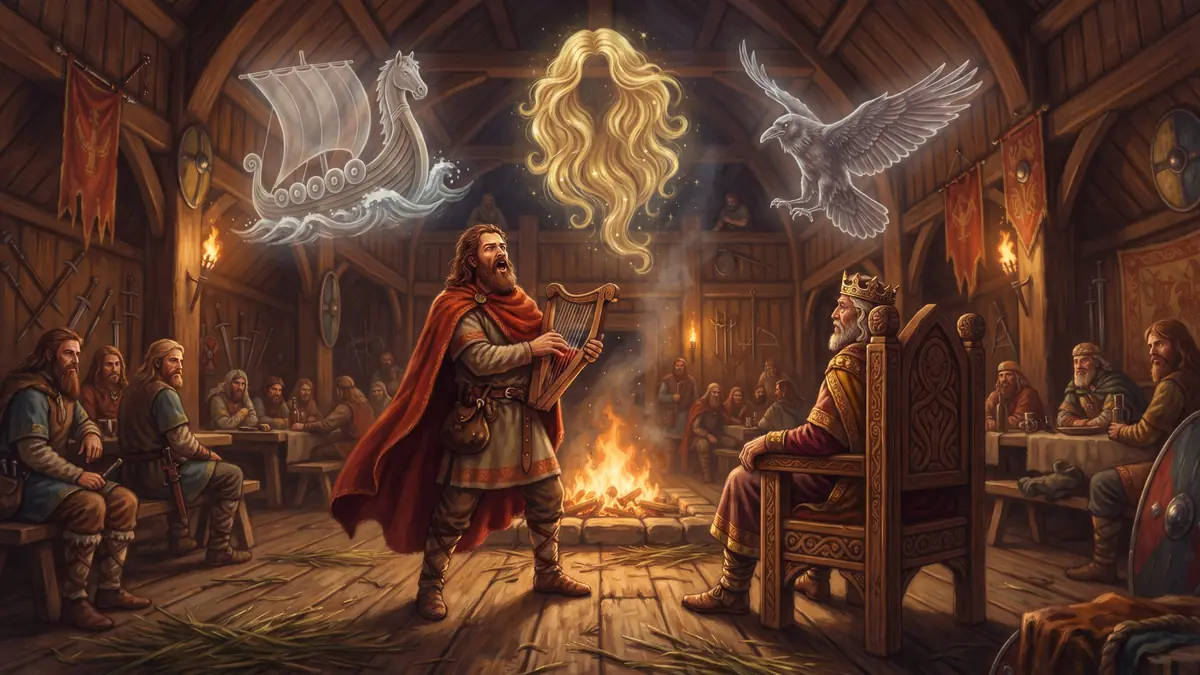
A skald rises before the king and, to speak of gold, says “Sif’s hair”. To speak of a ship, he says “sea-horse”. Whoever listens understands, and the pleasure lies in understanding.
What a kenning is
A kenning is a two-part expression that names something without using its name. Skaldic poetry, sung at Norse and Icelandic courts, is full of them. The skalds composed in demanding metres, with alliteration and fixed rules, and kennings gave variety and prestige to the verse.
Snorri’s handbook
Around 1220, the Icelander Snorri Sturluson wrote the Prose Edda to teach the new generation to understand and compose this kind of poetry. The part called Skáldskaparmál, “the language of poetry”, lists kennings and tells the stories behind them.
A few examples
According to Snorri, gold can be called “Sif’s hair”, because Loki cut the goddess’s hair and she was later given hair of gold. It can also be “Ægir’s fire”, because of a banquet of the gods lit by the metal.
Poetry can be “Odin’s mead” or “Kvasir’s blood”, in reference to the myth of the poets’ mead. Battle can be “Odin’s storm”. A ship can be a “sea-horse”, and a warrior can be a “tree of battle”.
There are similar kennings in other Germanic languages. In the Anglo-Saxon poem Beowulf, the sea appears as the “whale-road”, in the old language hronrād.
Mythology hidden in language
Many kennings only make sense to someone who knows the myths. For that reason Snorri ties them to the stories of the gods: the audience had to know who Sif was and what Loki had done in order to understand the word.
This shows how poems also served as memory. Each expression carried, like a small note, a whole story.
A poetry hard to translate
Kennings multiply when one sits inside another, and the result can be difficult even for specialists. That is why translations usually explain what is hidden.
Kennings and synonyms
Skalds had two devices. One was the heiti, a simple poetic word in place of the ordinary one, such as a rare name for “ship”. The other was the kenning, which joined two words. The more refined the poet, the more elements he piled up. One of the most famous, Egill Skallagrímsson, is said in his saga to have composed, in England, a poem to save his own head before King Eiríkr Bloodaxe. In many verses the king was called a “ring-breaker”, for handing out gold.
To solve the skalds’ riddles, play Kenning riddles.
Sources.
- Snorri Sturluson, *Prose Edda*, section *Skáldskaparmál* (around 1220)
- *Beowulf* (Old English poem), for the phrase "whale-road"
- Studies on skaldic poetry and on kennings