Brynhildr and Sigurd: the valkyrie in the ring of fire and the betrayal that ended on the pyre
After the dragon, the Saga of the Volsungs tells the fate of Sigurd and the valkyrie Brynhildr: an oath, a forgetting, a deception and a double pyre.
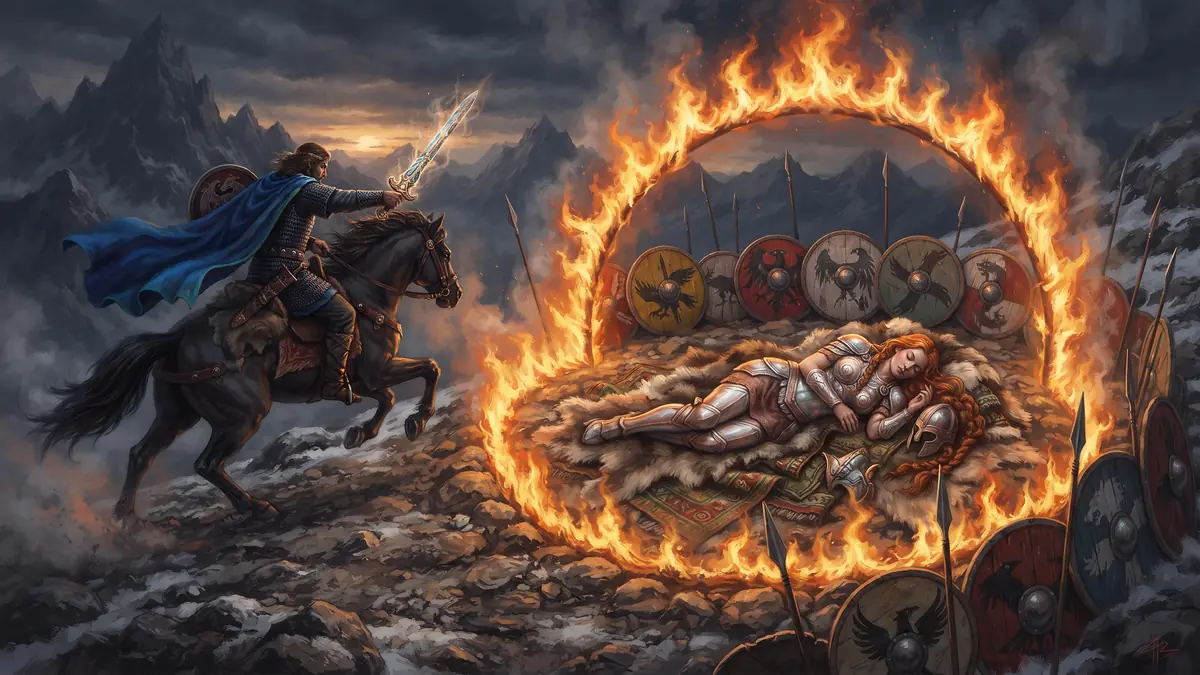
When the legend of Sigurd leaves the dragon behind, it grows darker. The hero is swallowed by oaths, deceptions and revenge, and at the centre of it all is Brynhildr.
The sleeping valkyrie
According to the Saga of the Volsungs, written in Iceland in the 13th century from older poems, Brynhildr was a valkyrie who disobeyed Odin. She gave victory to a king the god had condemned. As punishment, Odin pricked her with a sleep thorn and decreed that she would marry. Brynhildr swore that she would accept only a man who knew no fear, and she was placed on a hill ringed with fire, behind a wall of shields.
The hero and the fire
Sigurd rides to the hill and crosses the flames. Inside the shield wall, he finds a figure in armour, asleep. He cuts the mail with his sword, and Brynhildr wakes. She teaches him runes and counsel, which the poem Sigrdrífumál, in the Poetic Edda, keeps in verse, and the two exchange oaths.
Forgetting and deception
Fate turns at the court of Gjúki, king of the Gjúkungs. Queen Grímhildr gives Sigurd a drink that makes him forget Brynhildr, and he marries the king’s daughter, Guðrún. Gunnar, Guðrún’s brother, wants to marry Brynhildr, but his horse will not cross the fire. Sigurd, in Gunnar’s shape, mounts his own horse, Grani, and rides through the flames on his friend’s behalf. Brynhildr, not knowing, agrees to marry Gunnar.
The quarrel at the river
Years later, the two women bathe in a river and argue over whose husband is braver. Guðrún shows Brynhildr the ring that Sigurd took from her, and reveals the deception. Brynhildr feels betrayed, and anger rules the rest of the story. She presses Gunnar and his brother Högni to kill Sigurd. One of them, Guttormr, kills him in his bed.
Brynhildr dies by her own hand, and asks to be burned on the same pyre as the hero. In a poem of the Poetic Edda, Helreið Brynhildar, she travels to the realm of the dead in a wagon and talks with a giantess along the way.
Versions that differ
The sources do not agree on everything. In some poems, the reasons for Sigurd’s death and the role of each character change. In the Nibelungenlied, a German poem of around 1200, Brünhild is a queen of superhuman strength who lives in Iceland, and not a valkyrie. Richard Wagner’s opera The Ring of the Nibelung, premiered in 1876, uses the story and mixes it again.
This shows that nobody has the single version. The story is a set of heroic narratives written centuries after the times in which they are set, and none of them is a record of facts.
To try to cross the ring of fire by putting out every flame, play The ring of fire.
Sources.
- Unknown author, *Völsunga saga*, the Saga of the Volsungs (13th century)
- Unknown author, *Poetic Edda* (poems preserved in 13th-century manuscripts), especially *Sigrdrífumál*, *Sigurðarkviða hin skamma* and *Helreið Brynhildar*
- Unknown author, *Nibelungenlied* (around 1200), for comparison