Norse Greenland: four centuries of farms on the ice and the mystery of their end
The Norse lived in Greenland for more than four hundred years. The last known document is from 1408. Scholars still debate why the farms were left empty.
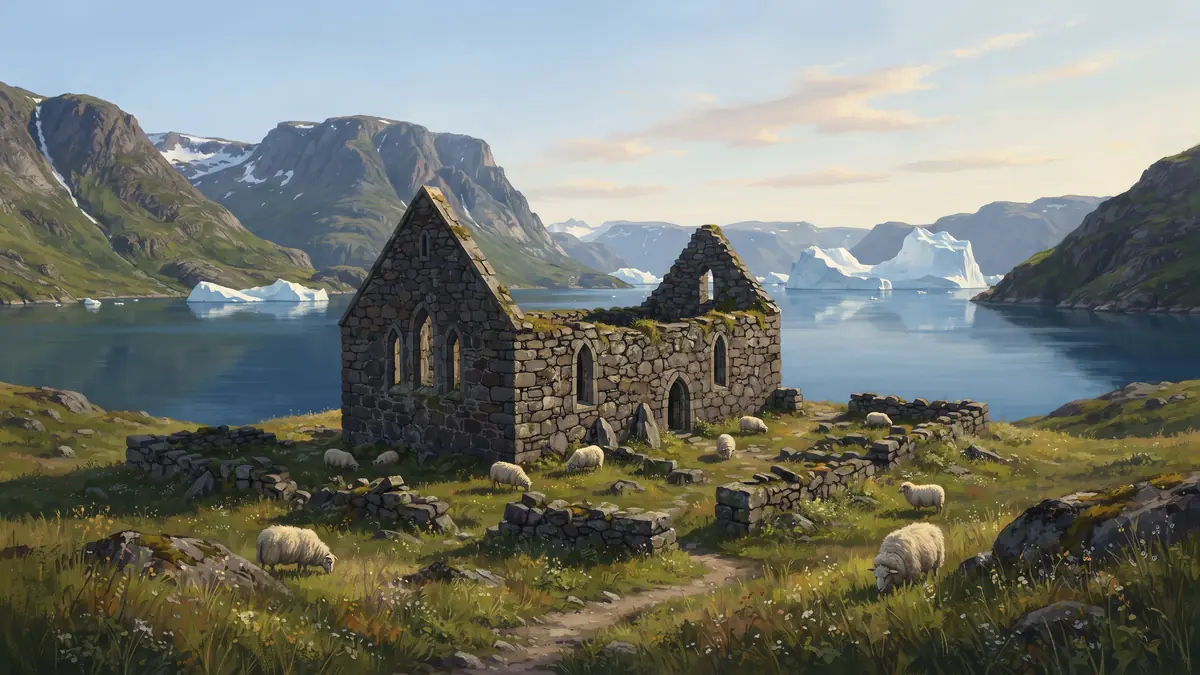
For more than four centuries, Norse farmers raised sheep, cows and goats in Greenland. They built stone churches and kept in touch with Norway and Iceland. Then the written records end, and the farms stand empty.
The colony
The Icelandic sagas say Eirik the Red reached Greenland around 985, and that other Icelanders followed him. The Norse settled in two areas, the Eastern Settlement, in the south, and the Western Settlement, farther north. Population estimates vary, generally between two and five thousand at the peak.
They kept animals and hunted seals, caribou and walrus. Walrus tusks, ivory, were exported. Greenland had a bishop and, in 1261, came to accept the king of Norway.
The last record
Around 1350, the priest Ívar Bárðarson was sent to the Western Settlement and said he found livestock running loose, but no people. The account was preserved in later copies, and scholars treat it with caution.
The most recent document known is from 1408, tied to a wedding in the church of Hvalsey, in the Eastern Settlement. After that, there is no more written news. The stone-walled ruins of Hvalsey are among the best preserved of the period.
Why?
Scholars have no single answer. Among the hypotheses discussed are cooling of the climate, in the so-called Little Ice Age, the fall in the value of walrus ivory in Europe, difficulties of navigation, and pressure on land and wood. Bone analyses show that, over time, the Norse ate more and more seal, which indicates adaptation.
The Inuit of the Thule culture arrived in the region in the 13th century. There are signs of contact, and scholars debate whether that contact helped or hindered the Norse. Some people may have moved to Iceland or elsewhere, and the farmers who stayed may have died out little by little. None of this is settled.
The search
In 1721, the Dano-Norwegian missionary Hans Egede went to Greenland convinced that Norse people were still alive. He found Inuit and ruins.
Today, archaeology shows a people who adapted for a long time to a hard place. It is a story with no villain, and no known ending.
What the ruins tell
Brattahlíð, Eirik’s farm, and Garðar, the bishop’s seat, are among the most studied sites. At Garðar the ruins of a cathedral remain. At Herjolfsnes, excavations in 1921 found graves with woollen clothing preserved by the frozen soil, in the style of European fashion of the late Middle Ages. These finds show that the Greenlanders followed the fashion of the continent, even living far away, and that they cared for their dead as in any European parish. Recent excavations keep revising the picture, and each new find changes a little the question of why the farms were left empty.
To try to cross the fjord by hopping from one ice floe to the next, play Crossing the fjord.
Sources.
- *Grænlendinga saga* and *Eiríks saga rauða* (13th century), on the founding of the colony
- Ívar Bárðarson, *Description of Greenland* (14th century, preserved in later copies)
- Archaeological and isotope studies of the Norse settlements in Greenland