Ivar the Boneless and the Great Heathen Army: what is known about the invasion that changed England
From 865, a Norse army moved across England for more than ten years. The chronicles describe the campaign, and the sagas link Ivar to it. What is certain, and what is not?
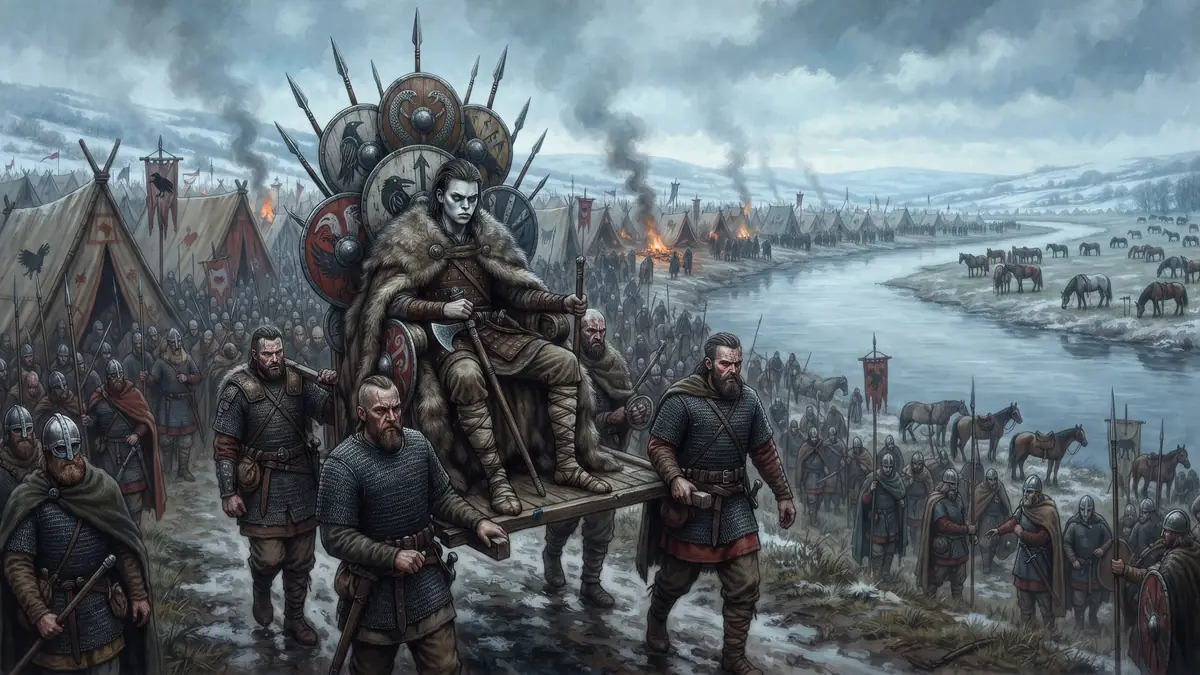
In 865, according to the Anglo-Saxon Chronicle, a “great heathen army” (micel hæþen here) landed in East Anglia, on the east coast of England. It did not come to plunder and go home. It stayed, and in little more than a decade it changed the political map of the country.
Who led it
The chronicle names several leaders, among them Halfdan and Ubba. Ivar (Ívarr), whom Norse tradition calls “the Boneless” (inn beinlausi), appears more clearly in later sources and in Ireland. According to the sagas, he was a son of the hero Ragnar Lodbrok, but historians disagree on that, and on whether the Ivar of the army is the same as Ímar, king of the Norsemen of Dublin, whose death the Irish annals record in 873.
The nickname is a riddle. A bone disease has been suggested, a figurative meaning, even a snake name. No hypothesis has been proven. The sagas say he was carried on a shield.
A campaign in stages
The army received horses in East Anglia and, in 866, went north. It took York, the capital of Northumbria, and in 867 defeated the kings Ælla and Osberht. In 869, it returned to East Anglia, where King Edmund died in combat or, according to a later tradition, was executed. The cult of St Edmund grew from that story.
In 871, it reached Wessex, where Æthelred and his brother Alfred fought several battles. In 873 and 874, it wintered at Repton, in Mercia. Afterwards the army split: Halfdan took Northumbria, and Guthrum part of the south.
The blood eagle and what the soil shows
The sagas say Ælla died by the “blood eagle”, an execution in which the ribs were supposedly opened. Many scholars doubt this, and some think the rite arose from a misreading of poems. No contemporary source describes it.
Archaeology helps more. At Repton, defences beside the church were found, and a collective burial with the remains of hundreds of people, which many link to the winter army. Among the graves was that of a warrior with a hammer-shaped pendant. The identification with Ivar, however, is only a hypothesis.
Modern estimates speak of a few thousand men, and not the tens of thousands that the chronicles might suggest.
What changed
In 878, Alfred defeated Guthrum at Edington. The Norse occupation left a whole region, the Danelaw, under Norse laws and customs, and many place names ending in -by.
Why the campaign worked
The English kingdoms were divided, and the army knew how to exploit internal quarrels, such as the civil war between Ælla and Osberht in Northumbria. It also gained mobility: it used horses on land and boats on the rivers, and set up fortified camps to pass the winter. Local kings sometimes bought peace with silver, and the army moved on. Only Wessex, under Alfred, managed to hold out to the end.
To break the shield wall as the Great Army did, play The shield wall.
Sources.
- *Anglo-Saxon Chronicle* (compiled between the 9th and 12th centuries), entries for 865 to 878
- Abbo of Fleury, *Passio sancti Eadmundi* (around 985–987)
- *Ragnars saga loðbrókar* and *Þáttr af Ragnarssonum* (13th century), for the Norse tradition about Ragnar's sons
- Archaeological studies of the winter camp at Repton (873–874)