Álfablót: the sacrifice to the elves, the door closed to a Christian skald and what the sources say about the rite
A Christian poet knocking on Swedish doors in the 11th century was told he could not enter because an álfablót was under way. See what the sources say about this rite for the elves.
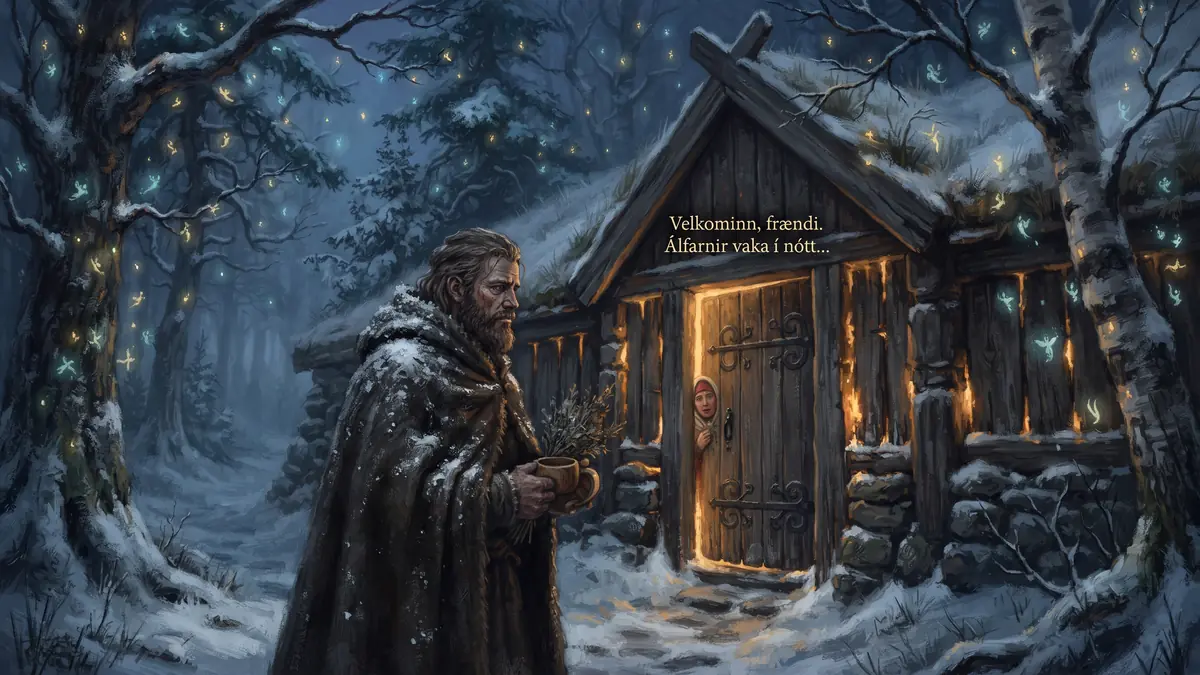
The Norse elves, the álfar, have little to do with those of modern books. Medieval sources speak of them briefly and confusingly, as beings tied to places, to ancestors and to fertility. And there are at least two passages that mention a rite in their honour, the álfablót, “sacrifice to the elves”.
The skald at the door
The most cited scene is in Austrfaravísur, “verses of the journey east”, by the Icelandic skald Sigvatr Þórðarson. He was a poet of the Norwegian king Olaf Haraldsson and was sent to Sweden around 1018 on a mission. On the way the skald, a Christian, sought lodging at farms of the region.
In the verses Sigvatr tells that he was turned away at several houses. At one a woman barred his entry. She said the family was pagan and that, inside, an álfablót was being held. There is also a refusal in which the hostess says she fears Odin’s wrath. The offended poet calls her rude and tells how he was treated. The text shows two things: that the rite took place at home, in a closed circle, and that the unfamiliar visitor was not welcome.
A bull for the mound
Kormáks saga, from the 13th century, carries a second reference. The poet Kormákr is wounded, and a wise woman, Þórdís, says he will only be cured if he sacrifices a bull to the elves on a mound where they live. She tells him to redden the outside of the mound with the animal’s blood and to make a feast for the elves with the meat. The saga presents the rite as a remedy, but does not say whether it worked as expected.
What is still unknown
There is no complete description of the álfablót. It is not known for certain who the elves in question were, whether spirits of the land, ancestors or something else, and scholars debate it. Nor is it known when and how it was done: Sigvatr’s source is a poem, and that of Kormáks saga is a narrative written centuries later by Christians.
What the passages allow us to say is that in pre-Christian or newly Christianised Scandinavia there were domestic rites made to beings not tied to the great gods, by families, in private.
A door that shows a world
The skald’s scene is precious because it shows the coexistence, and friction, between two religions. The woman defends her house and her rite. The poet, who writes as a Christian, records it with irritation, but at least he records it.
Scholars also note that the sources link elves to mounds and to the dead, but this link is interpreted in different ways, and no way is accepted by everyone.
To help link the offerings to the right places without letting any path cross another, play The Álfablót.
Sources.
- Sigvatr Þórðarson, *Austrfaravísur* (skaldic poem of the 11th century, preserved in *Heimskringla* and other sagas)
- Unknown author, *Kormáks saga* (Icelandic saga, 13th century, chapter on the sacrifice at the elf hill)
- Studies of pre-Christian Norse religion and beliefs in elves (*álfar*)