Rurik and Oleg: how the Primary Chronicle tells of the call to the Varangians that gave rise to Kyivan Rus', and what archaeology adds
According to the Primary Chronicle, tribes in eastern Europe called Varangian princes to rule them. See what it says of Rurik and Oleg and what archaeology shows and leaves open.
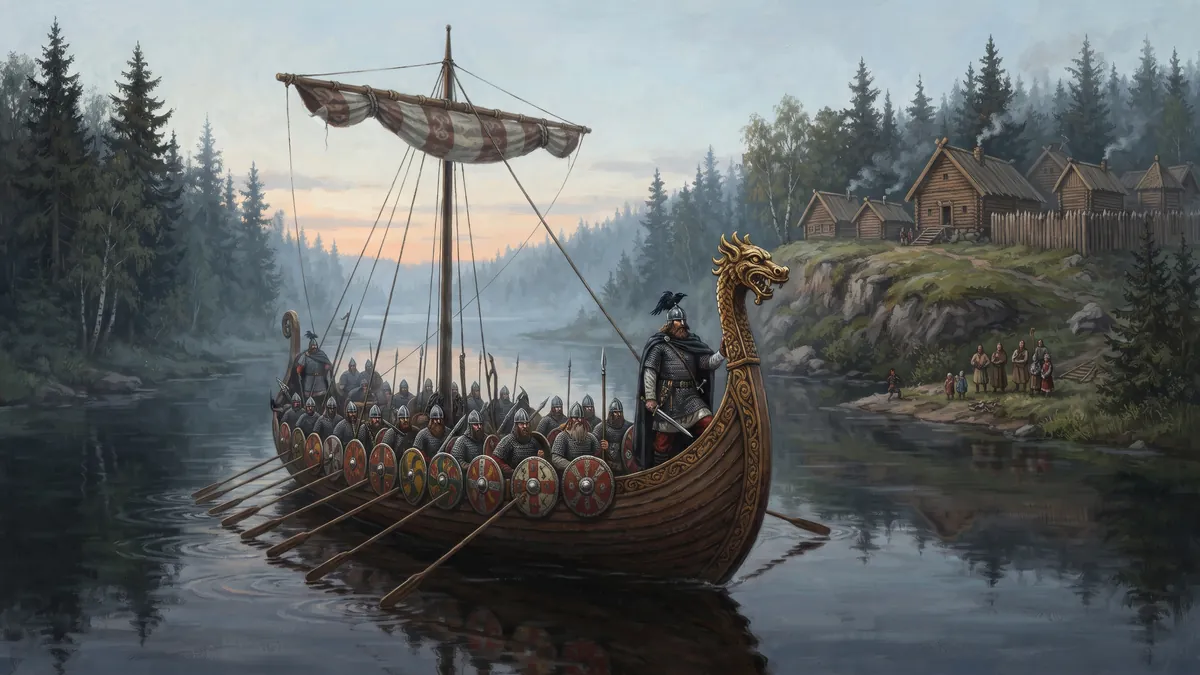
The story of Rus’, the medieval state centred on Kyiv, begins, according to tradition, with an invitation. The text that tells it is the Tale of Bygone Years, also called the Primary Chronicle, compiled in Kyiv around 1113, centuries after the events. That is why historians debate how far it can be trusted.
The call to the Varangians
The chronicle says that, in 859, Varangians from across the sea collected tribute from several tribes, among them Slavs and Finnic-speaking peoples. In 862 these tribes drove them out, but soon began to quarrel among themselves. Tired of it, says the text, they concluded they should seek a prince to rule them according to law. They went to the Varangians, called Rus’, and said: “Our land is great and rich, but there is no order in it. Come and reign and rule over us.”
Three brothers accepted, with their kin and their people. Rurik settled in Ladoga, and later Novgorod, Sineus at Beloozero and Truvor at Izborsk. The last two are said to have died soon after, and Rurik held everything.
From Novgorod to Kyiv
Rurik died around 879, according to the chronicle, and left his son Igor, still a child, under the guardianship of a kinsman called Oleg. Oleg went south, took Smolensk and, in 882, reached Kyiv. The chronicle tells that he killed the two chiefs of the city, Askold and Dir, by a ruse, and made Kyiv his capital.
Later Oleg attacked Constantinople, in 907, according to the chronicle, and the story includes a famous detail: he is said to have put his boats on wheels and sailed over land. Historians doubt this passage. The treaty of 911 with the Byzantines, however, is seen as more solid: the names of the Rus’ envoys listed in it are largely Scandinavian, such as Karl, Ingjald and Farlof.
What archaeology shows
Excavations at Staraya Ladoga, near Lake Ladoga, revealed Scandinavian-style objects from the middle of the 8th century, alongside Slavic and Finnic materials, which shows a multi-ethnic trading centre. At Rurikovo Gorodishche, near Novgorod, and at Gnezdovo, near Smolensk, there are Norse graves and objects. This confirms that Scandinavians travelled and lived in the region.
But archaeology does not prove that Rurik existed. Some historians see him as a historical figure, others as a legendary one created to give a dynasty nobility. This discussion is part of the so-called Norman debate, which sets those who stress the role of the Scandinavians against those who stress that of local peoples.
The name Rus’
The origin of the name Rus’ is also debated. A much-cited hypothesis links it to an Old Norse word related to “rowers” and to the Finnish term Ruotsi, which still means Sweden. It is not a unanimous explanation.
What seems clear is that Rus’ was born of a mixture of peoples, and that the Scandinavians were part of it, not the only part.
To help Rurik’s boat go up the river, working the oars in turn, play Rurik’s oars.
Sources.
- *Tale of Bygone Years* (*Povest' vremennykh let*, or *Primary Chronicle*, compiled in Kyiv c. 1113)
- Archaeological studies of Staraya Ladoga, Rurikovo Gorodishche and Gnezdovo
- Studies on the origin of the name Rus' and the debate on the Scandinavian presence in eastern Europe