Bergtatt: the Norwegian belief in those taken into the mountain
In Norwegian folk tradition, someone who was "bergtatt" had been taken into the mountain by the hidden people. Here is what accounts collected in the 19th century say, and how the idea reached Peer Gynt.
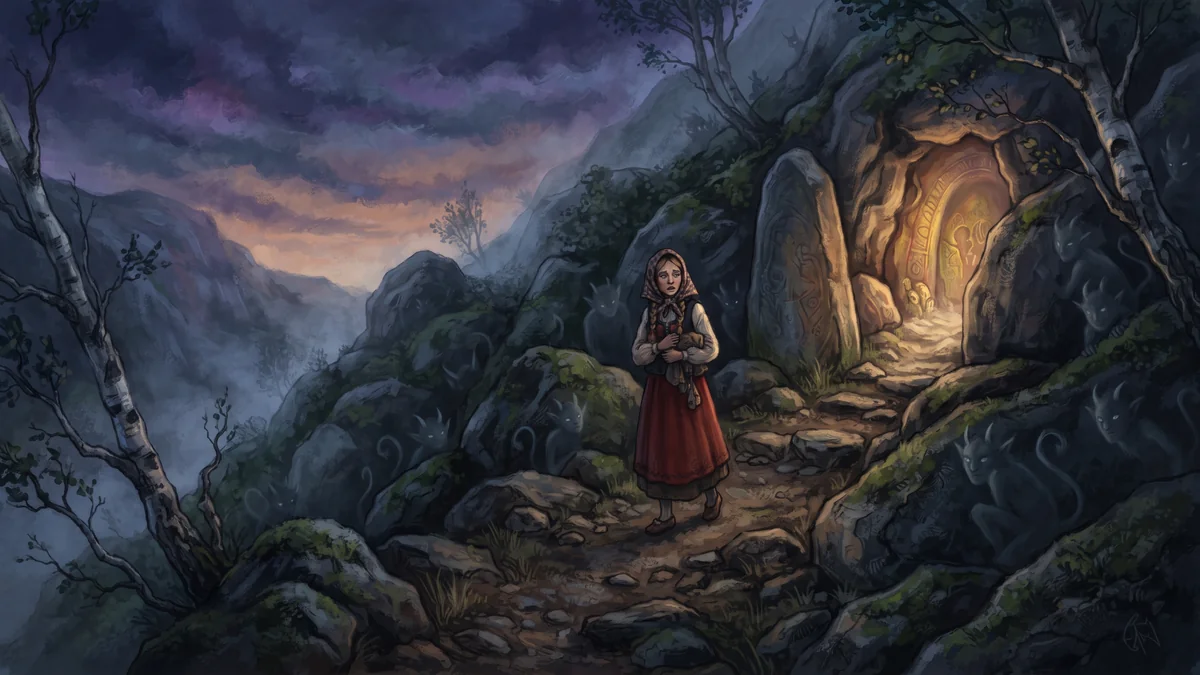
In Norway, the word bergtatt has two meanings. Today it means “enchanted”, “spellbound”, like someone before a landscape. But the word comes from an old belief: that a person could be berg-tatt, “taken by the mountain”, and carried inside it.
Who took and who was taken
According to Norwegian folklore, the mountain had inhabitants, the hidden people, who also appear in accounts of the huldra and trolls. They were beings of a life parallel to that of humans, and occasionally they sought someone for themselves. The collection of Peter Christen Asbjørnsen, in the 19th century, gathers many of these accounts in Norske Huldre-Eventyr og Folkesagn, from 1845 to 1848. In them, those taken are usually children, young women or people walking alone at nightfall.
The disappearance was experienced as something real. When someone vanished near a mountain range, the family and neighbours thought of the mountain folk. In some accounts, the person was found days later, silent, confused, like someone waking from a dream. In others, they never came back.
How to protect oneself
The accounts cite some defences. The most common was iron or steel: a knife, a needle or a pair of scissors left in sight. Other times it was fire, salt and Christian objects, such as the hymn book, or the words of a prayer. The sound of church bells, according to the stories, bothered the beings of the mountain. The tradition thus mixes old and Christian elements.
In some tales, the person taken heard the church bells and remembered home. This is a theme common to ballads and tales across Scandinavia: the call of the human world, which breaks the spell.
From folklore to the stage
In 1867, Henrik Ibsen published Peer Gynt, a dramatic poem inspired by characters and tales collected by Asbjørnsen. In the play, Peer enters the hall of the mountain king, the Dovregubben, who wants to make him a troll. The music for the staging was written by Edvard Grieg and dates from 1875, and “In the Hall of the Mountain King” became one of the best-known pieces of that tradition.
What we know of the belief comes from accounts by peasants collected by 19th-century scholars, not from medieval documents. That does not mean it is recent, but its audience and forms have changed. It is not always possible to tell what was living belief from what was polished by collectors and writers.
The idea that people could vanish into the mountains also has, according to many scholars, a practical side. In a land of fjords, cliffs and forests, walking alone at dusk was risky, and those who did not return had, in most cases, got lost or suffered an accident. The belief offered an explanation and, at the same time, a warning to the young: it was unwise to stray from home after sunset.
To cross the mountain hall dodging the falling stones, until you find the way out, play The mountain hall.
Sources.
- Peter Christen Asbjørnsen, *Norske Huldre-Eventyr og Folkesagn* (1845–1848)
- Henrik Ibsen, *Peer Gynt* (1867)
- Reidar Th. Christiansen, *The Migratory Legends* (Suomalainen Tiedeakatemia, 1958)