Fridtjof and the ship Ellide: the saga of the young man who faced a storm made by witches
The *Friðþjófs saga*, written in Iceland in the 14th century, tells of a young man without royal rank, a king's daughter and a magical storm. See what the saga says and how it reached the 19th century.
The Friðþjófs saga ins frœkna, “the saga of Fridtjof the Bold”, is an Icelandic narrative of the 14th century. It belongs to the group of sagas of ancient times, which are set in Scandinavia, before the settlement of Iceland, and mix heroes, love and magic. Not everything in it is late invention, but historians do not treat it as a chronicle.
Two young people and a prohibition
The saga begins in Norway, in the region of Sogn. Fridtjof is the son of a rich man, but not of a king. He grows up beside the young Ingibjörg, daughter of King Beli, and the two fall in love. When Ingibjörg’s father dies, her brothers, Helgi and Hálfdan, rule, and refuse the marriage, because Fridtjof, in their view, does not have enough standing. Ingibjörg ends up promised to an older king, Hring.
Among the possessions of Fridtjof’s family are a valuable ring and the ship Ellide, described as one of the best of its time. Many readers cite the ship as the liveliest figure in the story, because the saga treats it almost as a character.
The storm
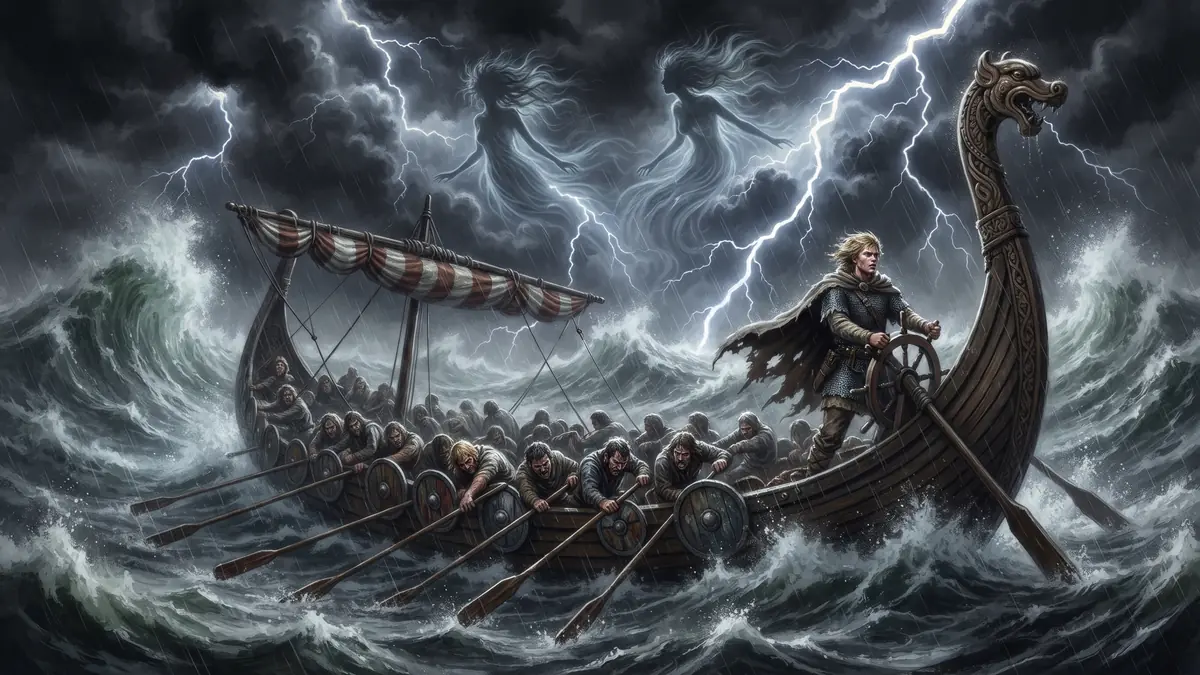
Ingibjörg’s brothers decide to get rid of Fridtjof. They send him to the Orkney Islands, on the pretext of collecting a debt, and hire two sorceresses, Heiðr and Hamglöma, to raise a storm against him. The saga describes the furious sea, the very high waves and the crew in danger. Fridtjof keeps control of the ship and encourages the men. According to the text, the Ellide withstands the sea, and the storm finally breaks up. The sorceresses are later killed by Fridtjof and his companions.
This passage shows the taste of the late sagas well. There is magic, but the focus remains the courage of the hero and the quality of the ship. Scholars see in the scene a reflection of the life of a people who depended on the sea.
Exile and fame
Later, Fridtjof is accused of having burned a temple and is declared an outlaw. He lives as a Viking for some time and, in the end, comes to the court of King Hring in disguise. The saga ends with his marriage to Ingibjörg after the king’s death.
The story gained new life in 1825, when the Swedish poet Esaias Tegnér turned it into a long poem, Frithiofs saga. The work was translated many times, including into English and German, and helped spread the romantic image of the Viking in the 19th century. It is worth remembering that Tegnér’s version is a re-creation, and that many details the public knows come from it, and not from the medieval manuscript.
It is also worth remembering that the saga exists in several versions and manuscripts, and that the details vary from one to another. The name of Ellide, for example, is spelled in different ways, and some episodes appear only in certain copies. This is common in medieval works, which were copied by hand and changed according to whoever copied them.
To cross, with the Ellide, the furious sea, steering clear of the waves and obstacles, play Ellide in the storm.
Sources.
- Unknown author, *Friðþjófs saga ins frœkna* (Icelandic saga, 14th century)
- Esaias Tegnér, *Frithiofs saga* (poem in twenty-four cantos, Stockholm, 1825)
- Rudolf Simek and Hermann Pálsson, *Lexikon der altnordischen Literatur* (Kröner, 1987, entry on the saga)