The boy who went to the North Wind: a Norwegian tale of flour, thieves and a cudgel
In the Norwegian tale collected by Asbjørnsen and Moe, a boy goes to demand from the North Wind the flour it blew away. See the plot, the origin of the tale and why it pleased so many.
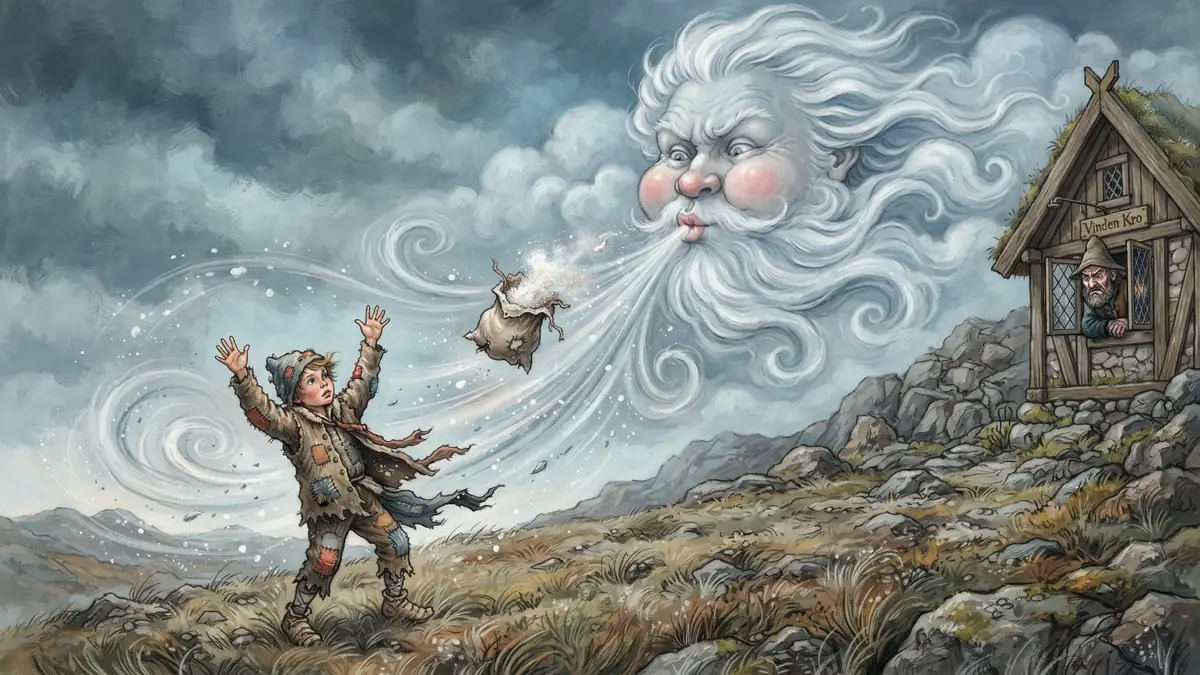
Among the tales that Asbjørnsen and Moe gathered in Norway, there is one in which a poor boy takes on the wind itself. The original title is Gutten som gik til Nordenvinden, “the boy who went to the North Wind”. The story is short and funny, and has been reproduced in many children’s books.
The plot
The tale begins with a mother who sends her son to fetch flour. When the boy returns, the North Wind blows and carries everything away. This happens again, and the boy decides to go to the wind’s house and demand the flour back. On arriving, the North Wind admits the mistake and gives the boy, as compensation, a magic cloth. When he says the right phrase, the cloth is covered with food.
On the way back, the boy stops at an inn. The innkeeper, suspicious, discovers the power of the cloth and swaps it for an ordinary one while the boy sleeps. At home, the boy finds out about the trick and goes back to the North Wind.
The cycle repeats
The North Wind then gives the boy an animal that produces gold coins, and the innkeeper swaps it again. On the third visit, the Wind gives the boy a cudgel that comes out of a sack and beats whoever the boy commands. This time, at the inn, the boy pretends to sleep. When the owner tries once more to swap the object, the boy orders the cudgel to act, and the owner, after a beating, returns everything he had stolen. The boy goes home with the cloth, the animal and the cudgel, and the family lives well.
The structure, with a magic object lost and recovered by a third party, is very common. Scholars find it in tales from several regions of Europe, and Stith Thompson’s catalogue gathers similar types.
What the tradition shows
Asbjørnsen and Moe published the tales from 1841, listening to peasant narrators, and later rewrote the texts in a style of their own that became very famous. For this reason, the text known today is a literary version, and not the exact transcription of a spoken telling. Historians see in this work a contribution to Norwegian identity in the 19th century.
The North Wind, in the tale, is neither wholly good nor wholly bad. He errs, and repairs the error, and the true villain is the innkeeper. The moral, if there is one, is that the thief’s cunning ends up punished.
It is worth remembering that winds appear as characters in many traditions, and that in Norway the north wind was a real presence, bringing cold and storms. Turning it into someone who can err, be called to account and still make up for the damage is a way of dealing with the uncertainty of the weather. The humour of the tale helps make this relationship lighter.
To teach the innkeeper a lesson, ordering the cudgel to strike whoever dares to appear, play The North Wind’s cudgel.
Sources.
- Peter Christen Asbjørnsen and Jørgen Moe, *Norske Folkeeventyr* (Christiania, 1843–1844, tale "Gutten som gik til Nordenvinden")
- Reidar Th. Christiansen, *The Folktales of Norway* (University of Chicago Press, 1964)
- Stith Thompson, *The Folktale* (University of California Press, 1977, tale type on magic objects)