Alvíssmál: the dwarf who wanted to marry Thor's daughter and lost to the sun
In the poem *Alvíssmál*, Thor holds a dwarf with questions until daylight enters the hall. See what the text says and why it interests scholars of the language.
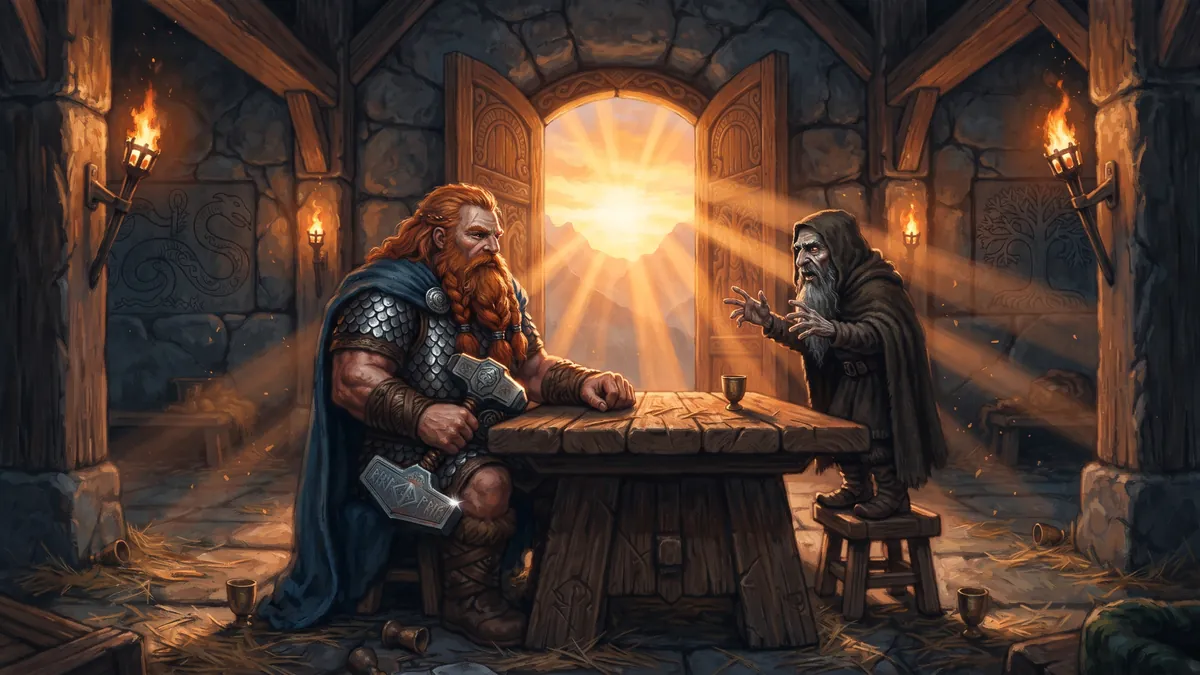
The Alvíssmál, “the sayings of Alvíss”, is a short poem of the Poetic Edda, preserved in the Codex Regius. It deals with an encounter between Thor and a dwarf named Alvíss, a name that means “all-wise”. Almost everything in the poem is dialogue, and what stands out is the way Thor decides the outcome: not by force, but by conversation.
What the poem tells
Alvíss arrives at a hall saying that he has come to fetch the bride who was promised to him, Thor’s daughter, called Thrúd. He says the gods gave him the promise while Thor was away. Thor returns and, on seeing him, remarks that the dwarf has a strange face, with a pale nose, like someone who has spent his nights among the dead, and that he seems to have something of a giant about him. The remark is one of the most remembered in the poem.
Thor sets a condition: if the dwarf is as wise as he claims, he may have the bride. To test him, he asks about the names of thirteen things, among them the earth, the sky, the moon, the sun, the clouds, the wind, the sea, fire, the forest, the night, grain and ale. To each question, Alvíss answers with the names that each group of beings gives them: humans, gods, giants, elves and dwarfs, among others.
The end of the conversation
The poem ends with a blow. Thor says that he has never found so much ancient knowledge in a single breast, but that the dwarf has been tricked: he stands in the hall because Thor kept him talking, and day is already shining inside. The text does not describe what happens next. Readers usually understand that the dwarf loses, because in Norse tradition dwarfs avoid the light of the sun, and some sources speak of them as creatures that turn to stone at dawn. The poem itself, however, does not tell of this transformation.
Why the poem matters
Scholars are interested in the Alvíssmál for a practical reason: it preserves a list of poetic synonyms, and many of them are words that appear in other poems and would hardly be understood without the help of the text. In other words, the poem works as a kind of dictionary in verse, useful to anyone reading skaldic poetry.
There is also a question of dating and intent. Some researchers think the poem is relatively late, and that it can be read as a parody of the genre of wisdom contests, like the one in the poem of Vafþrúðnir. Others prefer to see it as a serious piece, recording the knowledge of poets. The sources do not allow a definitive answer.
The lesson the poem leaves is known in many cultures: whoever talks without looking at the window may lose what he wanted most. Thor, who in other stories wins with the hammer, here wins with patience.
To stack, at exactly the right moment, one question upon another until the sun rises, play Thor’s questions.
Sources.
- *Alvíssmál*, in the *Poetic Edda* (Codex Regius, c. 1270)
- Carolyne Larrington (trans.), *The Poetic Edda* (Oxford University Press, 1996)
- John Lindow, *Handbook of Norse Mythology* (ABC-CLIO, 2001), entry on dwarfs