The Faroese saga: Sigmundur, Tróndur and the escape by swimming between the islands
The *Færeyinga saga* is the main medieval history of the Faroe Islands. It tells of the rivalry between Sigmundur and Tróndur, the arrival of Christianity and an escape by swimming.
The Færeyinga saga, “the saga of the Faroese”, is the most important medieval text on the history of the Faroe Islands. It was written in Iceland, probably in the 13th century, and tells of events that are supposed to have taken place around the year 1000. The source is valuable because the Faroes have few early documents, but the text is a saga, not a chronicle, so historians use it with care.
The two families
The plot revolves around two families of the archipelago. On one side is the family of Skúvoy, from which Sigmundur Brestisson comes. On the other is Tróndur í Götu, a powerful and cunning chieftain, who lives on the island of Eysturoy. The saga shows how the dispute between them moves from land and goods to honour, and how the two sides trade insults and deaths.
Sigmundur, still young, goes to Norway and is raised at the court of Earl Hákon. Later, King Olaf Tryggvason sends him back to the Faroes, with the mission of converting the inhabitants to Christianity. The saga says that he imposed the change, partly with threats, and that Tróndur resisted until he gave way in public. It is important to remember that the account was written by Christians, and so it exalts the conversion.
The escape by swimming
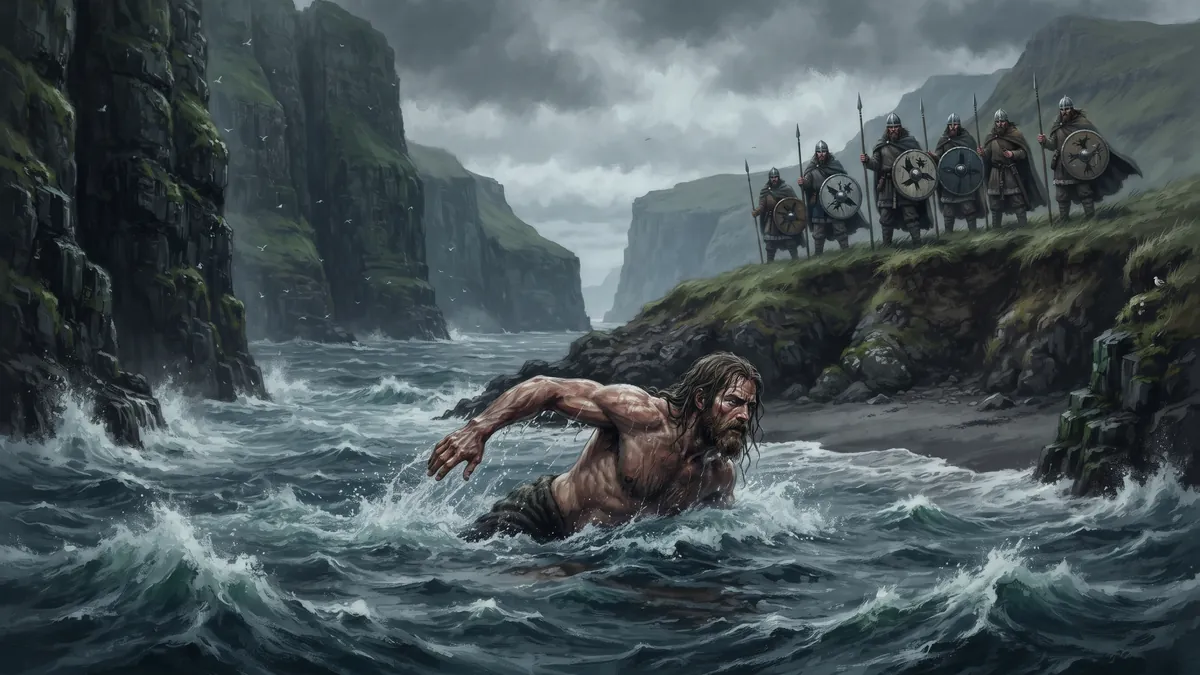
The most famous episode comes later. On the island of Skúvoy, Sigmundur and his companions are attacked by Tróndur’s men. The saga tells that he escaped by throwing himself into the sea and swimming across a strait to the neighbouring island of Sandoy. The crossing is described as a feat of strength, and readers remember it as the hero’s high point.
The ending is sad. Sigmundur reaches the beach, exhausted, and is killed by a man of the island who wanted his gold ring, a gift from Earl Hákon, according to the story. The saga shows with this that a man’s strength is not enough to escape betrayal.
What archaeology adds
Archaeology shows that the Faroes were settled before the time of the account, and researchers debate whether this happened around the 9th century or earlier, and whether Irish or Scandinavians arrived first. Excavations of longhouses, such as the one at Kvívík, show a way of life of shepherds and fishermen, with sheep farming and the use of peat.
The thread of the text, of disputes between families, recalls the sagas of Iceland, and many scholars think the author relied on stories told over generations. The details, such as the crossing by swimming, may have been enlarged by tradition. But what the saga shows well is the life of a small archipelago, where everyone knows everyone, and where an enmity can last a lifetime.
To cross, swimming, the strait between the islands, alternating your strokes without exhausting your breath, play Swimming between the islands.
Sources.
- *Færeyinga saga*, ed. Ólafur Halldórsson (Stofnun Árna Magnússonar, 1987)
- George Johnston (trans.), *The Faroe Islanders' Saga* (Oberon Press, 1975)
- Símun V. Arge, "The Landnám in the Faroes", *Arctic Anthropology* 28:2 (1991)