Ilmatar: the daughter of the air who floated seven hundred years at sea and the duck that laid the world
In the first canto of the *Kalevala*, Ilmatar, the daughter of the air, floats in the sea, and the world is born from the eggs of a bird. See what the poem tells and how it was assembled.
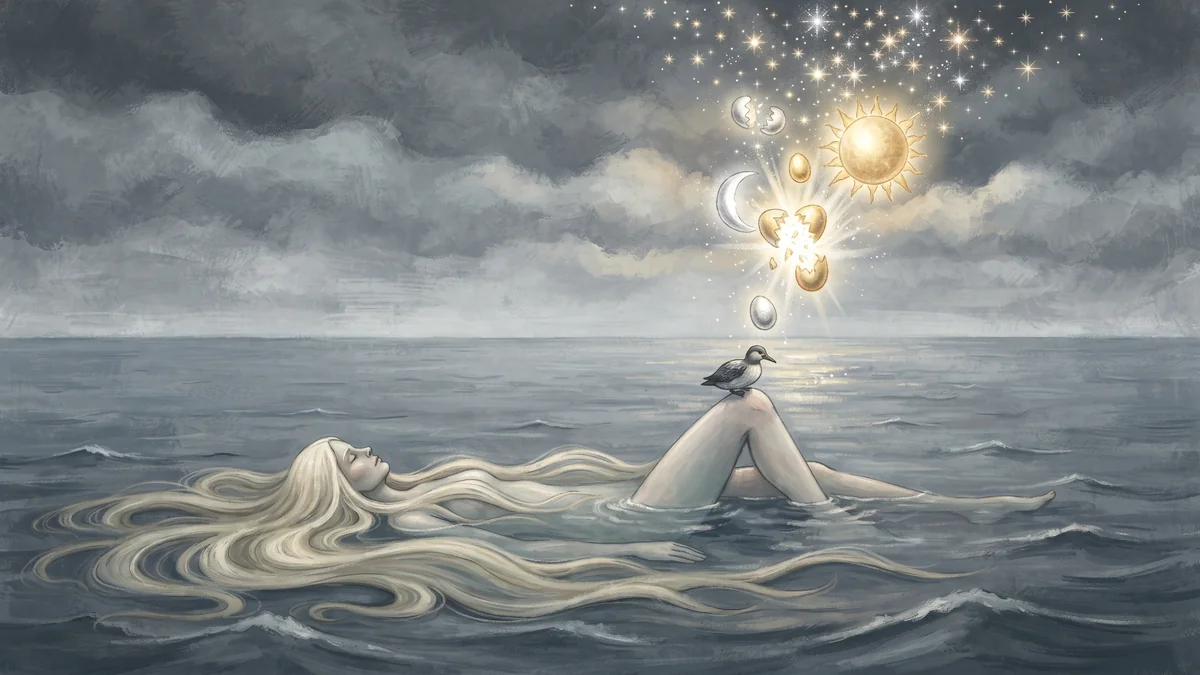
The first canto of the Kalevala begins not with a hero, but with a creation. A figure called Ilmatar, the “daughter of the air”, descends to the sea, and the poem tells how, from her and a bird, the earth, the sky and the first singer are born. The passage is one of the most quoted in Finnish culture, and it even inspired a work by Sibelius, the song Luonnotar, of 1913.
The daughter of the air
According to the canto, Ilmatar lived alone in the sky and grew tired of the loneliness. She descended to the waters of the sea, which rocked her with the waves, and she became pregnant by the water and the wind. For seven hundred years she floated, finding no place to give birth. In her distress she asked for help from the god of the sky, Ukko.
It was then that a bird, a duck, arrived and looked for a place to make a nest. Ilmatar raised a knee above the water, and the bird built the nest there and laid eggs, six of gold and one of iron. She incubated them for days.
The eggs that became a world
The heat of the nest burned Ilmatar’s skin, and she moved her knee, and the eggs rolled into the water and broke. The poem says that from the lower part of the shell the earth was born, and from the upper part, the sky. The yolk became the sun, the white, the moon, and the more colourful pieces became the stars and the clouds.
Ilmatar still gave shape to the world: with her hands and feet she drew bays and capes, deeps and sandbanks. At last the son she was expecting, Väinämöinen, the old sage and singer, was born already grown and swam to a shore to begin his life.
A myth assembled by an editor
Scholars remind us that this narrative is part of the work of Elias Lönnrot, who combined verses collected from folk singers into a single canto. The 1835 version of the Kalevala begins differently, and it was only in the 1849 edition that the story of Ilmatar took the form we know. For this reason it cannot be said to be an ancient doctrine, but rather a text resulting from collecting, choosing and assembling.
The theme of the world born from an egg exists in other regions of Eurasia, and is one of the most widespread motifs in mythology. The interest of the Finnish canto lies in the image of a creation made without violence, and in which a woman, rather than a god, gives shape to the earth. The canto also shows a trait of the Finnish poetry collected by Lönnrot: the eight-syllable line, with alliteration, which made the words easy to memorise and to sing.
To measure, with two vessels, the exact quantity of water, like someone giving shape to the primordial sea, play Ilmatar’s vessels.
Sources.
- Elias Lönnrot, *Kalevala* (1849 edition, canto 1), trans. Keith Bosley (Oxford World's Classics, 1989)
- Juha Pentikäinen, *Kalevala Mythology* (Indiana University Press, 1989)
- Matti Kuusi, Keith Bosley and Michael Branch (eds.), *Finnish Folk Poetry: Epic* (Finnish Literature Society, 1977)