Kong Lindorm: the Danish tale of the serpent prince and the bride of shirts
In the Danish tale of King Lindorm, a prince is born in the shape of a worm and becomes a man only if the bride takes off a shirt for each skin he sheds. See the sources and versions.
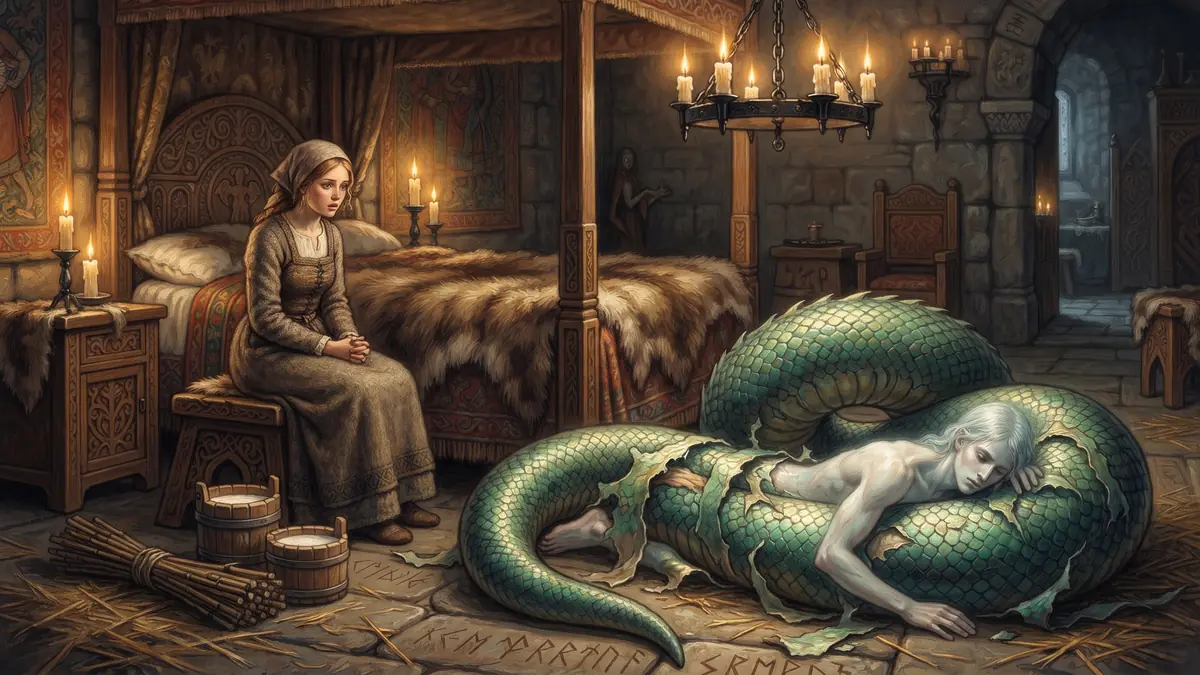
Among the folk tales of Denmark there is one that mixes fear and tenderness: that of Kong Lindorm, the “worm king”. It tells of a prince who is born in the shape of a serpent and is freed only by the courage of a poor young woman. The tale was collected by Danish folklorists in the 19th century, and there are versions in Sweden and other regions as well.
The story
A king and queen have no children. An old woman advises the queen to follow a ritual with two flowers. The queen, impatient, eats both, and gives birth first to a lindworm, a great worm, and then to a healthy boy. The worm crawls off into the forest and vanishes. The brother grows up, and the time comes for him to marry.
That is when the lindworm returns and demands a bride before his brother. If he does not have one, he says, no one will marry in the kingdom. The first young woman, chosen by the king, dies during the night. The second meets the same end. No one else wants to risk it, until a shepherdess accepts.
The prepared bride
The shepherdess receives advice from an old woman: to take with her many shirts, a tub of lye, another of milk and a bundle of rods. On the first night, the worm tells her to take off a shirt, and she answers that she will do so when he sheds a skin. He sheds the first, and she takes off hers. Then she whips him with the rods, bathes him in lye and, finally, in milk.
The process repeats, shirt by shirt, skin by skin. When the last layer falls, the lindworm turns into a handsome young man, the king’s son. The wedding takes place, and the brother can marry too. The bride, who seemed the least important, is the one who restores the order of the kingdom.
How scholars read the tale
The tale belongs to an internationally known type, which folklore catalogues call ATU 433B, and which has variants in other countries. Researchers observe that it combines common themes, such as the transformation of a monster into a man through fidelity, and that of the disobedience that causes the initial problem.
Some readings see in the story an image of the trials of marriage, in which the bride must accept what is strange in the other. Others note that the text is harsh on the first two young women, and that the versions vary in how they treat them. As in many tales, the moral is not stated, and each age interprets it in its own way. The rhythm of the tale, with the worm’s request and the bride’s reply repeated at every shirt, is typical of oral narrative, and helped the teller keep the attention of the listeners.
To take off, one by one, the ten skins of the worm, landing the crack of the whip at exactly the right moment, play The bride’s whip.
Sources.
- Svend Grundtvig, *Gamle danske Minder i Folkemunde* (Copenhagen, 1854-1861)
- Andrew Lang (ed.), *The Pink Fairy Book* (Longmans, 1897), tale "King Lindorm"
- Hans-Jörg Uther, *The Types of International Folktales* (FF Communications, 2004), type ATU 433B