Lemminkäinen in the river of Tuonela: the mother who fished her son's pieces out with a rake
In the *Kalevala*, the adventurer Lemminkäinen is killed in the land of the dead, and his mother gathers his body from the river with an iron rake. See what cantos 14 and 15 say.
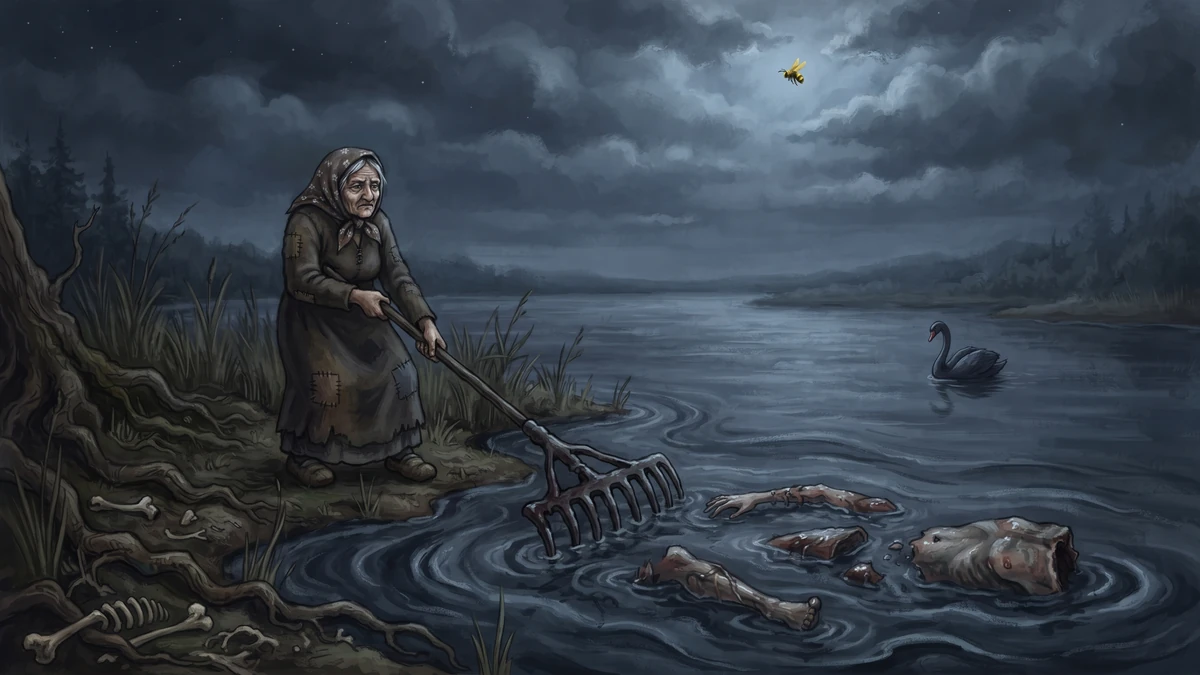
The Kalevala, Finland’s national epic, has several heroes, and one of the liveliest is Lemminkäinen, a handsome, vain and reckless young man. In cantos 14 and 15 he goes to the realm of the dead, and the one who brings him back is his mother. The passage is one of the best known in the work, and scholars read it as a story about care and persistence.
Louhi’s demand
The Kalevala was put together in the 19th century by Elias Lönnrot, who gathered oral poems collected in Karelia and other regions. In it, Lemminkäinen wants to marry a young woman of the land of Pohjola, and the mistress of the place, Louhi, sets tasks. One of them is to kill the swan that swims in the black river of Tuonela, the realm of the dead. It is an almost impossible task, because whoever goes in there rarely returns.
Lemminkäinen sets out with pride, but reaches Tuonela without the protections that a careful traveller would have. On the bank of the river, a blind herdsman called Märkähattu, whom he had offended, is waiting for him. The herdsman strikes him with a poisonous snake, and the hero dies. The body is cut up and thrown into the river.
The mother and the brush
At home, Lemminkäinen’s mother had been given a sign before her son left. If he were in danger, the hairbrush he left behind would begin to bleed. One day she sees the blood run, understands that something has happened and goes to Pohjola, where she forces Louhi to tell her what she knows.
She asks the smith Ilmarinen for an iron rake, with long teeth, and uses it to sweep the bottom of the river. Little by little she gathers her son’s pieces, joins them, and makes the body re-form. Life is still missing, however, and she sends a bee to the sky to bring a healing honey. With this remedy, Lemminkäinen wakes, and his first question is whether he has slept long.
What the passage shows
Scholars observe that the canto deals with a theme common to many traditions, that of the descent to the realm of the dead and the return. Here the one who descends is not a divine figure but a reckless young man, and the one who rescues him is a mother, which gives the episode a human tone. It is common to say that the poem values the quiet courage of those who care.
It is worth remembering that the Kalevala is a work of compilation: Lönnrot joined verses from different sources and ordered them, so the story we read is, in part, the editor’s work. Even so, the image of the mother standing on the bank, with the rake, stayed in Finnish memory and inspired paintings, music and theatre.
To gather, in the river of Tuonela, the pieces of the son, without being caught by the black swan that watches the waters, play The river of Tuonela.
Sources.
- Elias Lönnrot, *Kalevala* (1849 edition, cantos 14 and 15), trans. Keith Bosley (Oxford World's Classics, 1989)
- Juha Pentikäinen, *Kalevala Mythology* (Indiana University Press, 1989)
- Matti Kuusi, Keith Bosley and Michael Branch (eds.), *Finnish Folk Poetry: Epic* (Finnish Literature Society, 1977)