Ask and Embla: the first man and woman in the Norse sources
Two logs found on the beach become the first human couple. See what the *Völuspá* and Snorri say about Ask and Embla, and what remains in doubt.
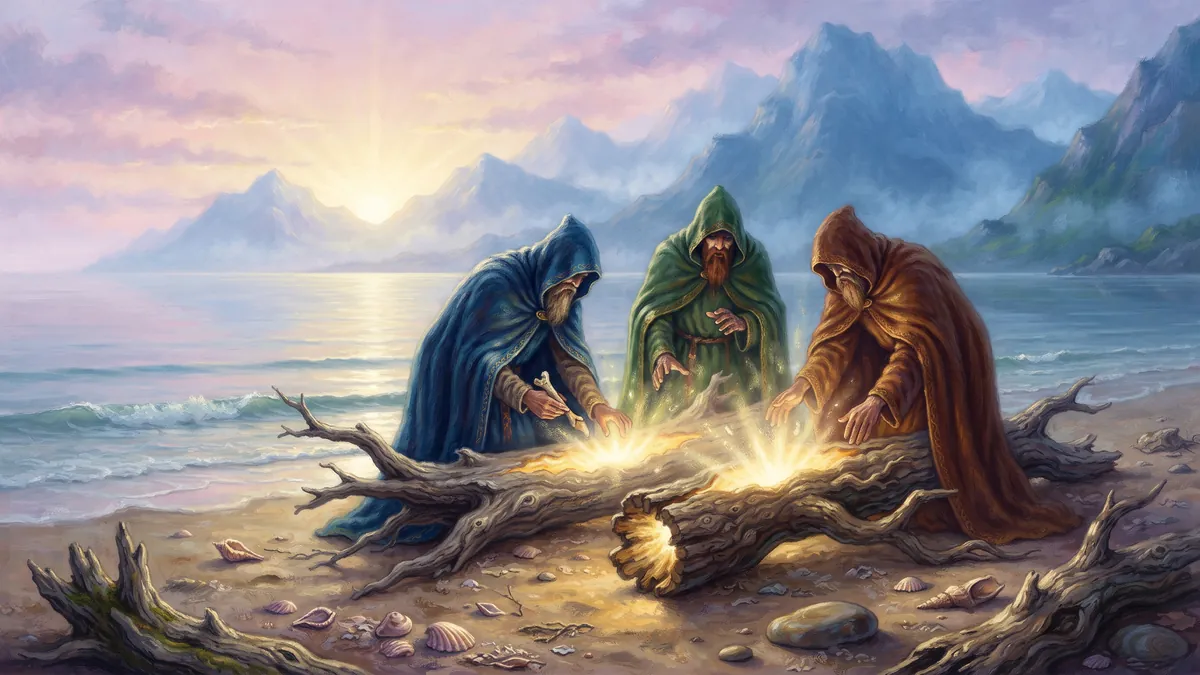
Many cultures tell how the first human beings came about. In the Norse sources the answer is short and leaves much open: two logs, found by the sea, come to life through the action of gods. The couple is called Askr and Embla, and the two sources that describe them, the Völuspá and Snorri’s Prose Edda, do not tell the same thing.
What the Völuspá says
The poem, in the Codex Regius, describes the moment when three gods go walking and find, on the land, two figures “without power”, called Askr and Embla. They had not yet “breath”, nor “senses”, nor “warmth” and “good colour”, according to the usual translation of the old terms. The gods give them these gifts, one by one. Odin gives breath, a god called Hœnir gives senses, and a third, Lóðurr, gives blood and good colour.
The poem does not say what Askr and Embla were made of before. Nor does it explain where the three gods who animate them came from, nor say clearly what each gift means. Scholars discuss the words of the original, and translations vary.
What Snorri says
In the Prose Edda, written in the 13th century, Snorri tells a more detailed version. The sons of Borr, Odin, Vili and Vé, were walking by the sea and found two trees. From them they made a man and a woman. The first gave spirit and life, the second, intelligence and movement, and the third, face, speech, hearing and sight. From the man, called Askr, and the woman, Embla, humans descend, and to them Miðgarðr was given to live in.
Snorri’s version has other names and other divisions of tasks. It is possible that he reorganised the material so that it made sense to a Christian reader, or that he used a tradition different from the one in the Völuspá. There is no way to know for sure.
Trees, ash and elm
Askr means “ash”, a common tree in Scandinavia. The meaning of Embla is less clear. Some have proposed that it comes from a word for “elm”, but the link is uncertain, and other explanations have been suggested. In any case, the idea that humans were born from trees also appears in other Indo-European cultures, and some researchers see in it a very old inheritance. Others recall that the likeness may be chance.
The ash also stands out in Norse mythology for another reason: Yggdrasill, the great world tree, is described as an ash. But the sources do not link one thing directly to the other, and connecting them is a modern interpretation.
What can be affirmed
With the sources we have, only two things are certain. First, that the Völuspá and Snorri speak of a couple called Askr and Embla, made of wood and animated by gods. Second, that the details vary from one source to another. Everything else, including the exact meaning of the gifts, is a debate among specialists. This gap is not a flaw of the myth, but a feature of texts written centuries after the time when the stories circulated by voice.
To join, two by two, matching blocks until only one is left, as if the logs gained value with every gift received, play The gods’ gifts.
Sources.
- *Poetic Edda*, *Völuspá*, stanzas 17 and 18 (Codex Regius, c. 1270)
- Snorri Sturluson, *Gylfaginning*, ch. 9 (*Prose Edda*, c. 1220)
- Rudolf Simek, *Dictionary of Northern Mythology* (D. S. Brewer, 1993), entries "Askr and Embla" and "Hœnir"