Þormóðr, the poet who followed King Olaf to Stiklestad
The *Saga of the Sworn Brothers* tells of two Icelandic friends, one of them a skald. See what the saga and Snorri say about Þormóðr and his death in a battle.
The Fóstbrœðra saga, the “saga of the sworn brothers”, is one of the strangest Icelandic sagas. It tells the life of two friends who swore to be like brothers, Þorgeirr and Þormóðr, and mixes violence, black humour and poetry. The second is a skald, that is, a court poet, and his story is a good occasion to understand how Icelanders thought of this profession.
Two friends, two temperaments
The saga was written in the 13th century, probably around 1200 to 1250, and survives in several manuscripts, of different dates and lengths. Specialists discuss which version is closest to the original. The text speaks of events that would have occurred about two hundred years earlier, and the distance between the facts and the account is great.
Þorgeirr is described as a violent man, who kills without much reason and is admired for it. Þormóðr is different: he is a poet, and the saga presents him courting a woman called Þórbjörg, to whom he dedicates verses. Because of her he gets the nickname Kolbrúnarskáld, “the skald of Kolbrún”, which, as understood, was a nickname for his beloved. When Þorgeirr is killed, Þormóðr takes part in the revenge.
A poet in the king’s army
The second half of the saga follows Þormóðr to Norway. He joins King Olaf Haraldsson, the future saint, and with him goes to the battle of Stiklestad, in 1030, where the king is killed. That battle is also narrated by Snorri in the Heimskringla, and many of the verses attributed to Þormóðr appear in these texts. Whether the stanzas are really his, or were composed later, is an open question.
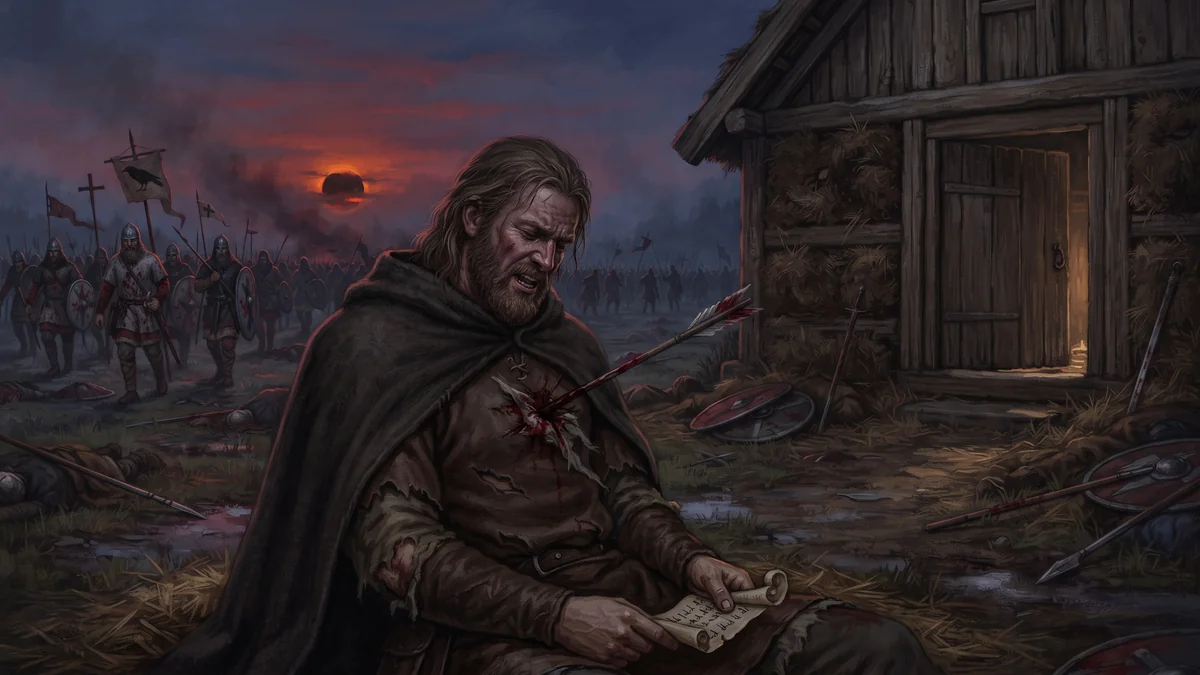
According to the narratives, Þormóðr was struck by an arrow. He withdrew from the field and ended up in a barn where the wounded were gathered. There is a scene in which the arrow is pulled from his chest, and he remarks, ironically, that the king had fed them well, because the fat still reached his heart. Saying this, he dies. The scene is famous for the coldness of its humour, and shows what the author wanted to stress: courage in the face of death and grace in words.
The poet and power
Skalds were important figures in Nordic courts. They composed verses of praise in difficult forms, with internal rhymes and elaborate metaphors, and received gifts in return. The saga shows Þormóðr as part of this tradition. His verses exalt the king, but also reflect personal loyalty, and death on the battlefield is, in the logic of the work, the proof of that fidelity.
Scholars observe that the saga’s taste for black humour is not mere decoration. It may be a way of speaking of a world where violence was frequent and where people expected heroes to face everything calmly.
What can be said
The figure of Þormóðr is literary, and there is little independent information about him. This does not mean that he never existed. It only means that what we know comes from texts written much later, which have an interest in telling a good story. For the present-day reader, the value of the saga lies precisely there: it shows how medieval Icelanders imagined their poets and their warriors.
To hit, with the bow, a target in the middle of the wind, adjusting angle and strength with every arrow, play Thormod’s bow.
Sources.
- *Fóstbrœðra saga*, in *The Complete Sagas of Icelanders*, vol. II (Leifur Eiríksson, 1997)
- Snorri Sturluson, *Heimskringla*, *Saga of Saint Olaf* (c. 1230), chapters on Stiklestad
- Jónas Kristjánsson, *Eddas and Sagas: Iceland's Medieval Literature* (Hið íslenska bókmenntafélag, 1988)