Hárbarðsljóð: the ferryman who would not take Thor across
In the *Poetic Edda*, Thor reaches a sound and finds a ferryman who mocks him instead of carrying him. Many readers see Odin behind the ferryman. See what the poem says.
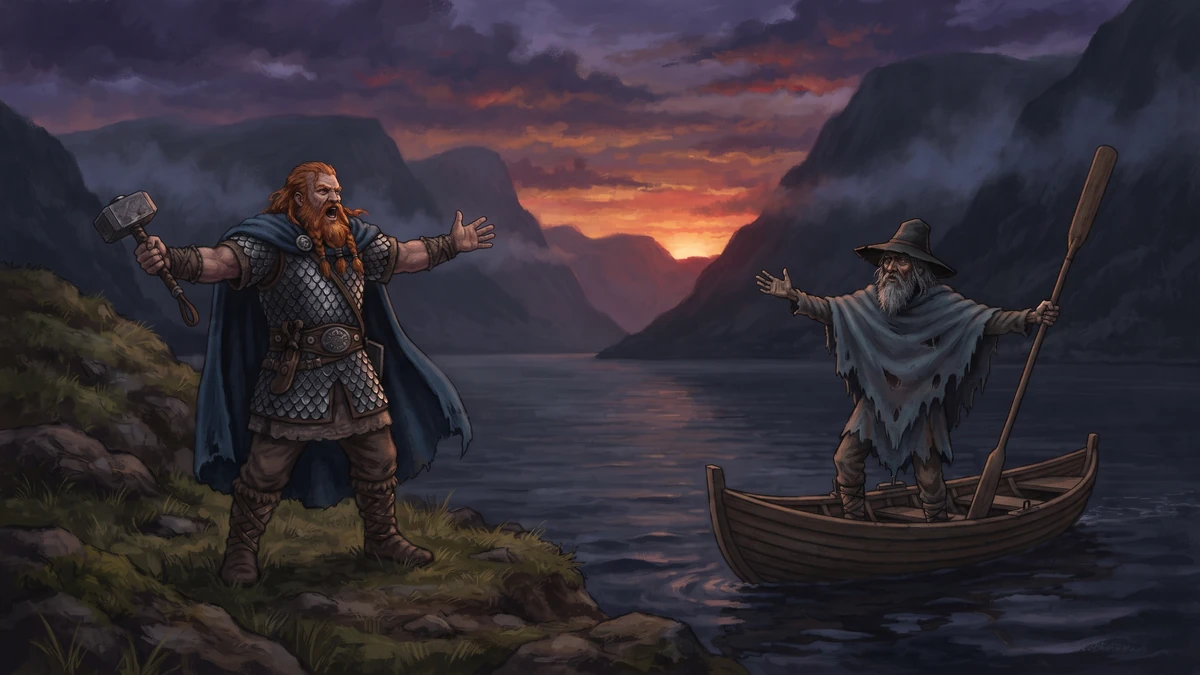
Among the poems of the Poetic Edda, the Hárbarðsljóð is one of the shortest and one of the strangest. It has no battle and no prophecy. What it has is a stubborn conversation, at the water’s edge, between the god Thor and a ferryman who refuses to carry him across. The text dates from the 13th century, but the genre it imitates, the exchange of insults, seems much older.
What the poem tells
According to the prose introduction in the manuscript, Thor was coming back from a journey to the east and reached a sound. On the other side there was a ferryman, in a small boat. Thor calls out and asks to be taken across. The ferryman answers with mockery: he says the traveller looks like a beggar, that he has neither decent clothes nor food, and that who he is does not interest him. Thor states his own name and his fame. The other, who introduces himself as Hárbarðr, “Greybeard”, keeps on provoking.
The poem goes on like this, in short stanzas that alternate the speakers. Each one tells what he has done. Thor boasts of having killed giants and of having beaten troll-women who threatened men. Hárbarðr answers with other kinds of achievements: he speaks of wars, of tricks and of love affairs, and hints that he knows more of the world than the god standing in front of him. In the end the ferryman tells Thor to go on foot, by the longer road, and the crossing never happens.
Who Hárbarðr is
The poem does not say outright that the ferryman is Odin, but many scholars identify him so. There are reasons for it. “Hárbarðr” appears in other sources as one of the names of Odin, the god who likes disguises and words. Moreover, the achievements the ferryman recounts, of wars, cunning and seduction, fit what is said of Odin in other texts. Thor, for his part, is in the sources the direct, strong and not very patient god, which makes the scene funny.
Some read the text as a parody, in which the poet enjoys the difference between two kinds of god, the warrior and the scheming sage. Others see a memory of real verbal contests, the so-called senna, in which two men traded insults in verse in front of an audience. The question is still debated, and the lack of a clear conclusion in the poem leaves the reader free to choose.
A poem hard to date
The Hárbarðsljóð survives in the Codex Regius and in a fragment of another manuscript, AM 748. The poem itself may be older than the manuscripts, but we do not know by how much. Some scholars see it as the work of a Christian poet who mocked old gods; others, as a text closer to pagan culture. Both readings have defenders, and neither convinces everyone.
Nor is it known for sure how the poem was recited. The stanzas vary in length, the rhythm changes often, and some passages look like rhymed prose. This shows that it belongs to an oral tradition, where form and content adjusted to each performance. What reached us is only a written record, made centuries later.
What remains
The interest of the Hárbarðsljóð lies in its tone. The Norse gods appear here as characters who argue, boast and tease each other, far from the solemn tone often associated with mythology. For those who study the subject, the poem shows that humour was also part of these narratives, and that the image of the thunder god as a simple, almost naive figure already existed in medieval sources.
To carry, step by step, Thor’s load across the strait, respecting what fits in the boat and what cannot be left alone on the shore, play Hárbarðr’s boat.
Sources.
- *Poetic Edda*, *Hárbarðsljóð* (Codex Regius, c. 1270, and fragment AM 748 I 4to)
- Carolyne Larrington (trans.), *The Poetic Edda* (Oxford World's Classics, 1996)
- Rudolf Simek, *Dictionary of Northern Mythology* (D. S. Brewer, 1993), entries "Hárbarðr" and "Þórr"