Kullervo: the young slave of the *Kalevala* who turned wolves into a herd
Among the heroes of the *Kalevala*, Kullervo is the most tragic. See how the poem presents him, what is known of the story's origins and what it inspired later.
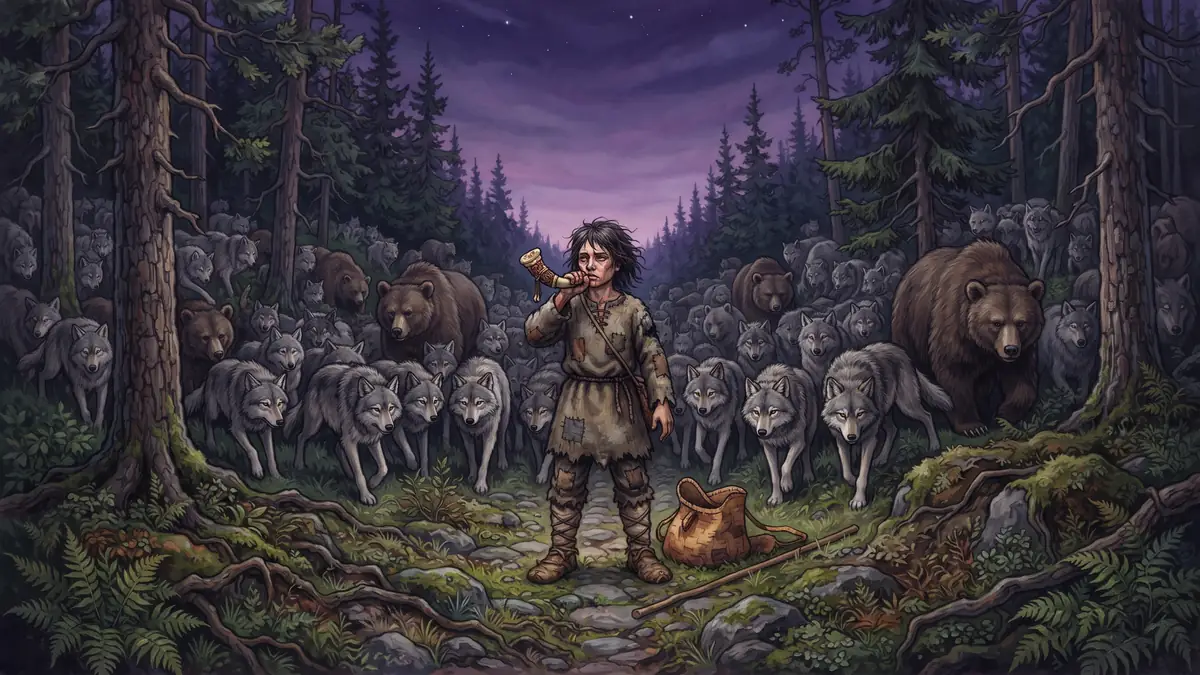
The Kalevala, the national epic of Finland, gathers folk songs collected in the 19th century by Elias Lönnrot. Almost all the heroes of the book win their challenges by magic, by words or by cunning. Kullervo is different. He is born marked by violence, is treated as a slave and grows up full of rancour, and his story, in runos 31 to 36, is one of the darkest of the whole work.
A boy born of revenge
The poem tells that the chief Untamo, at war with his brother Kalervo, destroyed the latter’s family. Only a pregnant woman survived, and it was she who gave birth to Kullervo, while living as a servant in Untamo’s house. From infancy the boy showed a strange strength, and so his uncles tried to get rid of him several times. According to the text, he was thrown into fire and into the sea and survived, as if nothing had happened.
Tired of him, Untamo sold him as a slave to the smith Ilmarinen. The poem treats this moment with the coldness proper to an oral song, without explaining much, and what remains is the feeling that the boy has no place in the world.
The herd and the bread with a stone
In Ilmarinen’s house, the smith’s wife makes Kullervo a herdsman. She mistreats the boy, gives him little food and, one day, bakes a loaf with a stone inside, for him to bite. When Kullervo strikes the bread with his knife, the knife breaks. It was the only memento he had of his father. The anger transforms the young man.
Instead of protecting the herd, he calls wolves and bears and makes them look like cows. When the woman comes to milk the animals, the beasts kill her. The scene is famous for its mixture of irony and violence, and it is for this that Kullervo became known as the herdsman who avenged the mistreatment.
The flight and the end
After this, Kullervo flees and meets his family again, which had survived, but he does not fit in. Later, he has an encounter with a young woman whom he does not know to be his sister, and the discovery leads to new tragedy. The poem continues with the revenge against Untamo and ends with the death of Kullervo himself, who chooses the end rather than go on living with what he has done.
The Kalevala is, in general, a book of extraordinary deeds, but this song recalls that the old stories also dealt with violence, guilt and fate. Scholars observe that the figure of Kullervo brings together motifs from several folk songs and that Lönnrot stitched them into a single story.
The influence
The story inspired works in several fields. The composer Jean Sibelius wrote a choral symphony called Kullervo, premiered in 1892. The painter Akseli Gallen-Kallela depicted the young man in famous paintings, and the writer J. R. R. Tolkien, as a young man, wrote a prose version, which later served as the basis for the story of Túrin Turambar. This shows how such a dark narrative could enter the imagination of later generations.
To lead into the pen, running around them, the animals of the herd before night falls, without letting them escape into the forest, play Kullervo’s flock.
Sources.
- Elias Lönnrot, *Kalevala* (1849), trans. Keith Bosley (Oxford University Press, 1989), runos 31 to 36
- Lauri Honko (ed.), *The Kalevala and the World's Traditional Epics* (Finnish Literature Society, 2002)
- J. R. R. Tolkien, *The Story of Kullervo*, ed. Verlyn Flieger (HarperCollins, 2010)