The man who was to mind the house: the Norwegian tale of the cow on the roof
A husband thinks his wife's work is easy and swaps places with her for a day. The result is one of the funniest folk tales collected by Asbjørnsen and Moe.
Among the tales that Peter Christen Asbjørnsen and Jørgen Moe collected in 19th-century Norway, there is one that still makes people smile: that of the man who thought that minding the house was easier than working in the field. It is a short story, with a quick pace, and it shows well the taste of folk tales for exaggerated situations and for a final lesson without a sermon.
The story
The tale begins with a peasant coming back from work, in a bad mood, who complains about his wife. He says she does nothing useful, while he suffers in the field. The wife proposes that the next day they swap roles: he stays at home, and she goes to the field. He accepts, convinced that it will be easy.
In the morning, he decides to make butter. Hardly has he begun churning the cream when he remembers that he is thirsty and goes down to the cellar to fill a mug with beer. Meanwhile, the pig, which was loose, comes into the house and knocks over the pail of cream. When the husband returns, the butter is spread on the floor, and the pig is already gone.
One disaster after another
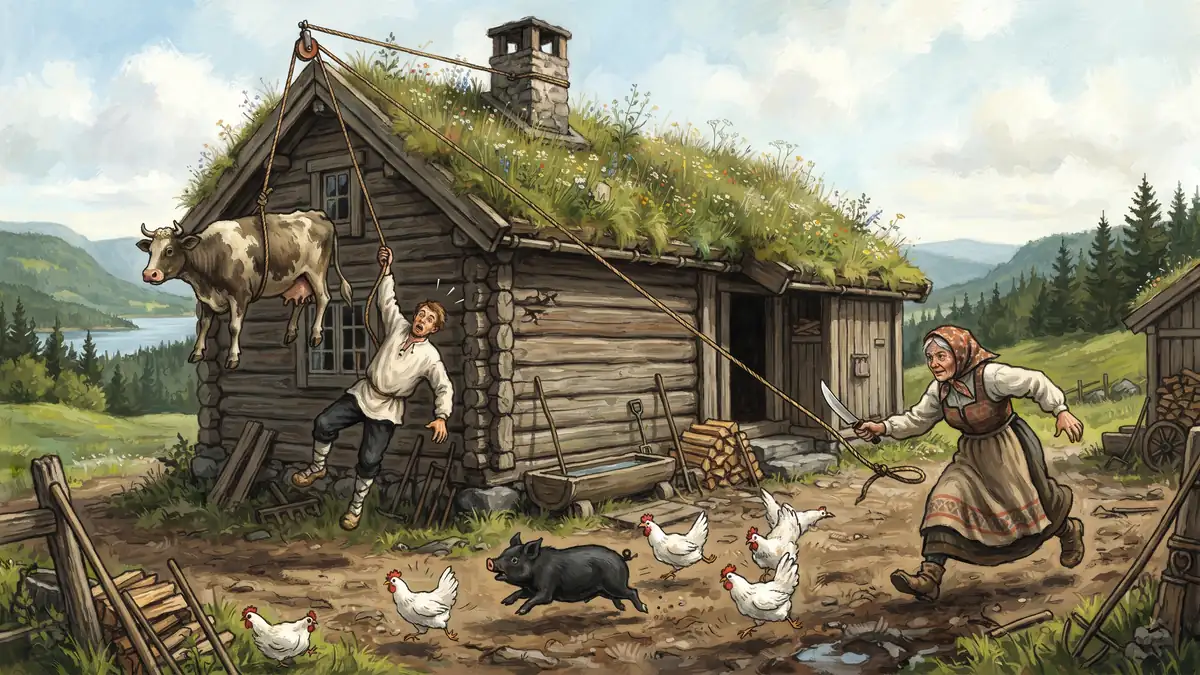
He tries to tidy up, but sees that the cow has not yet been taken to pasture. As the house has a grass-covered roof, he decides to put the cow up there, so that she can graze while he cooks the porridge. With great effort, he takes the animal to the top and ties a rope around her neck. So as not to lose sight of the cow, he passes the rope down the chimney and fastens the end to his own leg.
The cow suddenly slips from the roof and is left hanging on one side of the house. The man is pulled up and ends up dangling upside down, inside the chimney. That is how his wife found him, on coming back from the field: the cow stuck on one side, and the husband on the other.
The ending
She cuts the rope with a knife, and the husband falls headfirst into the pot of porridge that was on the fire. The wife, instead of quarrelling, laughs, and from that day on, says the tale, nobody complained any more about what the other did.
The lesson is simple and deliberately light. Each person knows their own work well, and it is easy to think the other’s is simpler than it is. The narrators make no speech at all, and let the scene itself play the role of the moral.
A story that travelled
This type of tale appears in many places in Europe. The international catalogue of folk tales organised by Aarne, Thompson and Uther classifies it as type 1408, “the man who does his wife’s work”. There are versions in varied languages and regions, with different details. In some, the character uses other animals, and in others the punishment is harsher.
The Norwegian version became known outside the country thanks to the translation by George Webbe Dasent, published in 1859 in English, with the title “The Husband Who Was to Mind the House”. This translation helped to spread the tales of Norway among English-language readers.
What it shows
The tale is a good example of the situational humour that folk tales like. Nothing needs to be explained: it is enough to see the man stuck in the chimney and the cow hanging. This helps to understand why stories like this survived so long aloud, before being written down.
To catch in the basket the chores of the house that fall from the roof, and dodge what only gets in the way, such as the pig, play The man and the housework.
Sources.
- Peter Christen Asbjørnsen and Jørgen Moe, *Norske Folkeeventyr* (1841 to 1844), tale "Mannen som skulle stelle hjemme"
- George Webbe Dasent (trans.), *Popular Tales from the Norse* (Edmonston & Douglas, 1859), "The Husband Who Was to Mind the House"
- Hans-Jörg Uther, *The Types of International Folktales*, FF Communications 284 to 286 (Academia Scientiarum Fennica, 2004), type 1408