Peer Gynt and the Mountain King: from folk tale to Ibsen's stage
Peer Gynt began as a figure of Norwegian tales and legends, before gaining Ibsen's drama and Grieg's music. See what is known of the sources and what was invention.
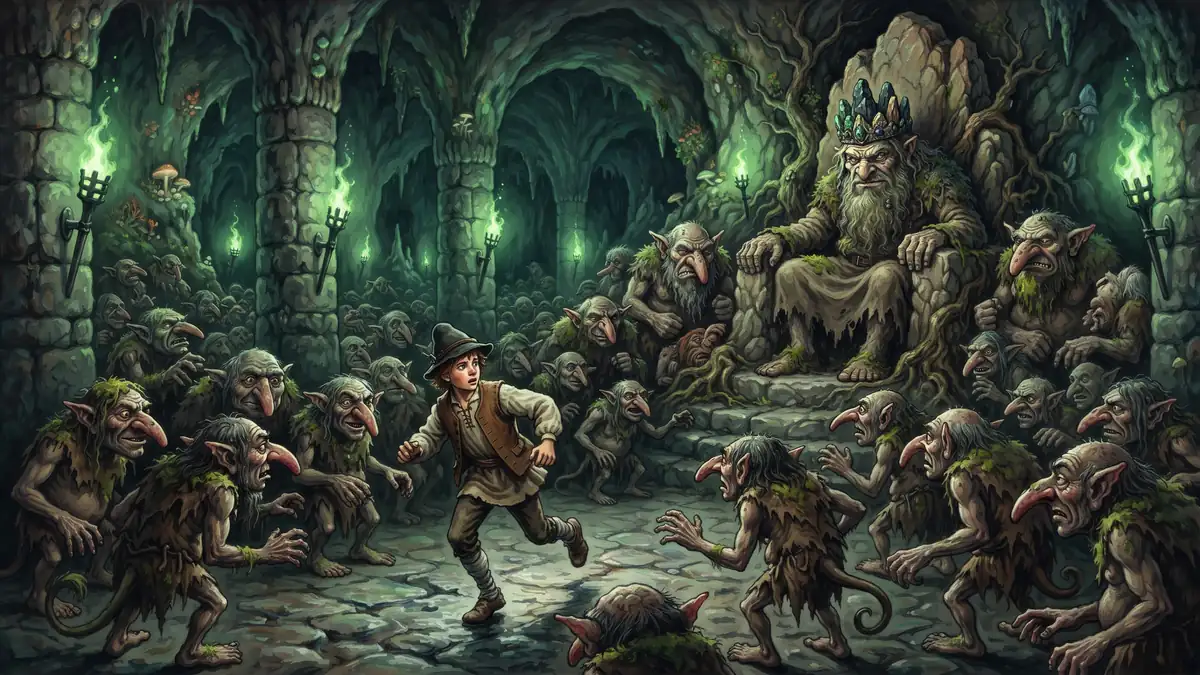
Few Norwegian characters have crossed as many centuries of storytelling as Peer Gynt. Many people know him from Henrik Ibsen’s dramatic poem of 1867, or from the music that Edvard Grieg composed for the play, in 1875. But before the stage, Peer Gynt was already a figure of tales and legends, linked to the mountains of inland Norway, and his case is a good example of how oral tradition and literature feed each other.
The Peer Gynt of the tales
In the 19th century, the folklorist Peter Christen Asbjørnsen collected legends and folk stories from Norway and published them in Norske Huldre-Eventyr og Folkesagn, between 1845 and 1848. In its pages, Peer Gynt is a reindeer hunter from the valley of Gudbrandsdalen, known for telling exaggerated stories about his deeds. According to the tradition collected, he used to say that he was capable of anything.
Among the stories there is the encounter with the Bøyg, an enormous, invisible creature that blocks the path in the fog and answers whatever is asked with a single phrase: “go around”. The Bøyg is a figure of Norwegian folklore, and its exact character varies between accounts.
The Mountain King
Dovregubben, the “old man of Dovre”, is a common character in northern traditions. He is a king of the trolls who lives in the mountains of Dovrefjell, in an underground court, and appears in the legends as lord of the trolls of the region. In Ibsen he has an important role: Peer, after being thrown out of a feast, wanders over the mountain, meets a figure in a green dress and is taken to the king’s hall, where the trolls surround him, and he can only escape when the bells of a church ring in the distance.
The hall scene, with Grieg’s music, became one of the best known in the orchestral repertoire. The melody, which begins low and speeds up, evokes the movement of a chase. It is worth remembering that Grieg composed the music for the stage, and that the scene does not appear with the same details in the folk tales.
What is Ibsen’s and what is the people’s
Ibsen wrote Peer Gynt in a few months, in Italy, and the play is, in good part, a personal work. He used the name and the tone of the tales, but invented a large part of the plot, which takes the protagonist to Morocco, to Egypt and back to Norway. The Peer of the play is a dreamy and selfish young man who discovers, at the end, what his life has been. Critics usually see in this figure an ironic portrait of the national character, but it is an interpretation that is still discussed.
Historians also debate whether there was a real person who gave rise to the stories. Some local traditions speak of a man called Per Gynt, who would have lived in the 18th century. Research has not reached a firm conclusion.
The value of the story
The case of Peer Gynt shows how a character changes as it passes from hand to hand. From the exaggerating hunter of the tale, he became a symbol of dreaming and self-deception, and the hall of the mountain king remained one of the strongest images of Norwegian culture.
To run from one side of the mountain king’s hall to the other, switching lanes to dodge the trolls that advance, play The Mountain King’s hall.
Sources.
- Peter Christen Asbjørnsen, *Norske Huldre-Eventyr og Folkesagn* (1845 to 1848)
- Henrik Ibsen, *Peer Gynt* (1867)
- Michael Meyer, *Ibsen: A Biography* (Doubleday, 1971)