The conversion of Iceland: the pagan chief who settled the question lying under a cloak
In the year 1000, according to Ari the Wise, Iceland was on the brink of splitting into two laws. The one who decided was a pagan chief, the lawspeaker, after spending a day and a night lying under his cloak. See the account.
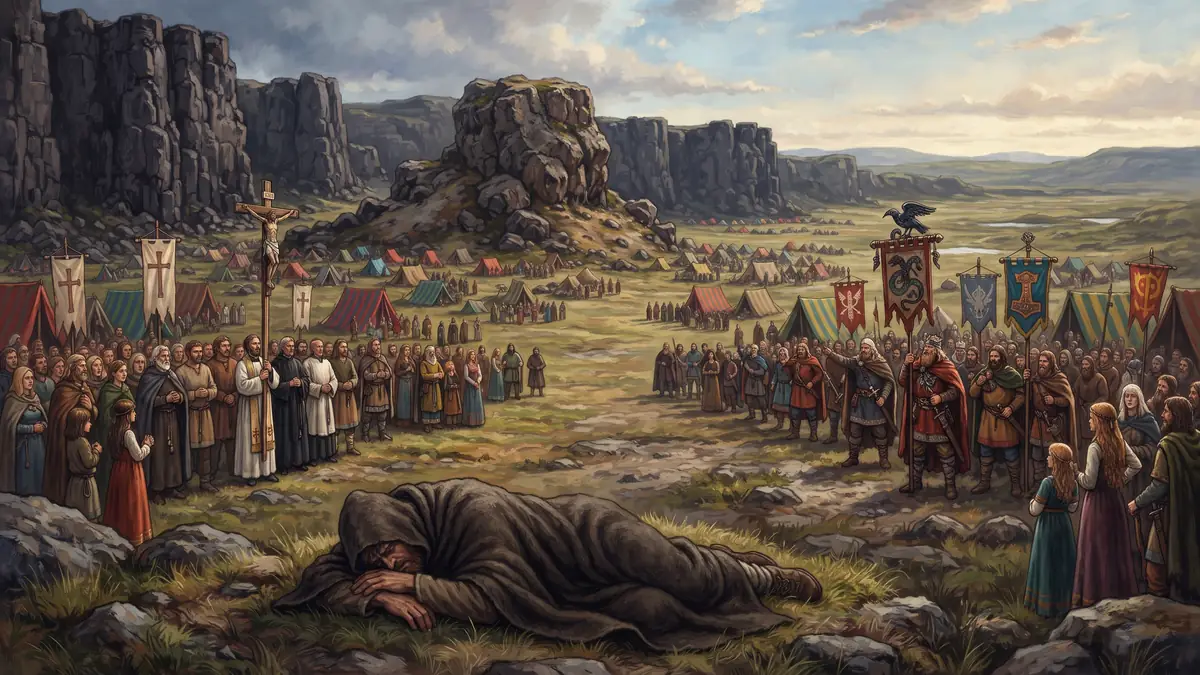
Few decisions in Norse history are as well recorded as Iceland’s conversion to Christianity, taken at the Althing, the national assembly, around the year 1000. The main account comes from a short book, the Íslendingabók, written a few generations later by Ari Þorgilsson the Wise, an Icelandic priest. Ari tells the story soberly, and for that reason it is one of the sources historians use most.
A country about to split
According to Ari, Iceland already had Christians and pagans, and both gathered every year at the Althing, at Thingvellir. The Norwegian king Olaf Tryggvason, a Christian, had been pressing the Icelanders to accept the new religion. That summer the two sides arrived at the assembly ready for confrontation. The Christians and the pagans declared that each group would have its own law, and Ari says that the risk was war.
There was a concrete problem: the country worked under a common law. The two groups needed an arbiter. A Christian chief, Síðu-Hallr, reached an agreement with the lawspeaker, Þorgeirr Ljósvetningagoði, that he would proclaim what the law should be.
Under the cloak
What makes the scene famous is that Þorgeirr was a pagan. According to Ari, he lay down on the ground and covered himself with his cloak. He stayed like that for a whole day and the following night, without saying a word. Then he called everyone to the Law Rock and spoke: if the law were divided, peace would be divided. He said that everyone should have one law and one faith.
The decision was that all Icelanders would be baptised and be Christians. However, sacrifice to the old gods could continue in private, as long as no one witnessed it. Ari adds that some old practices, such as eating horse meat and exposing newborn children, would remain permitted for some time.
What is history and what is legend
Ari’s passage is the closest source. There are later versions, such as the Kristni saga, that add details. A very well known tradition says that, on his way home, Þorgeirr threw images of the gods into a waterfall, which came to be called Goðafoss, the “waterfall of the gods”. That story seems late and does not appear in Ari. The name of the waterfall itself is probably older than the narrative.
What remains
The scene shows an unusual way of deciding: a country without a king settles a religious conflict by means of an arbiter, a law and an agreement. It also shows that the conversion was gradual. The new creed was officially imposed, but old customs remained for some time. Ari wrote as a Christian priest, so the account has a point of view. Historians read it carefully, comparing it with other sources.
To move, one by one, four blocks between three pillars, never putting a larger block on a smaller one, as in a decision that demands order, play The four blocks.
Sources.
- Ari Þorgilsson, *Íslendingabók* (c. 1122–1133), chapter 7
- Jón Hnefill Aðalsteinsson, *Under the Cloak: The Acceptance of Christianity in Iceland* (Uppsala, 1978)
- Jesse Byock, *Viking Age Iceland* (Penguin, 2001)