Gylfaginning: King Gylfi, disguised as Gangleri, asks questions in a palace that vanishes
The first part of Snorri Sturluson's *Prose Edda* uses the story of a Swedish king who visits Asgard in disguise to tell Norse mythology as questions and answers. See how the book is built.
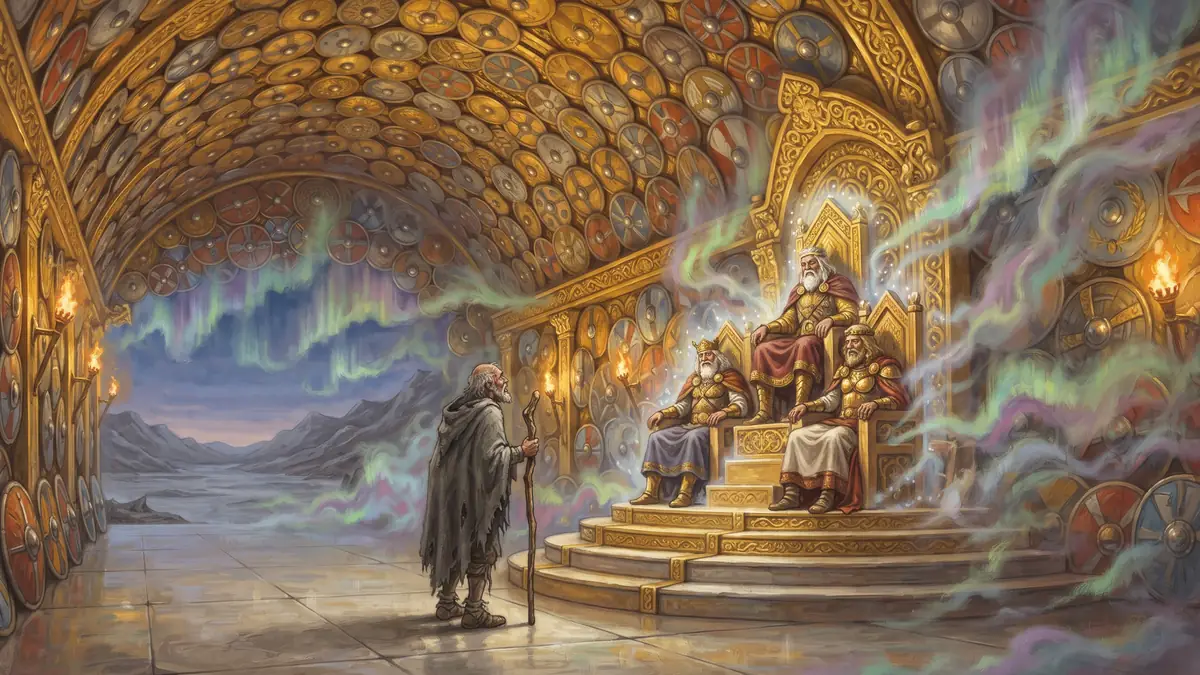
The Gylfaginning, “the deluding of Gylfi”, is the first part of the Prose Edda, a work attributed to the Icelander Snorri Sturluson and written in the 13th century. Almost everything that is told today about the Norse gods in an organised form, such as the creation of the world, the tree Yggdrasil and Ragnarök, comes from books like this one. But what makes the text special is the way it was put together: as a conversation.
The frame of the story
According to the prologue of the section, Gylfi was king of the land now called Sweden. A woman of the Æsir, the gods, deceived him in some way, and the king became curious: what kind of people were these, so powerful that they changed the world with magic? He decided to travel to Asgard, the home of the gods, and disguised himself as an old man. The gods, however, foresaw his arrival and prepared an illusion.
Gylfi arrives at an enormous palace. A man at the door asks his name, and he answers that he is called Gangleri. Inside the hall he finds three men seated on thrones, one above the other: Hár, “the High One”, Jafnhár, “Just-As-High”, and Þriði, “the Third”. Many scholars suppose that they are disguises of Odin, although the text never says so.
Questions and answers
Most of the work is a series of questions from Gangleri and answers from the three. They tell how the world was created from the clash of ice and fire, describe the nine worlds, speak of the gods and their families, relate myths such as Thor’s fishing for the serpent, and end with Ragnarök, the end of the world and its rebirth. For the answers, Snorri used poems of the Poetic Edda, which he quotes often, and other traditions he may have known.
This format has an advantage. With each answer the reader has the impression of learning something together with the visitor. And since each question comes from an outside character, the text can explain things that the original listeners perhaps already knew.
The ending
At the end of the book, when Gangleri has finished listening, a great noise is heard. The palace and all the people vanish, and Gylfi finds himself alone on an empty plain. He goes home and tells what he has heard. The reader understands that the hall was an illusion prepared by the gods, and the title of the section, “the deluding of Gylfi”, makes sense.
What remains
When reading the Gylfaginning one must remember that Snorri was a Christian writing about two centuries after the end of the Viking Age. He uses the frame of the illusion as a way of presenting this mythology without saying that it is true: what is told is what the “gods” said to a deceived king. This helps to understand why a Christian author could preserve so many pagan stories. For research the book is one of our main sources, but also a literary work, with the author’s own choices.
To knock down, with a ball and a paddle, the bricks of the hall that dissolves before King Gylfi, play Gylfi’s hall.
Sources.
- Snorri Sturluson, *Prose Edda*, *Gylfaginning* (13th century; manuscripts: Codex Regius GKS 2367 4to, Codex Wormianus, Codex Upsaliensis)
- Jesse Byock (transl.), *The Prose Edda* (Penguin Classics, 2005)
- Rudolf Simek, *Dictionary of Northern Mythology* (D. S. Brewer, 1993), entries "Gylfi", "Gangleri" and "Snorra Edda"