Maeshowe: the five-thousand-year-old tomb where Norsemen wrote on the walls
In Orkney, a Neolithic burial chamber holds one of the largest collections of Norse runes in Europe. They were graffiti written in the 12th century by men who sheltered there. See what they say and what they do not.
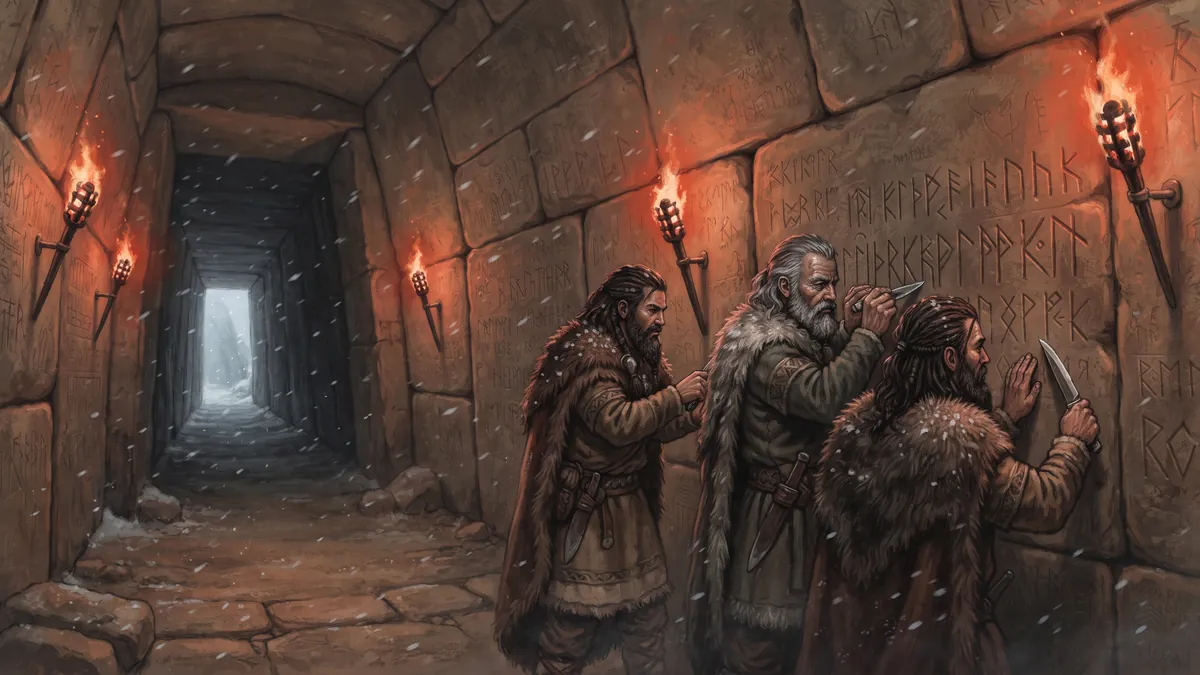
Maeshowe is a stone burial chamber, covered by a great mound of earth, on Mainland, the largest island of Orkney, in the north of Scotland. It was built about five thousand years ago, in the Stone Age, by a people who lived centuries before the Vikings. And yet the monument is famous because of the Norse: on its walls there is one of the largest collections of runic inscriptions in Europe.
A chamber opened by Vikings
The tomb was found empty by modern researchers. In 1861 workers opened the mound from above, entered the chamber and soon noticed runes and figures carved on the stones. The inscriptions are graffiti: they were made with the point of a knife or a sharp tool, not by a professional craftsman. There are about thirty, by the number usually quoted. From the shape of the letters, scholars date them between 1125 and 1175, in the 12th century, that is, at the end of the period usually called the Viking Age.
What the inscriptions say
The texts are short and mostly quite personal. One rune records that “Jerusalem-travellers broke into Orkahaugr”. That is important: the “Jerusalem-travellers” were pilgrims or crusaders who had gone to the Holy Land, and the name Orkahaugr is the Norse name of the mound. Another inscription says that a treasure was carried off from there over the course of three nights. There is also a sentence that became famous: “Ingibjorg, the fair widow. Many a woman has gone stooping in here.” Scholars debate whether it is a mocking comment, a joke, a reference to the low entrance passage or something similar. Some runes are just signatures.
The link with the Orkneyinga saga
The tomb also appears in the Orkneyinga saga, written around 1200. The saga tells that in 1153 men of Earl Harald took shelter from a storm in a mound called Orkahaugr. Two of them supposedly went mad inside. Scholars compare this with the runes and with the description of the monument and conclude that the saga refers to Maeshowe. It would be the most likely occasion for part of the inscriptions, although it cannot be proved that all of them were made on that same night.
What we do not know
It is not known whether the treasure the runes speak of really existed, nor what was taken. When the Norse entered, the tomb perhaps had already been emptied of its bones and objects, because the ancient peoples of Orkney may have removed the remains for ritual reasons. Nor is it known who the authors were. They may have been soldiers, fishermen or local travellers, people who could read and write runes, something quite widespread in the Norse world.
What remains
Maeshowe is a place where two ages separated by millennia meet. For the Norse of the 12th century it was a mysterious mound, tied to stories of treasure and hauntings. For us it is a rare direct record of ordinary people writing by hand, in a joking tone, about what interested them.
To decode, by guesses and clues, a secret sequence of four runes, play The chamber of Maeshowe.
Sources.
- Orkneyinga saga (c. 1200), transl. Hermann Pálsson and Paul Edwards (Penguin Classics, 1978), episode of 1153
- Michael P. Barnes, *The Runic Inscriptions of Maeshowe, Orkney* (Uppsala, 1994)
- Historic Environment Scotland, *Maeshowe Chambered Cairn*, official monument guide