Sigrdrífumál: the valkyrie who woke up and taught Sigurd the runes
In the *Sigrdrífumál*, Sigurd wakes a sleeping valkyrie, and she gives him a drinking horn and a list of runes and advice. See what the poem says and why the text reached us in such disorder.
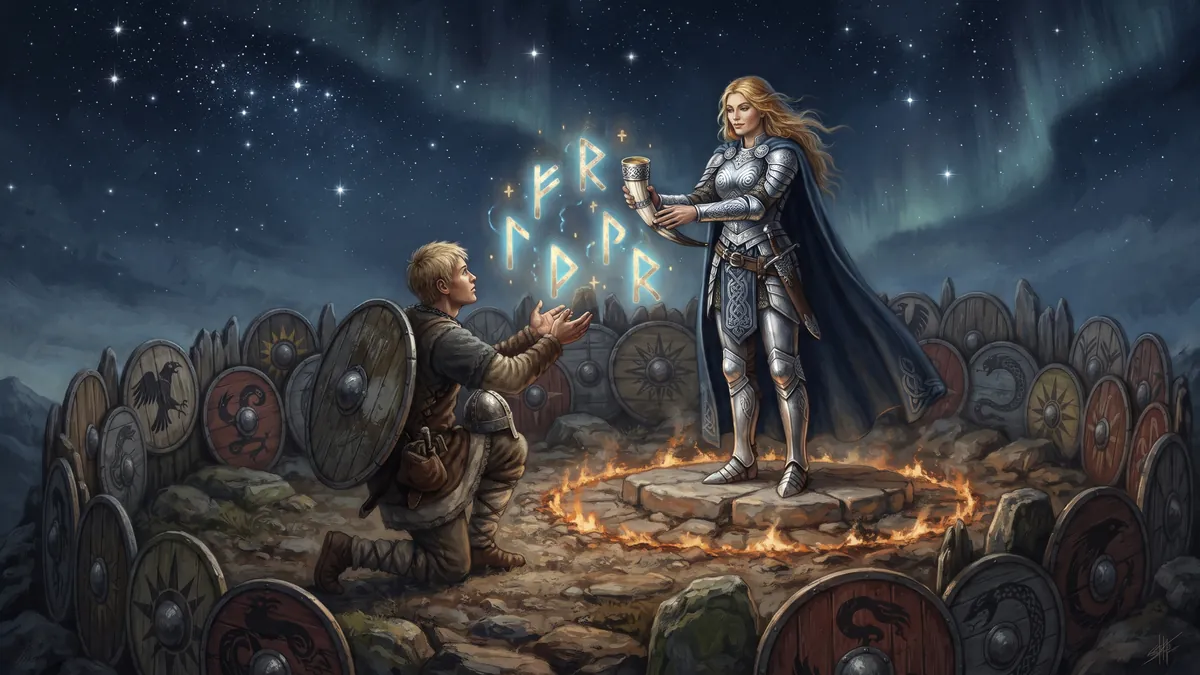
The Sigrdrífumál is one of the most curious poems of the Poetic Edda. It gathers, in loose stanzas, prayers, lists of runes and advice for life. That is also why it is one of the most disordered. Even so, it keeps one of the few passages in Norse literature in which someone speaks directly to the gods, as in a prayer.
The scene of the awakening
In the manuscript the poem comes right after the Fáfnismál, and the continuity is so great that there is almost no break. In the prose introduction, Sigurd, who has just killed the dragon Fáfnir, climbs a mountain and finds a structure ringed with shields. Inside lies a figure in armour, asleep. When he cuts the armour open, the woman wakes. She gives her name as Sigrdrífa, which means roughly “she who drives to victory”. Many scholars think this name is really an epithet of the valkyrie Brynhildr, and that the text ended up treating it as a proper name.
The first thing she does is greet the day, the night and the earth. The stanza is one of the rare surviving direct invocations and is sometimes called a “pagan prayer”. Then she gives Sigurd a horn with a drink of memory, so that he will not forget what he is about to learn.
The runes and the advice
The core of the poem is the list of runes. The valkyrie mentions victory runes, which are to be carved on the sword hilt and accompanied by the name of the god Týr, and runes of ale, of childbirth, of waves, of branches, of speech and of thought. Each kind has a function and a way of being used. The poem also says that the runes were discovered by Odin and then shared among the gods, the elves, the Vanir and humans.
After that comes a series of pieces of advice, numbered one to eleven, similar to those of another poem, the Loddfáfnismál. They deal with how to act regarding oaths, enemies, the dead and bad companions. Many scholars think this part was added later and has no connection with the scene at the beginning.
A disordered text
The Codex Regius ends this poem abruptly, in the middle of stanza 29, because part of the manuscript was lost, the so-called Great Lacuna. The final verses exist only in paper manuscripts, copied centuries later. The Völsunga saga, written in the 13th century, quotes eighteen stanzas of the poem, which shows that its author knew a version similar to the one we have. Even so, the poem seems to be a compilation of originally independent parts, and nobody knows for certain when they were put together.
What remains
For those who study Norse religion, the Sigrdrífumál is valuable because it shows the rune as more than a letter: an instrument of power, tied to rituals, objects and words. But care is needed. The poem is late, mutilated and mixes periods. It shows what medieval Icelandic poets imagined about runes, not necessarily what was done in the Viking Age.
To reveal, cell by cell, a rune hidden in a grid, following the clues for each row and column, play Sigrdrífa’s rune.
Sources.
- *Poetic Edda*, *Sigrdrífumál* (Codex Regius, c. 1270, with a gap; final stanzas in later paper manuscripts)
- Carolyne Larrington (transl.), *The Poetic Edda* (Oxford World's Classics, 1996)
- Rudolf Simek, *Dictionary of Northern Mythology* (D. S. Brewer, 1993), entries "Sigrdrífa" and "Runen"