Aino, in the Kalevala: the young woman promised to Väinämöinen who chose the sea
In the *Kalevala*, Aino is the sister of Joukahainen, promised as payment to an old singer. Instead of marrying, she goes to the seashore. See what the poem says, where the name comes from and how the story became a painting.
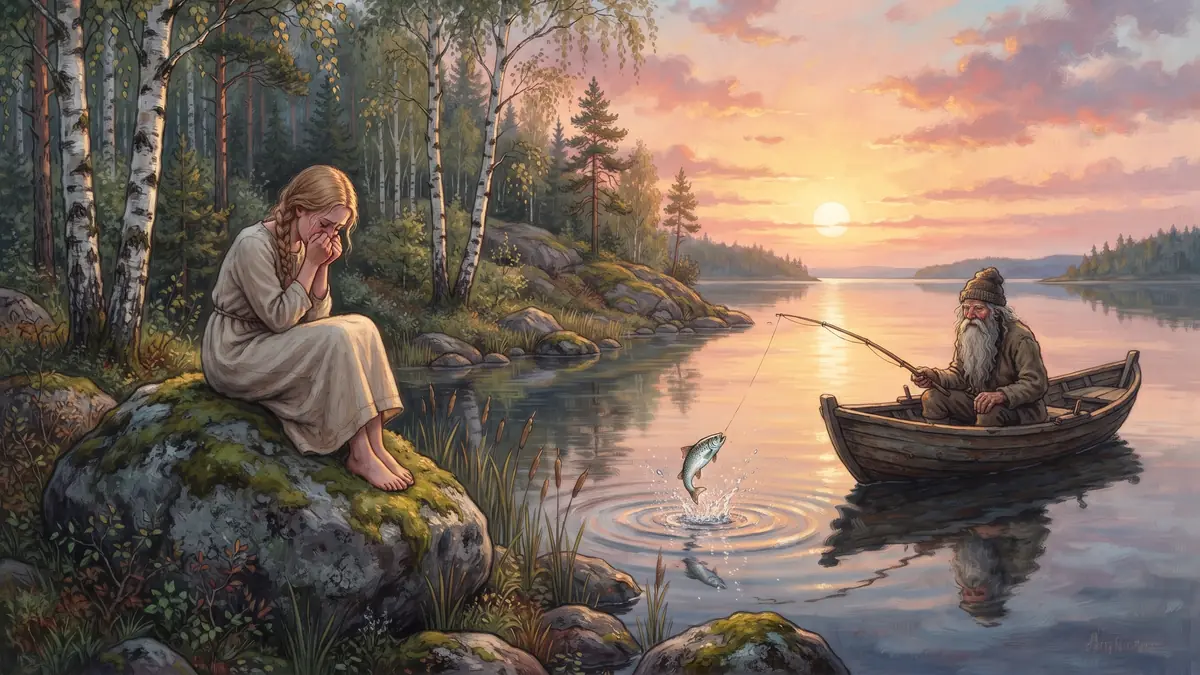
Among the characters of the Kalevala, the Finnish epic compiled by Elias Lönnrot, Aino is one of the most remembered, even though she appears in only a few verses. Her story fills the fourth canto of the poem, Runo 4, and it is one of the saddest scenes in the book.
What the poem tells
Aino is the sister of Joukahainen, the young man who challenged the old singer Väinämöinen to a singing contest and lost. As punishment, Väinämöinen made him sink into a swamp. To save himself, Joukahainen promised his sister’s hand. The mother rejoices at the idea of a famous son-in-law, but Aino does not want to marry an old man.
Aino suffers. She weeps and goes to the seashore. According to the version the tradition kept, she drowns or is turned into a creature of the waters. Later she returns in the form of a fish and taunts the old Väinämöinen, who tries to catch her. The story ends with the singer in mourning, without the bride and unable to recover what he has lost.
An invented name
The name Aino is a creation of Lönnrot, and it means “the only one”. In the folk poems that served as the basis, the girl is only “the only daughter” or “the only sister”. It was the editor who gave her a proper name and raised her to a character. After the publication of the Kalevala, the name became popular in Finland, and activists of the Finnish nationalist movement began to use it in the late 19th century. Aino Järnefelt, who would become the wife of the composer Jean Sibelius, was born in 1871.
Gallen-Kallela’s triptych
The story inspired the painter Akseli Gallen-Kallela, who in 1891 made the Aino Myth, a triptych. He used his wife, Mary, as the model. The three canvases show Aino’s first meeting with Väinämöinen in the forest, Aino weeping on the shore, and Väinämöinen fishing, when the small fish he throws away is Aino, who laughs and vanishes.
Fact and fiction
The Kalevala is not an ancient text by a single hand. Lönnrot gathered and arranged oral poems collected in Karelia and other regions, and gave them a continuous form. For that reason, the Aino we know is in part a 19th-century creation, even if it rests on older folk material.
What remains
Aino’s story is one of the first in the Kalevala to deal with a woman who refuses to obey the adults, and the price of that gesture is high. It has been read in many ways: as a tale of refusal, as national allegory, as family tragedy. The sea and the fish make her a figure of the border, between the human world and that of the waters.
To jump, from stone to stone, across a board of fifteen stones on the lake, until only one is left, play The stones of the lake.
Sources.
- Elias Lönnrot, *Kalevala* (1835, old edition; 1849, final edition), Runo 4
- Wikipedia (English), "Aino (mythology)", with references to the painting by Akseli Gallen-Kallela
- Akseli Gallen-Kallela, *Aino Triptych* (1891)