Atlakviða: King Gunnar in the snake pit and Gudrun's revenge on Atli
The Eddic poem *Atlakviða*, the "Poem of Atli", tells how the king of the Huns lures the brothers of his wife Gudrun into a trap over a treasure. See what the text says and how it links to the *Nibelungenlied*.
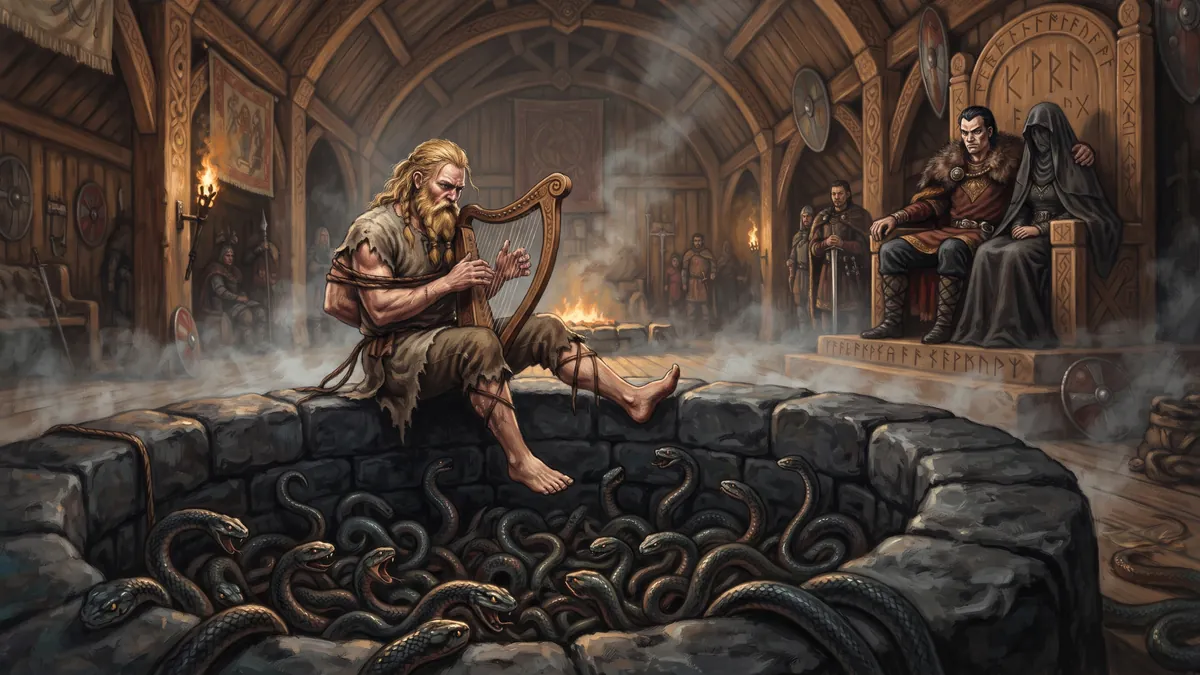
Few scenes in Old Norse literature are as harsh as that of the snake pit. It comes from the Atlakviða, the “Poem of Atli”, one of the heroic poems of the Poetic Edda. Its subject is a massacre among kinsmen, and for that reason the poem is read as one of the rawest stories of the tradition.
What the poem tells
Atli, the king of the Huns, is the villain. The Norse name recalls Attila, the historical chieftain, although the figure in the poem has little to do with the real man. Atli is married to Gudrun, whose brothers, Gunnar and Hogni, guard the treasure of the Nibelungs. According to the poem, Atli invites the two for a visit, intending to find out the secret of the gold. The brothers accept, despite warnings, and arrive at the king’s hall.
When they reveal nothing, Atli has Hogni’s heart cut out. The poem says Hogni laughs as he dies, and that Gunnar, a prisoner, answers with scorn. Then he is thrown into a snake pit and dies there. In the later tradition, as in the later Völsunga saga, Gunnar plays the harp with his toes to lull the creatures to sleep, until a viper bites him.
The revenge
Gudrun, described as “the sweet-faced one, delight of warriors”, plans her answer. According to the poem, she kills the two sons she had with Atli and serves him a feast of their hearts. Then, while the king is drunk, she stabs him and sets the hall on fire, letting only the dogs escape. The revenge is cruel, and the poem does not soften it.
Atlakviða and Atlamál
The same story appears in another Eddic poem, the Atlamál, longer and later. Scholars regard it as an expanded version, more concerned with domestic life and feelings. The Atlakviða, on the other hand, is seen as older and sharper. The two versions show how the theme circulated among poets, with variations.
A link with Germany
The interest of the story grows when it is compared with the Nibelungenlied, the German epic poem of about 1200. There the plot is similar, but Gudrun’s role is different, since she is Kriemhild and takes revenge on her own brother, Gunther, whose Norse equivalent is Gunnar. Atli corresponds to Etzel, Hogni to Hagen. The roles change, and the king of the Huns, who in the German poem is weak, is cruel in the Norse one.
What remains
For the medieval audience, the story showed the cost of betrayal inside a family, and the poem offers no comfort. It is remembered, among other things, for Gunnar, who faces death without giving up the secret of the gold, and for a revenge that wipes out an entire dynasty.
To drive away, one by one, the snakes that rise from the pit, tapping them before they bite, play The snake pit.
Sources.
- *Poetic Edda*, *Atlakviða* (Codex Regius, c. 1270)
- Encyclopaedia Britannica, "Lay of Atli"
- Henry Adams Bellows (transl.), *The Poetic Edda* (1936), "Atlakvitha en grönlenzka" and "Drap Niflunga"