Baldrs draumar: Odin rides to Hel to hear what Baldr's dreams foretell
The short poem *Baldrs draumar* tells how Odin goes down to the realm of the dead and wakes a seeress from her grave to learn why his son Baldr has nightmares. See what the text says and what is debated.
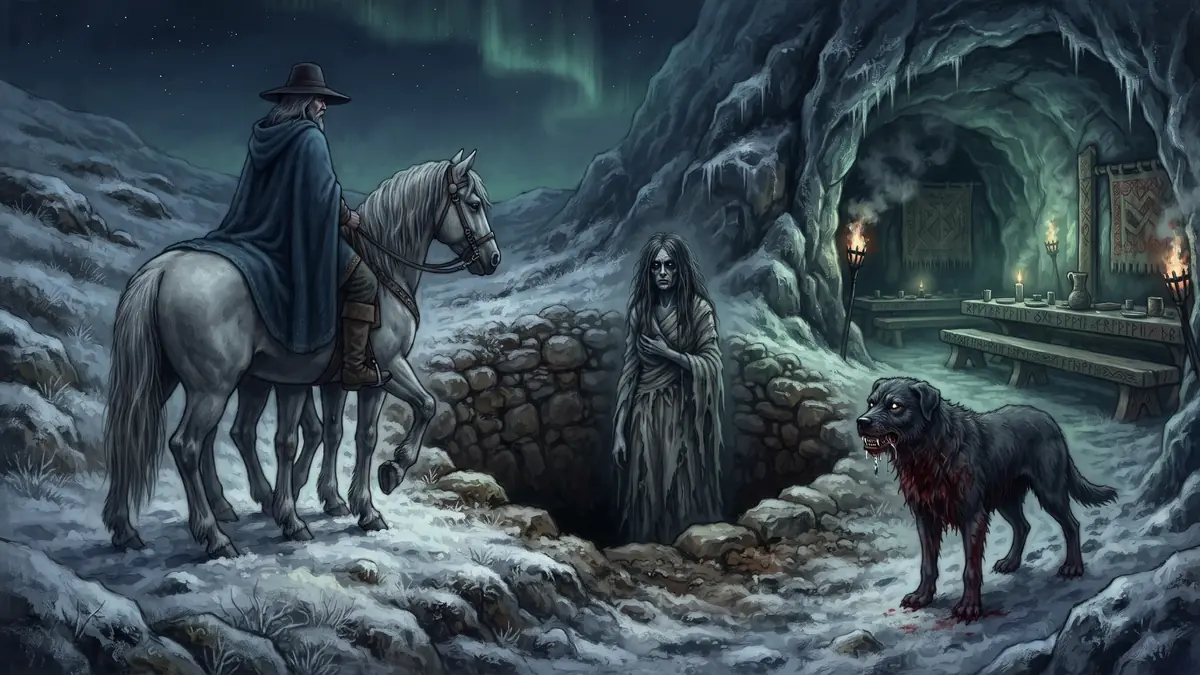
The Baldrs draumar, “Baldr’s Dreams”, is one of the shortest poems of the Eddic tradition. It has only fourteen stanzas in the form editors accept, written in the fornyrðislag metre. It also appears under the title Vegtamskviða, “Poem of Vegtamr”, because in the story Odin gives that name when speaking to the seeress. Despite its size, it is one of the texts that best show how the Norse imagined Baldr’s death before it happened.
What the poem tells
The gods gather, worried. Baldr, Odin’s best-loved son, has bad dreams, and they fear for his life. Odin decides to find out what the dreams mean. He saddles Sleipnir, his eight-legged horse, and rides down towards Hel, the realm of the dead. On the way, according to the poem, he meets a hound with a blood-stained chest, which barks at him for a long time.
Odin goes on to the house of Hel and rides round to its eastern part, where a seeress’s grave lies. He chants spells of death until the woman rises and asks who this stranger is who disturbs her. Odin answers that he is called Vegtamr, son of Valtamr, and asks for whom Hel’s hall is being prepared, with its benches covered in rings and its beds decked with gold. The seeress says the mead is ready for Baldr, with a shield laid over the drink.
Who strikes and who avenges
The seeress also says who will cause the death: Höðr, the blind god, will throw the fatal twig, and a child yet unborn, Váli, will avenge Baldr in a single night. Here the poem agrees with what Snorri tells in the Gylfaginning, and scholars see in this agreement a sign that both sources draw on the same tradition. Then Odin asks a different question, about women who weep, and the seeress realises he is not Vegtamr. She sends him away and says she will speak again only when Loki breaks free, at the end of the world.
Date and authorship
The poem survives in the manuscript AM 748 I 4to, and not in the Codex Regius. Some late paper copies add about five stanzas, which scholars consider of recent origin. Bellows suggested the poem dated from the middle of the 10th century, but admitted it might be older and that it could not be dated earlier than the 10th century. The author may have known the Völuspá, since stanza 11 recalls stanzas 32 and 33 of that poem. There is also a stanza almost identical to the first, which appears in the Þrymskviða, and one scholar proposed that the Þrymskviða borrowed it.
What remains
The poem does not show Odin winning. On the contrary, he is the god who knows everything and still cannot change what the seeress says. The scene of the grave, with the god asking advice from a dead woman, was later taken up by Richard Wagner and by a ballet by the composer Geirr Tveitt, from 1938.
To find, among face-down cards, the pairs of signs that appear in Baldr’s dreams, play Baldr’s dreams.
Sources.
- *Poetic Edda*, *Baldrs draumar* (manuscript AM 748 I 4to)
- Henry Adams Bellows (transl.), *The Poetic Edda* (1936), "Baldrs Draumar"
- Carolyne Larrington (transl.), *The Poetic Edda* (Oxford World's Classics, 1996)