The funeral of Baldr: the giantess Hyrrokkin launches the gods' greatest ship
According to the *Gylfaginning*, the gods could not launch the ship Hringhorni for Baldr's funeral and summoned a giantess riding a wolf. See what Snorri and the poets say and what is debated.
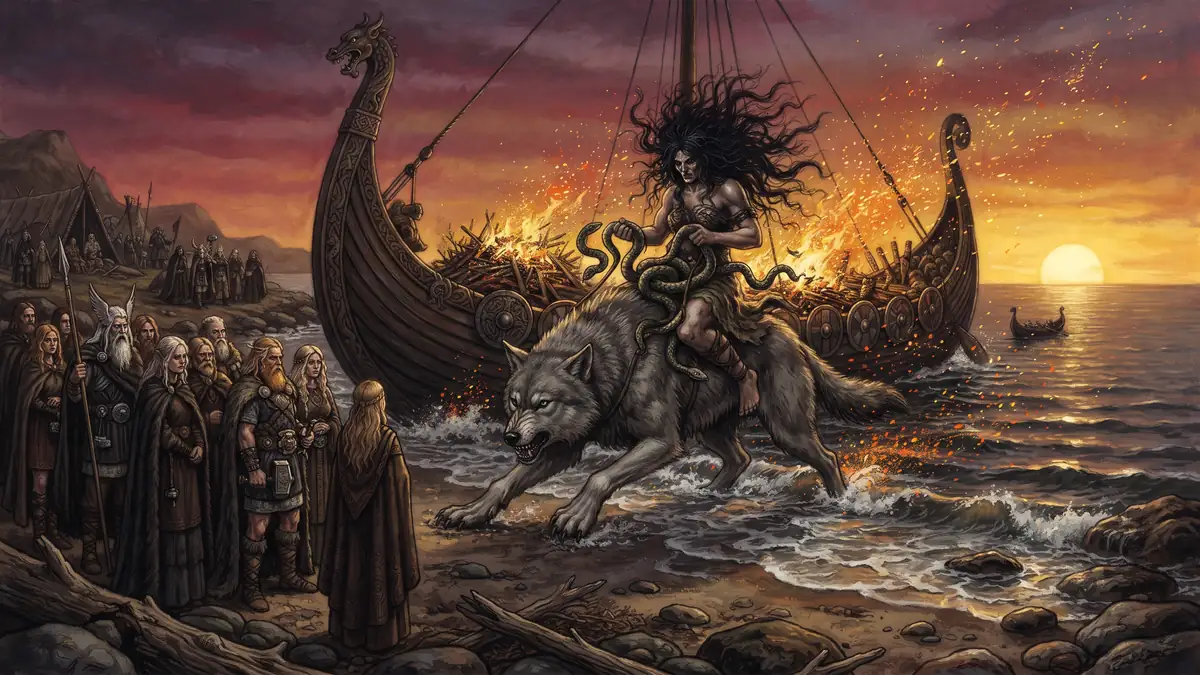
Among the many scenes of Snorri Sturluson’s Prose Edda, the funeral of Baldr is one of the most striking. After Odin’s son had been killed, the gods decided to burn him in a ship, as was done for great chieftains. And at that moment, in a short episode, a strange figure appears: the giantess Hyrrokkin.
What Snorri tells
According to the Gylfaginning, Baldr’s ship was called Hringhorni and was the largest of all. But the gods could not make it slide into the sea. So they sent to Jötunheimr for a giantess called Hyrrokkin. She arrived riding a giant wolf and using vipers as reins. When she dismounted, the animal was so strong that Odin called four berserkers to hold it. They could master it only by knocking it unconscious.
Hyrrokkin went to the prow and pushed the ship with such force that the wooden rollers caught fire and the earth shook. Thor, angered by this violent entrance, took his hammer and wanted to smash her head. The other gods asked him to spare her, and he held back. After that, Baldr’s wife, Nanna, died of grief and was laid beside him on the pyre.
Other sources
The scene does not come from Snorri alone. The poet Úlfr Uggason, who composed around the year 985 in western Iceland, describes in the Húsdrápa a giantess who makes the ship move and warriors of Odin who kill her mount. The Húsdrápa was composed to decorate a hall, and so scholars think the funeral of Baldr was a subject for painting or carving at the time. In another part of the Prose Edda, the poet Þorbjörn dísarskáld lists Hyrrokkin among the giants Thor killed at the funeral. There are also lists of troll-women’s names in which she appears.
The name
The name Hyrrokkin is debated. Jan de Vries understood it as “fire-withered” or “fire-steam”, from hyrr, “fire”, and hrokkinn, “wrinkled”. John Lindow proposed “fire-smoked”, perhaps describing a dark, shrivelled look. Andy Orchard, for his part, translated it as “fire-steamer”.
Was she shown in stone?
Some scholars, among them Neil Price, have suggested that the figure of a woman riding a wolf, with snakes as reins, on a monument at Hunnestad in Sweden might be Hyrrokkin. The identification is possible, but it is not certain.
What remains
The episode is short, but it shows something important. Even the gods needed the help of a giant for a rite of farewell, and Hyrrokkin, who comes from outside and solves the problem, gets more attention than the gods themselves. Lindow describes her as a figure of some importance in the last decades of paganism in Iceland.
To free Baldr’s ship, stuck among other pieces, and bring it out to the sea, play The ship Hringhorni.
Sources.
- Snorri Sturluson, *Prose Edda*, *Gylfaginning* (c. 1220), chapter on the death of Baldr
- Úlfr Uggason, *Húsdrápa* (c. 985), preserved in the *Prose Edda*
- John Lindow, *Norse Mythology: A Guide to the Gods, Heroes, Rituals, and Beliefs* (Oxford University Press, 2001), entry "Hyrrokkin"