Gestumblindi: disguised Odin challenges King Heiðrekr with 37 riddles
In the *Hervarar saga ok Heiðreks*, a stranger called Gestumblindi faces King Heiðrekr in a riddle contest. In the end he is Odin, and the last question no one can answer. See what the saga says and what is known of the manuscripts.
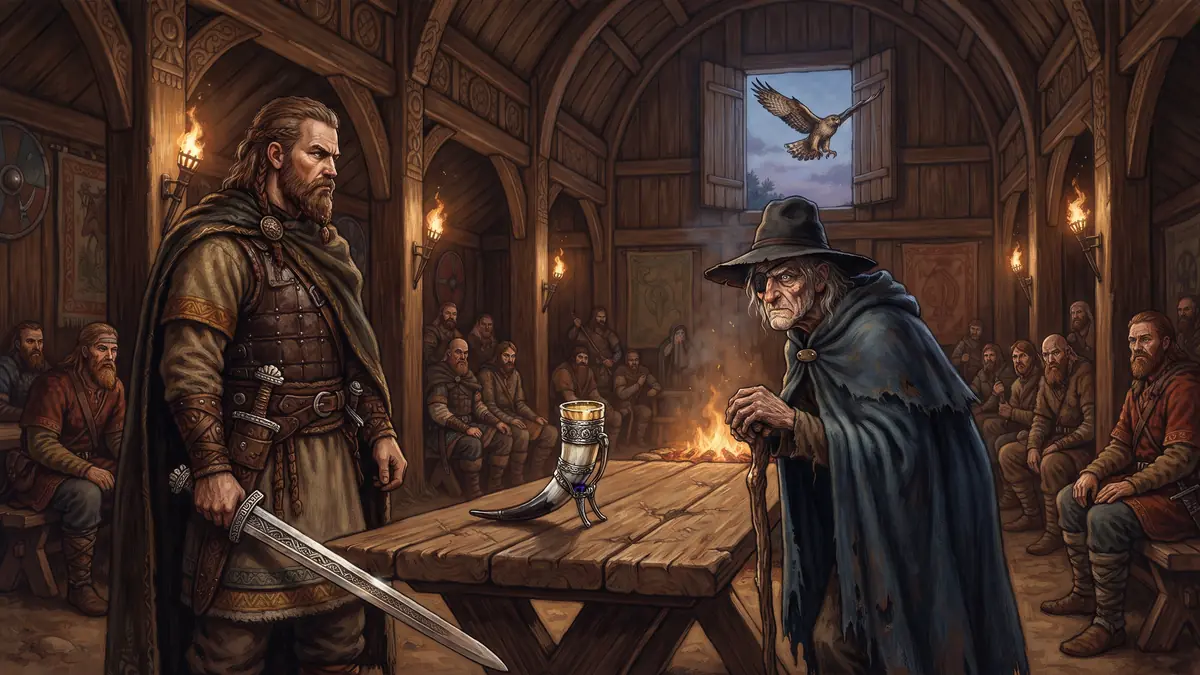
A riddle contest sounds like a light subject, but in the Norse tradition it was serious business. In the Hervarar saga ok Heiðreks, the “Saga of Hervör and King Heiðrekr”, the game of questions is a matter of life and death. The saga dates from the 13th century, and the riddles, which total about thirty-seven, are the largest collection of this genre that survives from medieval Scandinavia.
The king and the stranger
Heiðrekr is king of Reiðgotaland. According to the saga, he had a violent youth but became a wise ruler, and twelve of his men give just judgements. There is a curious rule: an accused man can escape punishment if he poses riddles the king cannot solve. A man called Gestumblindi, who has offended the king, is ordered to make peace or lose his life. In trouble, he makes a sacrifice to Odin.
A stranger then appears. The two exchange clothes, and the stranger, who is Odin, presents himself as Gestumblindi. The man who was disguised goes into hiding.
The contest
The false Gestumblindi poses riddle after riddle, and the king answers them all. The answers, according to the saga, range from ordinary things to strange ones, such as ale, dew, fire, a swan, a hammer and a spider. One riddle describes a dead snake on a drifting block of ice. Another, number 36, is a variant of a riddle known in many countries, that of the rider and the horse, and the answer is Odin and Sleipnir.
Then comes the last question, which is not an ordinary riddle: “What word did Odin whisper in Baldr’s ear before the pyre was lit?” No one knows it except Odin himself, and so it works as a riddle that cannot be solved.
The end
On realising who the visitor is, Heiðrekr, furious, strikes with the sword Tyrfingr. Odin turns into a hawk and flees, but the blade cuts off part of the bird’s tail. The saga says that is why hawks have short tails. Before leaving, Odin curses the king: he will be killed by slaves, and that is what happens in the next chapter.
The manuscripts
The riddles survive in three main versions, called R, U and H. The H version, from the Hauksbók, has the largest number of riddles. They were also copied separately in many later manuscripts. Studies from this century suggest that the author of the saga used riddles written earlier, rather than composing all of them for the work.
What remains
The game shows how knowledge and power were mixed up. The king wins by being wise, but the final question proves that some things only the gods know. The riddles in the game that follows are not those of the saga: they were invented for this site, in the same spirit.
To answer riddles in the style of Gestumblindi, picking the right answer before time runs out, play Gestumblindi’s riddles.
Sources.
- *Hervarar saga ok Heiðreks*, "Gátur Gestumblinda" (manuscripts R, U and H, the last being the *Hauksbók*)
- Christopher Tolkien (ed. and transl.), *The Saga of King Heidrek the Wise* (Nelson, 1960)
- Medievalists.net, "Can You Solve Odin's Riddles?" (2014)