Hymiskviða: Thor and Týr go to fetch the giant Hymir's enormous cauldron
In the poem *Hymiskviða*, the gods run out of ale for Ægir's feast and Thor sets out with Týr to take from a giant the cauldron in which everything could be brewed. See what the text says and what scholars note.
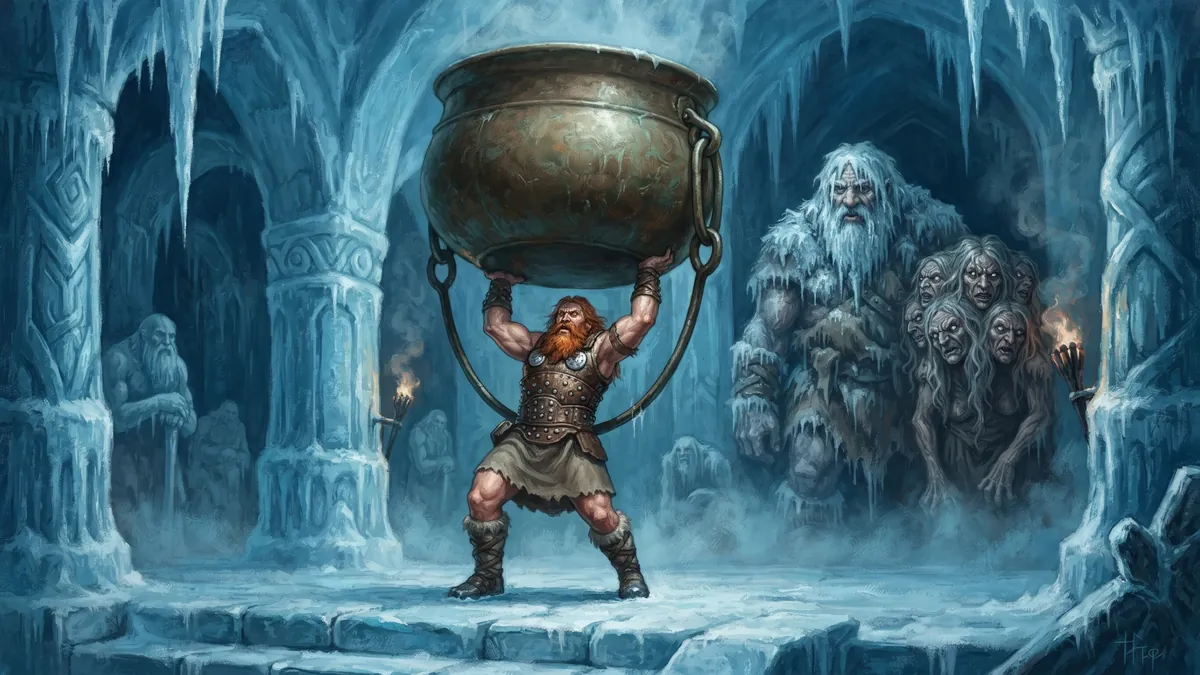
The Hymiskviða, the “Poem of Hymir”, is one of the liveliest stories about Thor in the Poetic Edda. It has little of the solemn tone of the poems about the fate of the world. It is an adventure of travel, feasting and brute strength, with humour. At the same time it contains a curious situation: the god Týr appears as the son of a giant, something that is hardly seen in other sources.
What the poem tells
It all begins at a feast. The gods are going to drink at the house of the giant Ægir, but they have no cauldron big enough to brew ale for everyone. According to the poem, Týr knows where a suitable vessel is: it belongs to his father, Hymir, who lives at the end of the sky, east of the icy rivers of Élivágar. The cauldron is described as a vessel a mile deep. Thor and Týr set out from Ásgarðr, stop at the house where Thor leaves his goats, and reach Hymir’s hall.
There they find a grandmother with nine hundred heads and a bright-browed woman who brings ale to her son. When Hymir comes back from hunting, his beard full of ice, the welcome is hostile. Thor, hiding by a pillar, breaks a roof beam, and eight cauldrons fall from a shelf. Only the one that matters stays whole. At supper the god kills three oxen and eats two of them.
The fishing and the cups
Next day Thor insists on going fishing. He tears off the head of a black ox to use as bait. Hymir catches two whales at once, but Thor casts his line and hooks the Midgard serpent. The poem describes the monster’s roar and the shaking of the earth. The text is incomplete here, with verses missing, and Hymir turns pale and silent on his oars.
Back at the hall, Hymir challenges Thor to break his cup. Thor hurls it against the pillars and it comes back whole. Then Hymir’s wife whispers the secret: strike the giant’s head, which is harder than glass. Thor obeys and the cup shatters. Hymir mourns the loss and says the cauldron will be handed over, if anyone can lift it.
The escape
Týr tries twice and fails. Thor grips the rim, puts the cauldron on his head, and the handles jingle at his heels. Hymir and the giants of the mountains give chase. Thor sets the cauldron down, takes his hammer Mjöllnir and kills them all. One of his goats goes lame on the way, and the poem blames Loki. In the end the cauldron reaches Ægir’s house, and the gods drink ale there, every winter.
A poem that mixes stories
The editor Bellows himself, in 1936, judged the text uneven in quality, assembled from older material, and noted the more elaborate style of its kennings, quite unlike the older poems. The connection with the fishing for the serpent also appears in other sources, which suggests that the author reused a story already known.
What remains
The interest of the poem lies in the way it mixes strength and cunning. Thor wins by force, but he learns the giant’s weak point only because a woman of the house tells him. The story works as an explanation for the origin of the gods’ ale.
To carry Hymir’s cauldron without letting it tip over, keeping it balanced at every step, play Hymir’s cauldron.
Sources.
- *Poetic Edda*, *Hymiskviða* (Codex Regius, c. 1270)
- Henry Adams Bellows (transl.), *The Poetic Edda* (1936), introduction and text of "Hymiskvitha"
- Carolyne Larrington (transl.), *The Poetic Edda* (Oxford World's Classics, 1996)