Bandamanna saga: the case at Thingvellir and Ófeigr's cunning
An Icelandic saga set entirely after the adoption of Christianity tells how a case of theft turns into a contest of bribes. See how Oddr loses in court and how his father turns the game around.
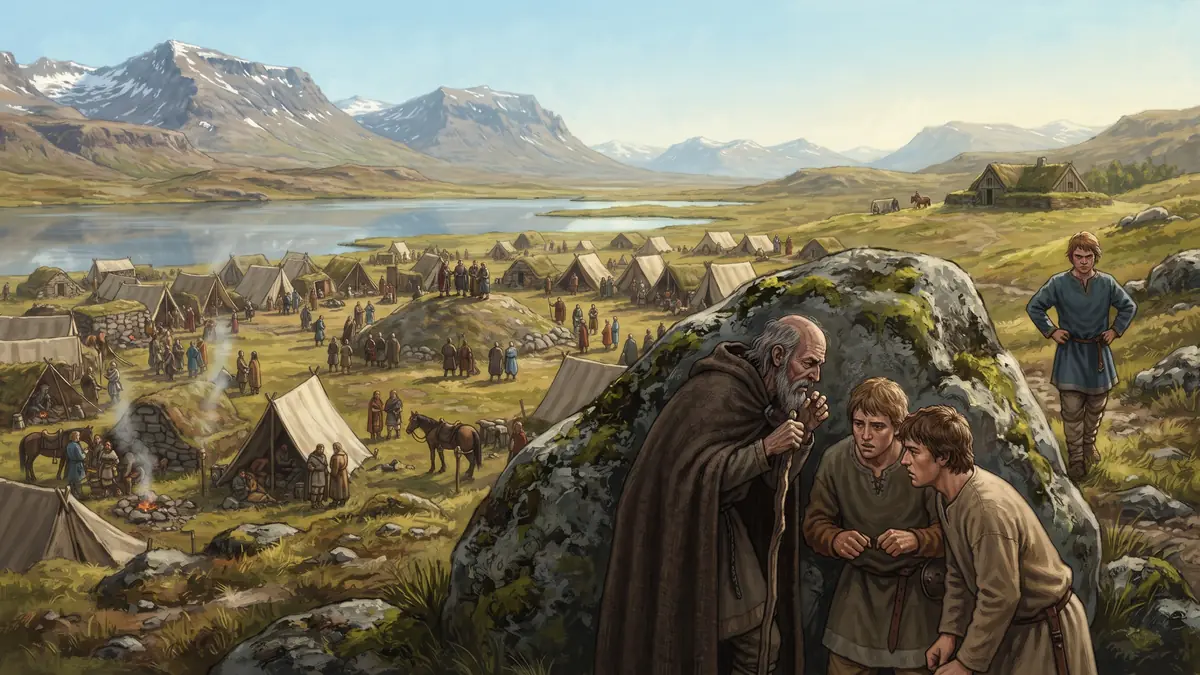
The Bandamanna saga, the “Saga of the Banded Men”, is one of the sagas of the Icelanders, but it has a trait that sets it apart from the others: all the action takes place after Christianity was adopted in Iceland, in the year 1000. Instead of blood feuds, it tells of a lawsuit, and the decisive weapon is cunning.
The manuscripts
The oldest surviving manuscript is the Möðruvallabók (AM 132), from the middle of the 14th century. Another complete text is in GKS 2845 4to, from the middle of the 15th century. The two versions differ in style, syntax and verses, and may share a common origin, perhaps at the end of the 13th century.
Oddr and Óspakr
The saga begins with Oddr, son of Ófeigr, who leaves his father’s house and becomes a wealthy merchant and landowner. The main farm is Mel, in Miðfjörður. Óspakr, son of Glúmr, asks to live there. Oddr agrees, because of Óspakr’s connections, despite his bad reputation. Óspakr works well and gains much control of the estate, but then falls out with Oddr, courts the wealthy Svala and moves to her estate.
The case that fails
Oddr’s livestock begin to disappear. Váli, raised by Oddr’s father and living with him, promises to find out whether Óspakr is the thief. Váli tells Óspakr that he is suspected and is killed when he visits his house with Oddr. Oddr takes the case to court at Thingvellir, but makes a procedural error, and the prosecution fails.
The father steps in
On the way home, Oddr meets his father, Ófeigr, who agrees to take the case in return for payment. Ófeigr arranges jurymen who will condemn Óspakr and who will be paid for it. Óspakr’s father-in-law, Thórarinn, and a friend, Styrmir, suspect the bribe and gather a group of six who swear to prosecute Oddr and seek a fine. That is why the saga speaks of “banded men”, the bandamenn.
Ófeigr then bribes two of the six and promises one of them that Oddr will marry his daughter. The court allows Ófeigr to choose two jurymen to decide the case. The two find Oddr guilty but impose a trivial fine. Technically they do not break their oath and still receive a reward. The saga ends with Oddr reconciled with his father and married to the daughter of one of the jurymen.
What can be said with care
The page consulted gives no critical interpretation of the saga and only describes the plot. To speak of satire or comedy would require other sources, such as the editions cited on the page itself. What the text shows is that the “law” of the saga is less a matter of justice than of who understands the rules and the people better.
To take coins from three heaps, in your turn, so as to keep the last one, against a clever opponent, play The Althing’s coins.
Sources.
- Wikipedia, "Bandamanna saga" (summary, manuscripts, dating and bibliography)
- Sagadb.org, "The Story of the Banded Men" (English translation of the saga)
- Manuscripts: Möðruvallabók (AM 132) and GKS 2845 4to, according to Wikipedia