Grottasöngr: Fenja, Menja and the mill that ground gold, peace and salt
In the Prose Edda, two enslaved giantesses turn a magic mill for the Danish king Fróði. See how their song brings an army into being, and how the same mill ends up grinding salt at the bottom of the sea.
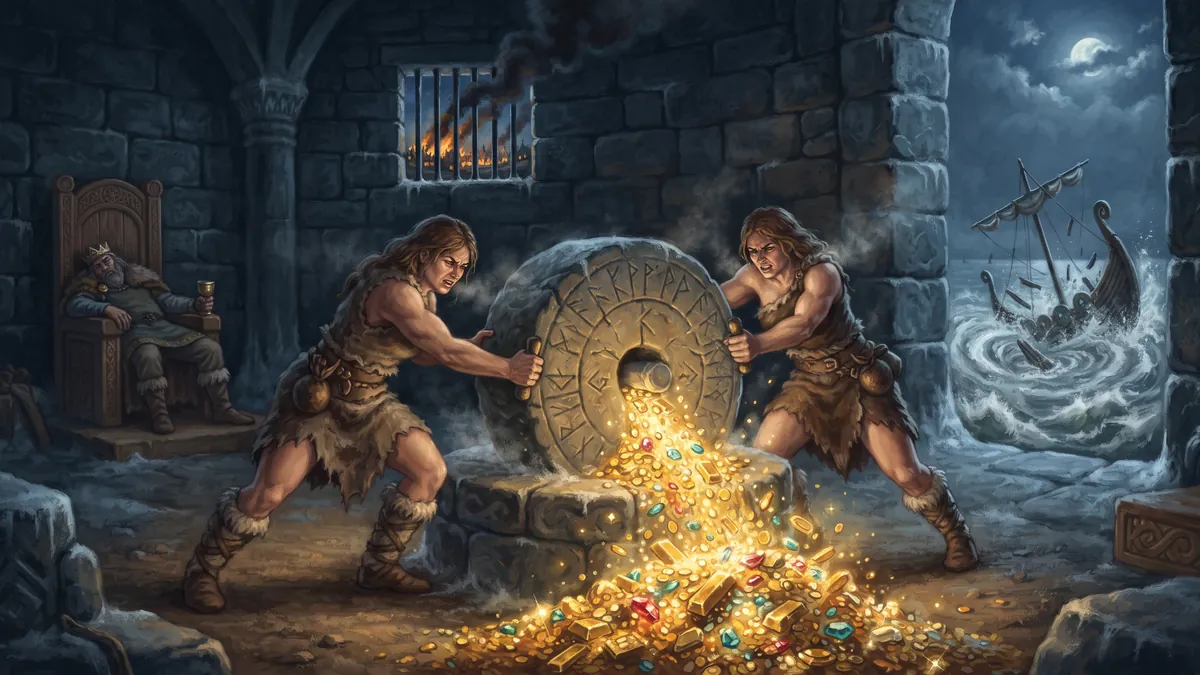
Among Norse poems, the Grottasöngr, “The Mill’s Song”, has one particular quality: the song of workers whom labour turned into a weapon. It is not in the Codex Regius, the main manuscript of the Poetic Edda, but appears in later manuscripts and in one manuscript of Snorri Sturluson’s Prose Edda, with an explanation of its context.
The mill and the king
According to Snorri, the Danish king Fróði had two magic millstones, called Grótti, given to him by Hengikjöpt. Whoever ground with them could ask for anything, but they were too big for any man. Fróði bought two enslaved giantesses, Fenja and Menja, from the Swedish king Fjölnir and made them grind gold, peace and happiness. He allowed them no rest beyond the length of a song or the silence of a cuckoo.
Vengeance in the form of a song
The two then sang the poem, and before they finished they had produced an army led by the sea-king Mýsingr. He attacked Fróði at night, killed him and took great booty. That was the end of “Fróði’s peace”.
In the poem, the women ask for rest and are refused. They say they descend from mountain giants, recall past deeds and describe their present life as slavery, cold, dirty and exhausting. They announce an army that will burn the settlement at Lejre and overthrow Fróði, and say they are grinding it into existence. They grind so hard that the shafts of the frame snap, they sing a prophecy of vengeance involving Hrólfr Kraki, Yrsa, Fróði and Halfdan, and the mechanism falls apart: the magic stone splits in two.
The mill at sea
Mýsingr took the mill and the two women and made them grind salt. At midnight they asked whether he had enough, and he ordered them to grind more. The ships sank, a whirlpool formed where the sea passed through the hole of the stone, and the sea became salt.
After Snorri
Many editors include the poem among those of the Poetic Edda, even though it is not in the Codex Regius. The supporting sources of the page consulted are the translations and studies by Larrington (1996), Orchard (1997) and Tolley (2008). Modern works have taken up the story, among them Viktor Rydberg’s Den nya Grottesången and texts by Johannes V. Jensen, which shows how the image of the two grinders of fates kept serving writers long after the Middle Ages.
What can be said with care
The page consulted gives no date of composition for the poem, nor the number of stanzas. Snorri’s chronology, which links Fróði’s peace to Augustus and the birth of Christ, is part of the legendary narrative and not a historical date. There are later popular versions, among them the salt of the sea, which survives in folktales and in traditions from Orkney and Shetland.
To join, two by two, the pieces of the same number on a four-by-four board, until you reach the piece of 256, play Grotti’s millstones.
Sources.
- Wikipedia, "Grottasöngr" (summary of the *Prose Edda* and of the poem, with bibliography by Larrington, Orchard and Tolley)
- Voluspa.org, "Grottasöngr" (text of the poem)
- Vikingr.org, "Grottasöngr – The Lay of Grótti" (text of the poem)