Reginsmál: Andvari, the ring Andvaranaut and the curse on the gold
In the Poetic Edda, the gods kill Hreidmar's son Otr and pay the ransom with the treasure of a dwarf who lives as a fish. See what the poem says about the ring, the curse and the end of Hreidmar.
The gold that causes the most misfortune in Norse literature begins with a bad throw. In the Reginsmál, a poem of the Poetic Edda, a stone thrown by Loki kills an animal that was in fact a man. From that death comes Andvari’s treasure, the ring that goes with it and one of the most famous curses of Norse mythology.
The death of Otr
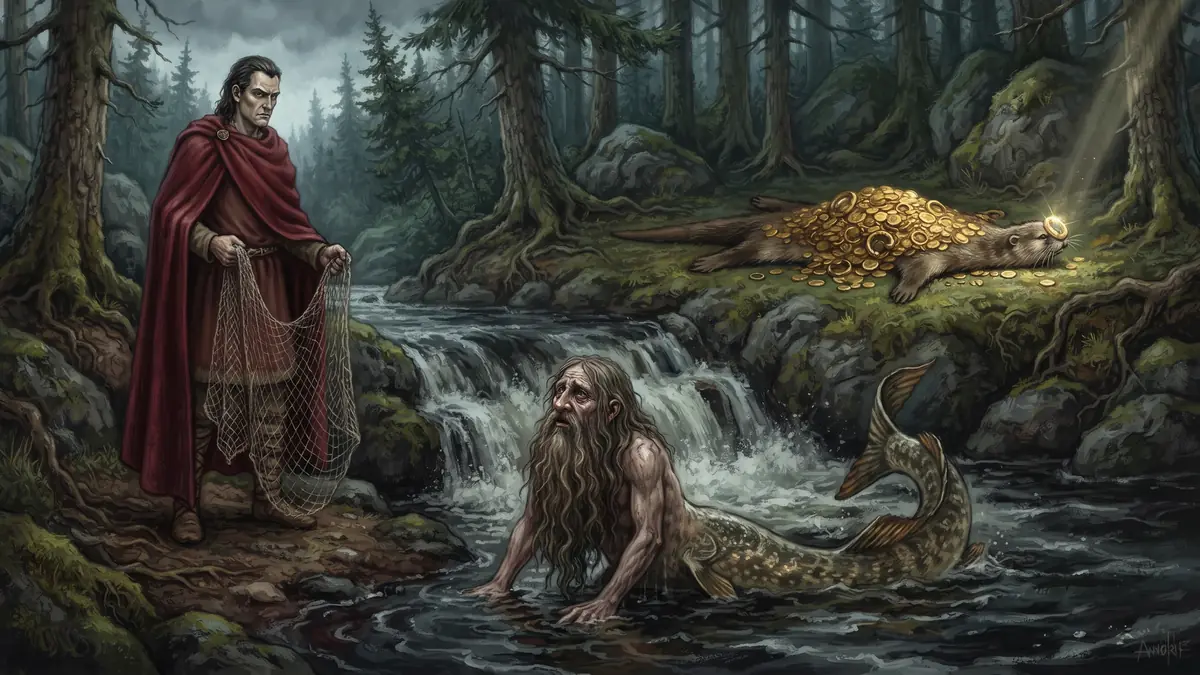
The prose that accompanies the verses tells that Odin, Hœnir and Loki came to the waterfall where the dwarf Andvari lived, taking the form of a pike. On the bank, Otr, Hreidmar’s son, was eating a salmon in the shape of an otter. Loki killed him with a stone, and the gods skinned the otter. In the evening they asked for shelter at Hreidmar’s house and showed the skin to their host.
The ransom
Hreidmar’s sons, Fafnir and Regin, seized the gods. The price for Otr’s life was to fill the skin with gold and also cover it on the outside with red gold. Loki borrowed Rán’s net, caught Andvari in the form of a pike and forced him to hand over all his gold. The dwarf tried to hide one ring, Andvaranaut, but Loki took that too.
The curse
Andvari, on losing the ring, pronounced a curse on the treasure. When the gods heaped the gold on the skin, one whisker was left showing. Odin gave the ring to cover it, and Loki spoke a curse of his own: the gold would bring death to Hreidmar’s sons. Hreidmar complained that the gods gave the gold unwillingly. Then Fafnir refused to share the compensation for Otr with Regin and killed his sleeping father. He took all the gold and left Regin without an inheritance.
The poem as a patchwork
Bellows warns that the title “Reginsmál” does not come from the manuscript. For him the text is an assembly: the compiler joined verses from various sources and linked them with prose to tell the story of Sigurd. That is why the curse also has a confusing detail: stanza 5 is attributed to Andvari, but, according to Bellows’ notes, the curse the prose describes is Loki’s. Bellows also states that the story of Andvari, Loki and Hreidmar is purely Norse, with no Frankish trace.
What comes next
The poem goes on with Regin raising Sigurd, forging him the sword Gram and urging him to kill Fafnir, who guards the gold. Sigurd insists on avenging his father first, and the poem ends with a voyage, a storm and a battle. The further fate of the gold belongs to other sources, which carry on the story of Sigurd and Fafnir.
What can be said with care
The poem does not explain what the ring does or how the gold “multiplies” on its own. It only says that it is worth the ransom and that it was cursed twice: by Andvari and by Loki. Everything the later tradition added, such as magic powers of the ring, should be read as another layer, not as part of this poem.
To catch, with a bag, the gold falling from above, letting the ring marked by the curse go past, play Andvari’s gold.
Sources.
- *Poetic Edda*, translated by Henry Adams Bellows (1936), prose and notes to "Reginsmál" (Mythopedia, Poetic Edda library)
- Voluspa.org, "Reginsmál" (text and commentary)