Wulfstan of Hedeby: the voyage of seven days and nights to Truso, on the Baltic
A merchant of the late 9th century described, in an Old English text, the sea route from Hedeby to Truso. See what he tells, what the page consulted says and what remains in doubt.
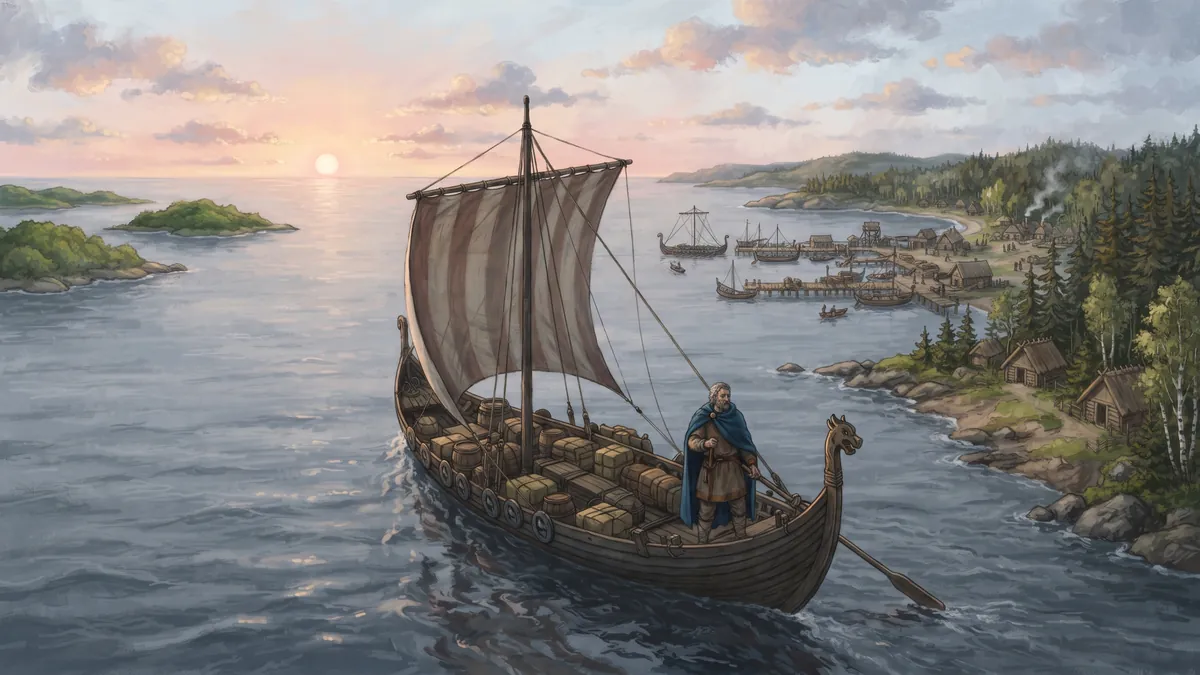
Among the texts that describe the world of the Baltic in the Viking Age, there is one that comes not from a saga or a chronicle of battle, but from a travel account. It is Wulfstan’s, a merchant of the late 9th century, who told how he went from Hedeby to Truso.
Who Wulfstan was
Wulfstan of Hedeby was a traveller and trader of the second half of the 9th century. It is not clear whether he was English: the page consulted says he was probably from Hedeby, near Schleswig, in what is now northern Germany, which in the 9th century was Danish.
Where the account is
The account is in the Old English Orosius, together with the narrative of another trader, Ohthere of Hålogaland. The page consulted credits the translation of the Orosius to King Alfred. It gives no precise date nor describes the circle around Alfred, and it does not discuss why the text included both accounts.
The voyage
Around 880, Wulfstan sailed from Hedeby to Truso, the trading centre of the Prussians. He says he went from Hedeby to Truso “in seven days and nights”, with the ship under sail the whole time. The text names lands on the left and on the right: Langland, Læland, Falster and Sconey, all subject to Denmark, then the Burgundians, who had a king of their own. Further on, to the left, were Blekingey, Möre, Eowland and Gotland, subject to the Swedes. Weonodland, the land of the Wends, lay on the right as far as the mouth of the Weissel, the Vistula. The page does not say what the ship carried or what the commercial reason for the voyage was.
Words and peoples
The page notes that this may be the earliest record of the word “Denmark” (Danemearcan). The text is also one of the earliest mentions of the western Balts, called Aesti (Prussians), and of their land, Witland.
How to read the route
The text is not a map: it is a list of lands seen to the right and to the left of the ship, in order. “Seven days and nights” under sail is a duration, and the page does not convert it into a distance. For those who want to go further, it cites as reading Jesch (2018), Englert and Trakadas (2009), Malone (1933), Cross (1931) and Appleton (2025), who deal with the voyage and the text.
What can be said with care
The purpose of the voyage is not clear. One hypothesis is that Alfred wanted allies against the Vikings and so was interested in the Prussians. The page does not deal with the exact location of Truso, with customs of the Aesti such as funerals, horses or mead, nor with islands such as Bornholm or Öland. These points are therefore left out of the account.
To fill a four-by-four grid with four route marks, without repeating any in a row, column or block, play The route marks.
Sources.
- Wikipedia, "Wulfstan of Hedeby" (traveller, voyage c. 880, lands named, bibliography)
- *Old English Orosius* (text in which Wulfstan's account appears beside Ohthere's), according to Wikipedia
- Jesch (2018), Englert and Trakadas (2009), Malone (1933) and Cross (1931), cited on Wikipedia