Bäckahäst: the white brook horse that drowns whoever climbs on its back
In the mist, by a river, a majestic white horse waits. Whoever climbs on it never gets off. See what the article consulted says about the brook horse, the nøkk in other forms and what remains uncertain.
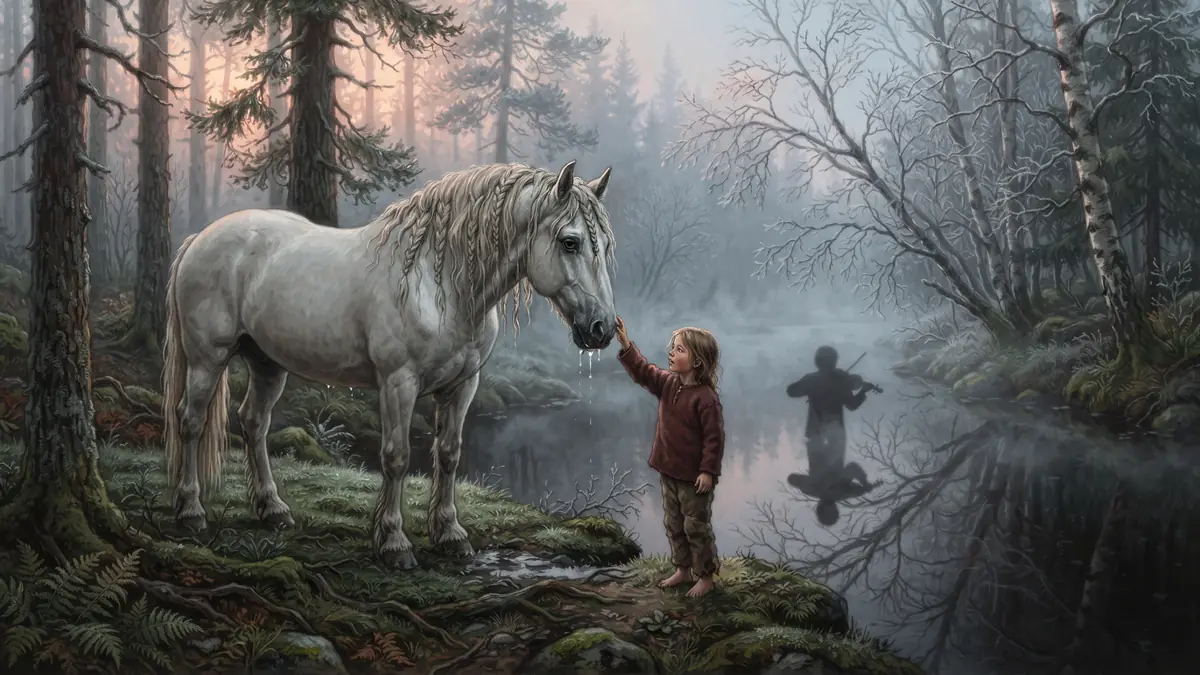
Among the water creatures of Nordic folklore, the brook horse is one of the simplest to imagine and one of the most dangerous. In Swedish it is the bäckahäst. The source consulted treats it as one of the forms of the näck, the water spirit, which in Norwegian and Danish is nøkk or nøkken, in Faroese nykur, in Old Norse nykr and in Finnish näkki. According to the text, the names come from a common Germanic root meaning “to wash”.
The horse
The bäckahäst appears as a majestic white horse near rivers, especially in mist. Whoever climbs on its back cannot get off. The horse jumps into the river and drowns the rider. It can also be harnessed to the plough, sometimes because it wants to trick someone, sometimes because it has been tricked. In one tale, a maid ploughing with the farm horse is dragged to the lake by the brook horse after striking it with the bridle; the article does not finish how she escapes.
Other forms
The same spirit can be a man, in elegant clothes in the old accounts and naked and fair in modern images, who appears in brooks and waterfalls playing the violin and can teach a musician to play so well that trees dance. Males can take human, fish and snake forms, and females have a fish’s tail and can be recognised by the wet hem of their clothing. It can turn into any four-legged animal but cannot imitate the horns of a ram. It can also appear as treasure or as floating objects.
Norway and the Faroe Islands
In Norwegian and Faroese tradition, the spirit lives at the bottom of lakes and sometimes comes onto land, where an encounter is dangerous. It disguises itself as a small, tame horse to lure whoever strokes it, and whoever touches its tail sticks to it and is dragged under the water. It can be mastered with a cross carved on its back, and was then made to drag large stones from the mountains to build walls and houses. Stones and a broken tail remain at Húsavík and Takmýrar, on Sandoy, and at Eiði, on Eysturoy.
Other stories
It lures with promises of joy in its hall and loses power over whoever calls it by its true name, nykur. Some tales show it as malicious, others, like that of Fagertärn, describe it giving fishing luck in exchange for a daughter, and the girl ends up killing herself. A nineteenth-century poem by Stagnelius shows the spirit lamenting that it has no salvation, for not being a “child of God”.
After Christianity
The text records superstitions about avoiding it on Christmas Eve and on Thursdays, and says that many of these beliefs developed after Christianisation, although not all versions are tied to them. Among images, it cites a drawing by Theodor Kittelsen, Gutt på hvit hest, “Boy on a white horse”, which shows the brook horse.
What remains uncertain
The article gives no reliable dates for the first mention, does not know whether the spirit had a “true shape” and does not make clear whether the Fagertärn tale is Swedish. What is well described is the central idea: a handsome, tame horse by the water that is a trap.
To find, by trial, the ford where the brook horse waits, guided by hot-and-cold hints, play The brook horse’s ford.
Sources.
- Wikipedia (mirror), "Neck (water spirit)" (names, bäckahäst, Norway and the Faroe Islands, Christian-era beliefs, uncertainties)
- Theodor Kittelsen, *Gutt på hvit hest* (drawing), mentioned in the article
- Stagnelius (nineteenth-century poem), mentioned in the article