Landnámabók: the book that lists more than three thousand people and about 1,400 farms of Iceland
The Landnámabók tells who came to Iceland and where they settled. See how the text is organised, which versions survive and why scholars still debate how much of it is history and how much is tradition.
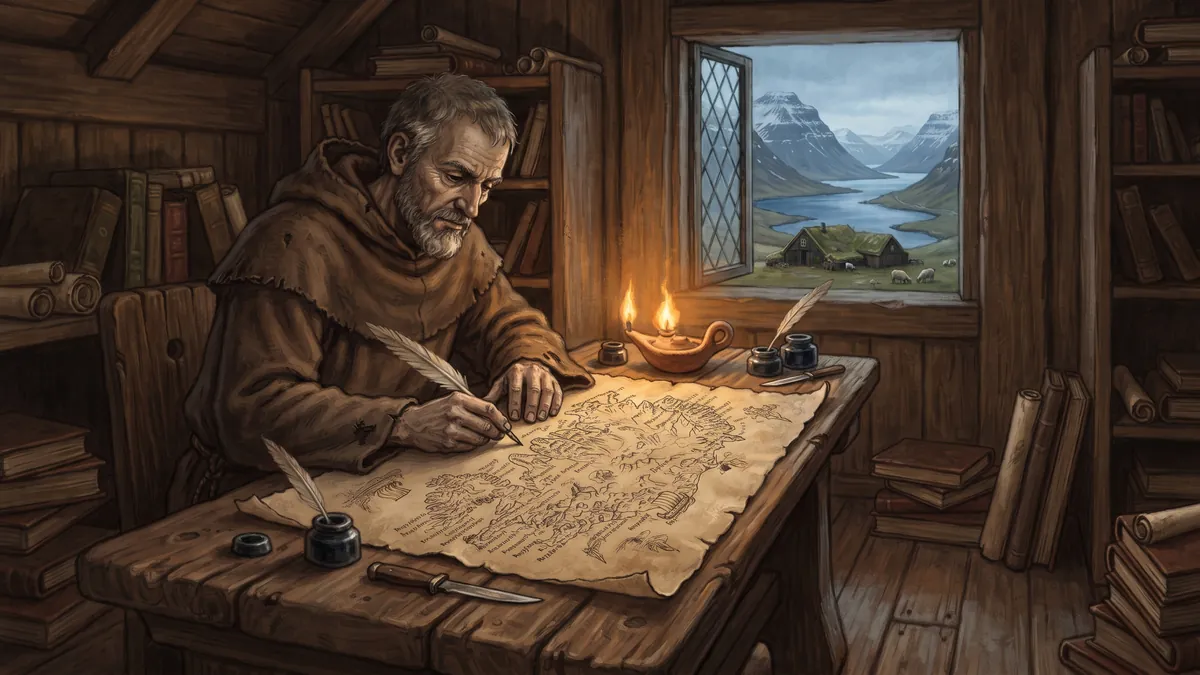
Few societies have a book that lists who founded each farm. Iceland does: the Landnámabók, the “Book of Settlements”, which records the settlement of the island in the ninth and tenth centuries. According to the source consulted, it has five parts and 102 chapters, with more than three thousand people and about 1,400 farms, and 435 initial settlers, women among them.
How the book is organised
The first part tells how the island was found and who the first settlers were. The following parts count, quarter by quarter, those who settled afterwards, starting in the west and ending in the south. The initial settlement is thought to have taken place mostly between 870 and 930, and the text follows descendants into the eleventh century and sometimes the twelfth.
When it is from
The work is thought to have arisen in the late eleventh or early twelfth century and survives in versions from the thirteenth and fourteenth centuries. Some propose a single author; others think the text was gathered at assemblies. Ari Þorgilsson may have written the earliest version together with his short Íslendingabók, or the earliest versions used genealogies he said he had left out of that book.
The versions
The Sturlubók, by Sturla Þórðarson, is dated 1275 to 1280. The Hauksbók is an early-fourteenth-century compilation by Haukr Erlendsson, based on the Sturlubók and the lost thirteenth-century Styrmisbók, by Styrmir Kárason. The Melabók, from about 1300, has only two surviving sheets. The Skarðsárbók was compiled before 1636 by Björn Jónsson of Skarðsá, and the Þórðarbók in the seventeenth century by Þórður Jónsson, from the former and sections of the Melabók.
How much is history
The article records that the debate goes on: is the account wholly historical, or does it carry folklore and mythology? Gunnar Karlsson notes that the story of Hrafna-Flóki, guided to land by three ravens, parallels Noah, but says this does not prove it false. Some historians suggest that early Christian Icelanders may have tied the island to biblical lore. Helgi Þorláksson, on the other hand, considers the story of Ingólfr Arnarson’s settlement accurate and consistent with other sources. The Irish ruler called Kjarvalur is identified with Cerball mac Dúnlainge.
Sveinbjörn Rafnsson argues that the Sturlubók and the Hauksbók give too much weight to Christianity, while the Melabók does so less.
What can be said with care
The book is not an official ninth-century register but a text that gathers traditions told and written long after the first settlers. Even so, its numbers, of people, farms and regions, show how Iceland remembered itself. What the book says of each settler should be read as tradition, and what each version adds or drops deserves attention.
To land a ship on the beach, controlling the thrust, without crashing and with little fuel, play Landing on the beach.
Sources.
- Wikipedia, "Landnámabók" (structure, dating, versions, reliability)
- Gunnar Karlsson and Helgi Þorláksson, cited in Wikipedia (on the Hrafna-Flóki account and Ingólfr's foundation)
- Sveinbjörn Rafnsson, cited in Wikipedia (on the weight of Christianity in the versions)