Stöng: the Icelandic farm buried by Hekla and the replica that shows how it might have looked
In the valley of Þjórsárdalur, ash from the volcano Hekla covered medieval farms. See what the guides consulted say about the ruins of Stöng, its rooms, the man tradition ties to the place and the rebuilt house.
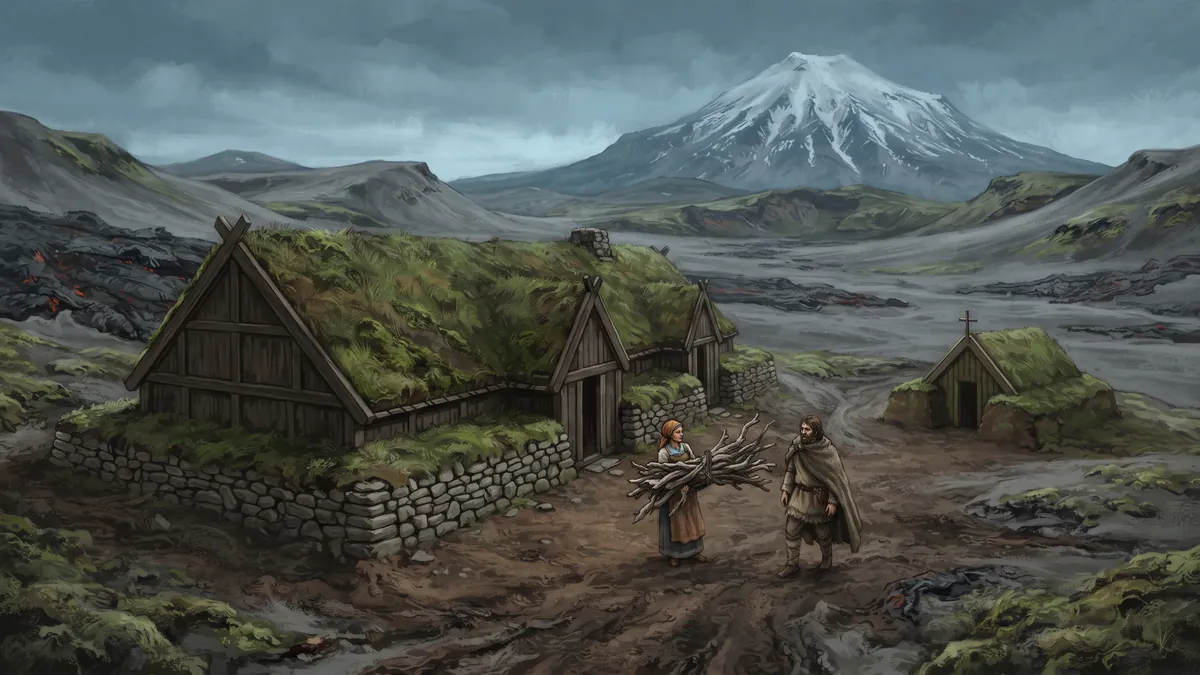
Iceland has few medieval houses still standing, but one of them was preserved in a rare way: by volcanic ash. In Þjórsárdalur, in the south of the island, the farm of Stöng lay under volcanic material, and that is why you can now see what remains of its stones and visit a replica. The three texts consulted agree on the essentials but differ on dates, and that is recorded below.
The volcano
The source consulted says the farm is “believed” to have been buried in 1104, when Hekla erupted. EXARC tells that, in the 1930s, excavators examined about 40 farms in the valley destroyed suddenly in 1104, and that Stöng was among the best preserved. The inhabitants, the text says, were chiefs of the district. The tourist guide adds a list of Hekla eruptions and claims the site was inhabited almost continuously until about 1300, which does not match the 1104 date, and itself notes that the cold may have contributed. The sources do not agree on this point.
The excavation
According to the guide, a Nordic archaeological team excavated Stöng in 1939, after the ruins had lain under pumice for 835 years, and it was the first time trained archaeologists studied Icelandic ruins. Only Stöng stayed visible, with the stone foundations sheltered by a red-roofed wooden building from 1957 and by a see-through roof from 2024. A stall, a barn and a smithy were found, along with the ruins of a church, a churchyard and an older farm beneath. A bone cross from the eleventh century, 6.3 by 5.7 cm, also turned up.
The rooms
The guide describes the entrance, the hall (skáli), with a long fire where people worked, ate and slept along the walls, a room with a loom, where about 20 loom weights were found, a pantry with dug-in containers for dairy products and a room the guide calls a “toilet room”.
Gaukur Trandilsson
Tradition ties Stöng to Gaukur, son of Þorkell Trandill, who appears in two chapters of Njáls saga; his own saga is lost. According to the guide, he was killed by his blood brother, Ásgrímur Elliða-Grímsson, in a duel over an alleged affair. Bones found in the nineteenth century on the cape of Gaukshöfði may or may not be his.
The replica
The rebuilt house, the Þjóðveldisbærinn, was raised from 1974 to 1977 to mark the 1100 years of the settlement of 874, under the direction of Hörður Ágústsson, and stands beside the original ruins. There is also a turf church consecrated in 2000, modelled on early churches and on the one excavated at Stöng in the 1980s and 1990s, and the guide notes that not everyone agrees with the design.
What can be said with care
The texts show a chiefs’ farm, with a long-fire hall, pantry and smithy, and a replica that is an architects’ hypothesis. The exact date of the burial and the length of the occupation are points on which the sources diverge.
To cut blocks of turf from a rectangle, without being left with the last block, play The turf blocks.
Sources.
- Wikipedia, "Þjóðveldisbærinn Stöng" (location, burial in 1104, reconstruction of 1974–1977, church of 2000)
- EXARC, "Þjóðveldisbærinn – Viking farm Stöng" (excavations of the 1930s, about 40 farms)
- Guide to Iceland, "Stöng – Ruins of a Real Viking Settlement Manor and the Reconstructed Saga-Age Farm in Iceland" (excavation of 1939, rooms, Gaukur Trandilsson, replica)