The dwarfs of the Edda: maggots in Ymir's flesh, smiths of the gods and stones at sunrise
The dvergar are born from Ymir's body, forge Thor's hammer and turn to stone in daylight. See what the source consulted gathers on dwarfs in Norse and German sources, and what nobody knows for sure, like their size.
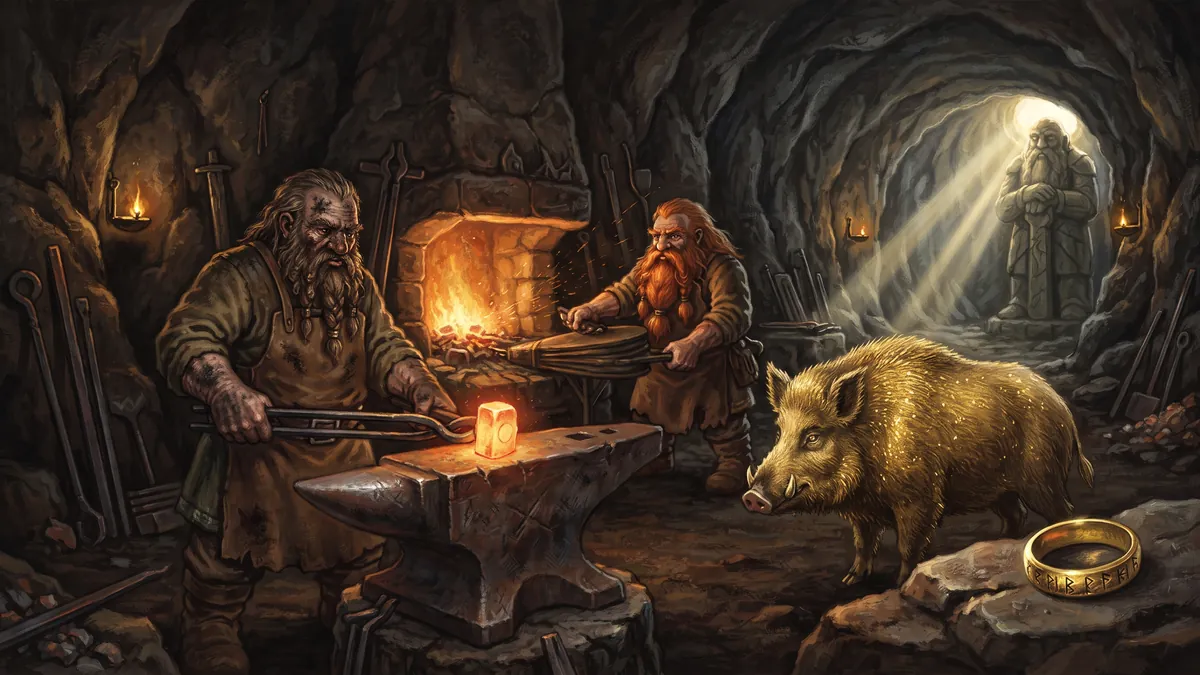
Dwarfs come from so many places in the Germanic imagination that they are hard to sum up. The source consulted deals with the Norse dvergar and their relatives in German and English, and shows that what is now thought of them, small, bearded and carrying a pickaxe, is only part of the story.
The name
The English word dwarf comes from Old English dweorg, with relatives in Old Norse dvergr and Old High German twerg. The Proto-Germanic form is usually reconstructed as dwergaz, but the ultimate origin is much debated: there are proposals tied to “damage” and “deception”, and the linguist Guus Kroonen suggests a verb meaning “to squeeze”. The plural dwarves was popularised by Tolkien, who called it “private bad grammar”.
Where they came from
In the Prose Edda, dwarfs form like maggots in the flesh of Ymir, which becomes the earth. The Codex Regius version of the Völuspá says something else: that they were produced out of the earth. Four of them, Norðri, Suðri, Austri and Vestri, hold up the corners of the sky, made from Ymir’s skull. The article recalls that the sky may have been imagined close to the horizon, and that does not make the dwarfs tall.
Smiths of the gods
Sindri and Brokkr, brothers, forged Draupnir, Gullinbursti and Mjölnir. The sons of Ívaldi made Gungnir, Skíðblaðnir and Sif’s hair. Dwarfs also made the chain Gleipnir and, in the Sörla þáttr, Freyja’s necklace Brísingamen. Fjalarr and Galarr killed Kvasir and made the mead of poetry from his blood. Litr was kicked by Thor into Baldr’s pyre. And Andvari, who lived as a pike, was forced by Loki to hand over his treasure, including the ring Andvaranaut.
The Dvergatal list
A passage of the Völuspá, the Dvergatal, is a catalogue of names. It includes Álfr, “elf”, Gandálfr and Vindálfr, which shows the overlap between dwarfs and elves, and even Yngvi, a name of the god Freyr. Every dwarf named in the list is male.
Stone and sun
The Völuspá calls dwarfs “masters of the rocks”, and some poetic names for stone speak of a dwarf’s house. In the Alvíssmál, the dwarf Alvíss wants to marry Þrúðr, Thor’s daughter, and Thor keeps him talking until dawn, when the sun turns him to stone. In the Ynglinga saga, a dwarf who fears the sun lures King Sveigðir into a stone, which closes behind him.
In Germany and in illness
In German works, dwarfs often wear the Tarnkappe, a cloak of invisibility, and are great smiths. Alberich guards the Nibelung treasure and is defeated by Siegfried, and Dietrich von Bern fights the dwarf king Laurin. In Old English, dweorg could also mean “fever”, and medical charms describe a dwarf-sickness that rides the patient. An eighth-century skull fragment from Ribe seems to invoke Odin against harmful dwarfs, and in Norwegian dvergskott, “dwarf-shot”, is an animal disease.
What remains uncertain
The origin of the word is not known, nor whether dwarfs began as nature spirits or as beings tied to death. It is also not known whether svartálfar and dökkálfar are the same as dwarfs, since they appear only in the Prose Edda. The early sources do not state their size, and names like Fullangr and Hár are ambiguous. Females appear only in late sagas, and there is no proof that dwarfs received offerings.
To dig in a mine without stepping on the traps, guided by the numbers on neighbouring squares, play The dwarfs’ mine.
Sources.
- Wikipedia, "Dwarf (folklore)" (etymology, origin, Dvergatal, Andvari, Alvíssmál, Sindri and Brokkr, sons of Ívaldi, Gleipnir, sun and stone, German literature, illness and charms)
- Prose Edda, Völuspá, Alvíssmál and Ynglinga saga, cited in the article