Codex Regius: the calfskin book that kept the poems of the gods and came back to Iceland
The Codex Regius, from about 1270, is the main source of the Poetic Edda. See what is known about the manuscript, the eight pages that are missing, the bishop who called it Sæmundr's Edda, the trip to Denmark and the return to Iceland in 1971.
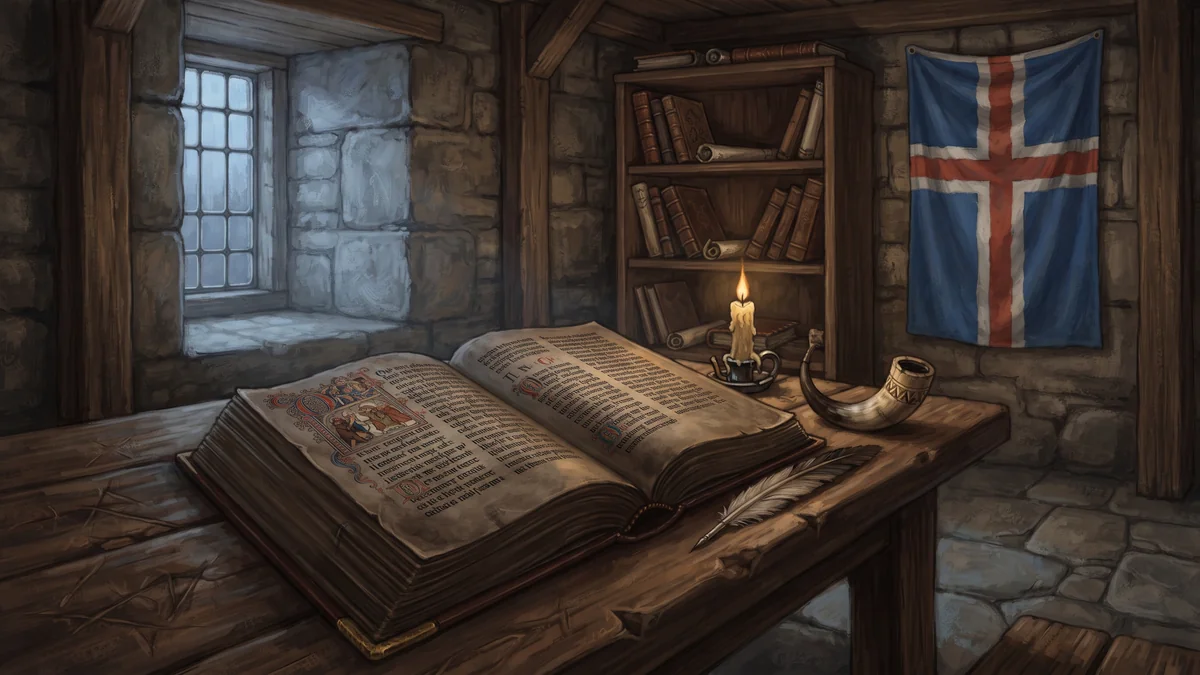
The Codex Regius is an Icelandic manuscript of about 1270, written on vellum, that is, parchment made from the skin of a young animal. It contains 29 poems, and is the main source of the so-called Poetic Edda, also known as the Elder Edda, the collection of poems about gods and heroes of the Norse world.
What the book is
The Poetic Edda is not a book with an author: it is the name given to a set of anonymous poems of different origins and ages, which the Codex Regius brings together. The manuscript shows that these poems, speaking of Odin, Thor, Freyja and heroes like Sigurd, were written down in thirteenth-century Iceland. Without it, much of Norse mythology, such as the Völuspá, which describes the creation of the world and the end of the gods, would be known only from quotations in other works.
The missing pages
By 1643 the manuscript had already lost eight pages, and 45 remained. The gap falls in the middle of the poems about Sigurd, and historians rely on the Völsunga saga, which reproduces the subject in prose, to fill in part of what was lost. Some lost poems survive that way, in prose and verse, inside the saga. It is not known how or when the pages disappeared.
The bishop and the wrong name
In 1643 the manuscript belonged to Bishop Brynjólfur Sveinsson of Skálholt. He attributed it to the Icelandic scholar Sæmundr the Learned, who had lived centuries earlier, and so the book was long called “Sæmundr’s Edda”. That attribution is wrong, and the compiler of the codex remains unknown.
The trip to Denmark
In 1662, Brynjólfur sent the manuscript as a gift to King Frederick III of Denmark, hence the name Codex Regius, “the king’s book”. It stayed in the Royal Library in Copenhagen for more than three centuries, until 1971.
The return home
In 1971 the manuscript was returned to Iceland, among the first documents of a large Icelandic collection that Denmark began to give back. Today it is kept at the Árni Magnússon Institute for Icelandic Studies in Reykjavík. It was a national event: the book that held the island’s mythology was back.
The numbers
The article’s numbers are simple: 29 poems, 45 leaves preserved and 8 lost by 1643. What is missing is the core of the Sigurd story, and so the prose saga became the second way into that stretch. The book is thus both a main source and an incomplete one, and whoever studies it needs both texts side by side.
What remains uncertain
The text of the Codex Regius probably copies even older sources, from the early thirteenth century, that did not survive. Who compiled the book, where and why, and when the eight pages vanished, remain unanswered. What is known is that without this book the poems of the Norse gods would have reached us much poorer.
To put numbered pages in order, sliding one piece at a time, play The Codex pages.
Sources.
- Britannica, "Codex Regius" and "Poetic Edda" (date, number of poems, pages, history of the manuscript)
- Wikipedia, "Codex Regius" (Brynjólfur Sveinsson, sending to Denmark, return in 1971, lacuna)