The myling: the soul of a child who asks to be carried on the road at night in Nordic folklore
The myling is, in Scandinavian folklore, the soul of a child who died without baptism or burial and pursues those who walk alone at night. See what the source consulted gathers on the name, the meeting on the road, the remedies against it and what the tale reveals about the past.
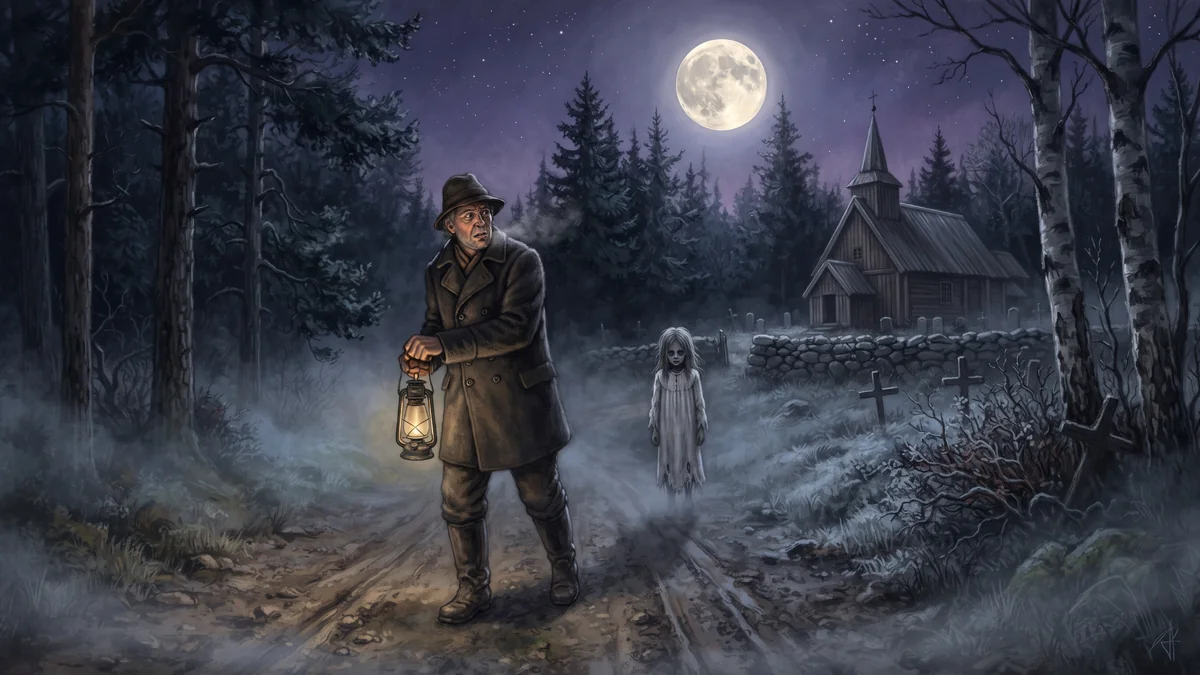
The myling is a figure of Scandinavian folklore. According to the source consulted, it is the soul of a child who died unbaptised or was killed in secret, often by a mother who did not want the child, and who sings at night. It is a hard subject, and what lies behind it is a historical reality of infanticide that society did not admit.
Names
In Norwegian the being is also called utburd, in Icelandic útburður, and in Finnish it appears under names such as ihtiriekko, liekkiö and sikiö. The name myling would come from myrþa, “to murder”, and the suffix -ling. Ut-burd means, in the article’s reading, “out-born” or “extra burden”.
The encounter
The typical story is of a lone traveller, at night. The myling chases him, jumps on his back and demands to be carried to the cemetery. The child grows heavier and heavier. If the traveller does not reach the cemetery in time, the myling kills him.
How to be rid of it
The article cites two remedies: giving the myling a name, and burying it in holy ground. It does not say that baptism frees it, and it is prudent not to claim more than the text claims. What the two remedies have in common is that they give the child what was denied it: a name and a place in consecrated ground.
What the tale hides
The myling is born of a reality: infanticide was a secret, and children who died unbaptised were also denied Christian burial. The studies of af Klintberg, of 2010, of Kvideland and Sehmsdorf, of 1988, of Pentikäinen, of 1968 and 1989, and of Simpson, of 1988, deal with the subject. In modern games such as Year Walk, the myling appears as a horror creature.
One possible reading
It is common for folklore to give shape to things that society could not speak of openly. Here, the fear and guilt before children who died without a name and without a grave would have found a figure that walks at night asking for what is owed to it. This is a reading, not a documented fact: the article only points to infanticide, secrecy and the lack of baptism and burial as the background. What the stories do is treat the child as someone who still needs to be taken in, and not only as a monster.
What remains uncertain
The article says little about regional differences in the myth and about the myling’s appearance. The stories vary, and there is no single account that holds for all of Scandinavia. Nor is the age of the belief known, since the folklore was collected long after it had circulated orally.
To dodge the small souls that run along the road at night, changing lanes, play The mylings’ road.
Sources.
- Wikipedia, "Myling" (name and etymology, the encounter and the weight, remedies, historical context, studies by af Klintberg, Kvideland and Sehmsdorf, Pentikäinen and Simpson)